

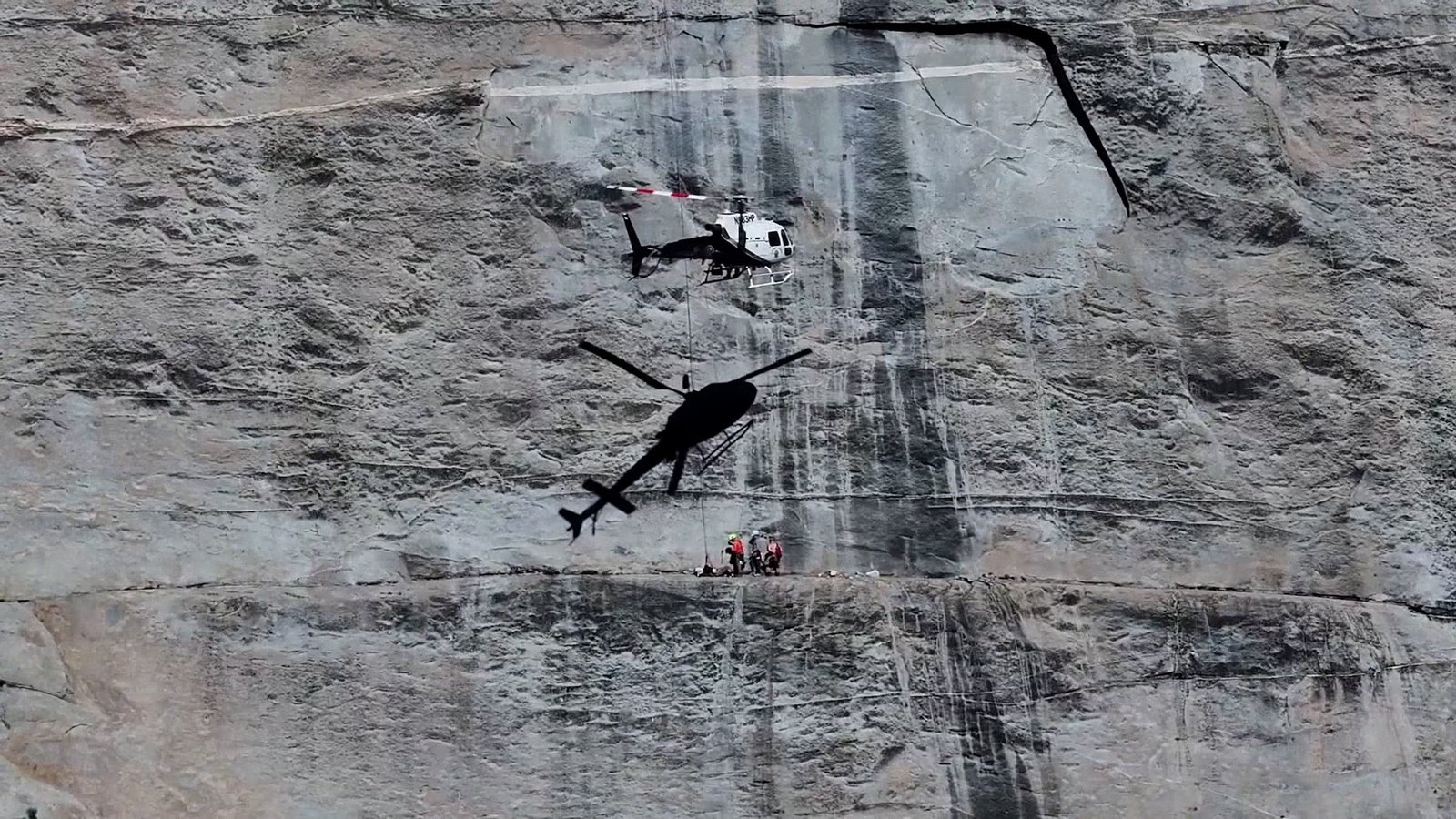
A severe fall on California’s 700-foot Power Dome left a climber heavily bleeding on a shoulder-width ledge 200 feet above the ground. To save him, a California Highway Patrol helicopter crew flew within 15 feet of sheer granite—the absolute limit of their safety clearance—to pull off a high-risk rescue.
Published September 15, 2026 04:04PM
On September 11, a climber fell 200 feet while ascending on a 700-foot-tall rock face known as Power Dome in California’s Sierra Nevada mountains. He was bleeding heavily, and his friends used a shirt as a bandage while they awaited a helicopter rescue.
A California Highway Patrol (CHP) helicopter flew within 15 feet of the sheer granite cliff and rescued the climber with a hoist evacuation system, officials said in a statement. Authorities have not released the climber’s name, age, or condition.
“He was completely coherent and alert, despite a lot of blood loss,” flight officer and paramedic Scott Clays, who operated the helicopter’s hoist during the rescue, told Outside. “He just seemed very tough.”
Power Dome is a 700-foot granite formation located near Courtright Reservoir, a popular climbing and camping area about two hours from Fresno, California. Authorities did not say which route the climber was on, but Power Dome has around 40 trad, sport, and toprope routes of varying difficulty.
Inside the Harrowing Power Dome Rescue
Around 12:45 P.M., CHP’s Coastal Division Air Operations said that it received an evacuation request for the fallen climber.
During the climber’s ascent, he fell and hit the cliff face, Clays said. The climber lost a significant amount of blood from his injuries. His climbing partners removed his shirt and used it as a bandage to control the bleeding. Still connected to his ropes, the victim’s climbing partners lowered the man to a narrow ledge for rescuers to evacuate him from.
“The ledge seemed to be shoulder-width,” Clays said, adding that it was about 200 feet off the ground.
The Fresno County Sheriff’s Office, which assisted in the rescue, first sent in a drone to provide images of the climber’s condition and location. The CHP helicopter crew flew within 15 feet of sheer granite—the limit of their safety clearance—to execute a high-risk short-haul hoist rescue.
Any closer, Clays said, and a “catastrophic” collision may have occurred.
A Highly Specialized Big Wall Rescue
Responders used what’s known as a big-wall rescue to save the injured climber. The technique is often used in climbing-related accidents in Yosemite National Park and other parts of the Sierra Nevada.
Here’s how it works: From the helicopter, a rescue technician dangles by a rope as the chopper inches closer to the wall—but not too close; any impact would be catastrophic, Clays said. During this time, the pilot hovers in place for 30 to 40 seconds in what Clays said is a constant battle with the wind to keep the chopper a safe distance from the wall. Once on the ledge, the rescuer disconnected his rope to stabilize and secure the injured climber for transport, and both were hoisted separately back into the helicopter.
The climber was conscious and coherent when rescuers arrived, Clays said, and remained alert and helped keep himself steady while hanging from the helicopter.
Once the helicopter delivered the victim to a waiting ambulance, Clays said he could see how much pain the injured man was in.
“You could see the grimace in his face,” Clays said. “You know he was hurting.”
In nearby Yosemite, where CHP crews train for similar big-wall rescues, records more than 100 climbing accidents each year.
