

Published September 28, 2026 01:49PM
How We Reported This Story: Outside interviewed wildlife photographer Adam Borkhus to get a firsthand account of his encounter with a mountain lion in the Wyoming wilderness. We also spoke with a researcher from the Mountain Lion Foundation to contextualize the rarity of cougar attacks and provide expert advice on backcountry safety.
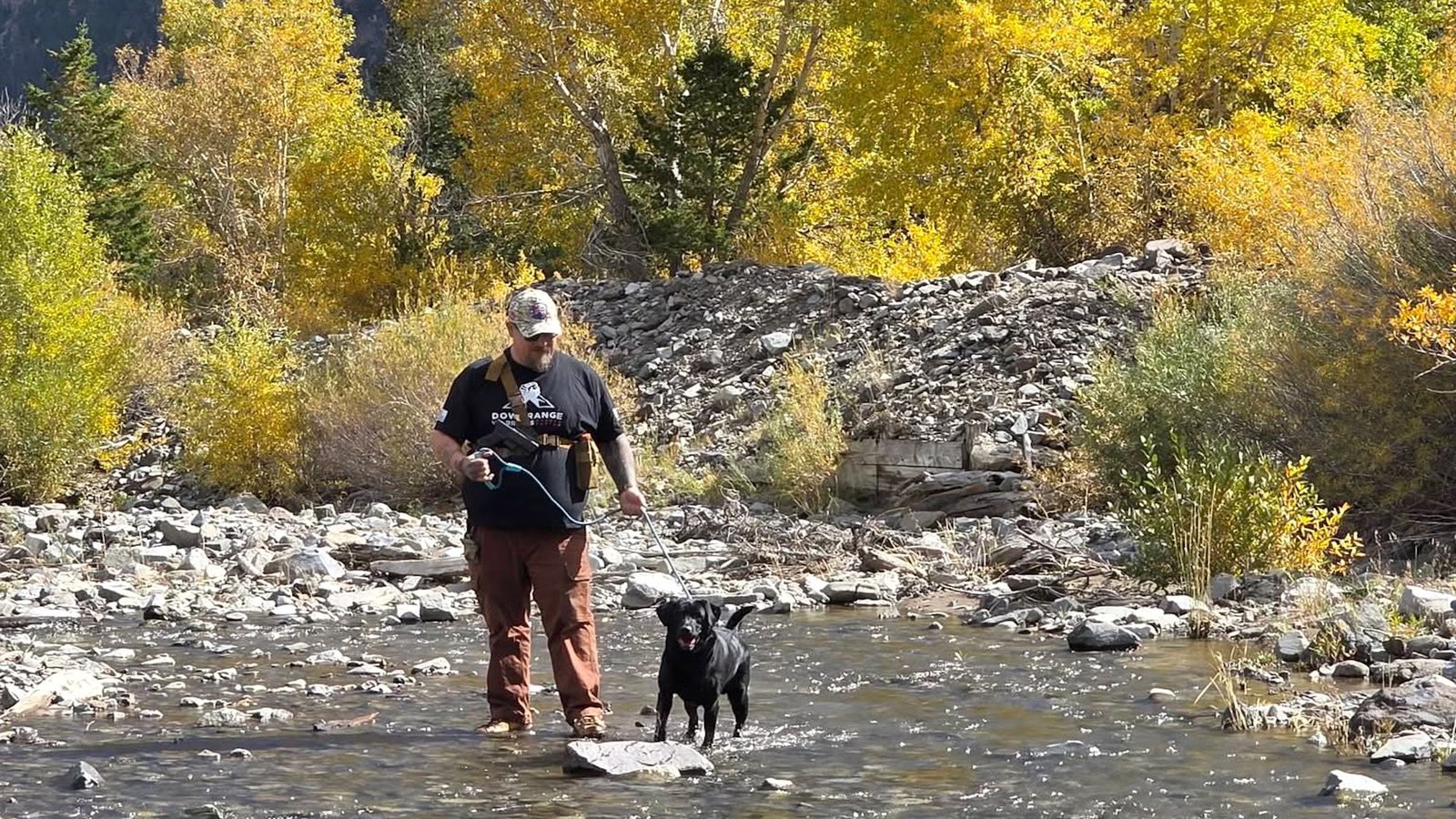
On the evening of September 19, amateur wildlife photographer Adam Borkhus was looking for elk on a remote road outside Cody, Wyoming. He pulled over to change camera lenses and let his two-year-old Labrador retriever, Diesel, out of the car. Within seconds, he heard the dog yelp.
Borkhus, 33, ran into the thick brush and found a mountain lion on top of his dog in a surprise attack.
“He was fighting against the cat,” Borkhus told Outside. “I’ve seen a dog in a fight—I don’t think he was sure what was happening.”
Borkhus was out on a photography trip near the Thoroughfare Valley, a wilderness area near the southern end of Yellowstone National Park and Teton Wilderness. Search and rescue experts told Outside that the are is considered one of the most remote places in the Lower 48. Borkhus said he’d seen grizzlies in the area, but never mountain lions.
He was carrying a firearm and bear spray, but deploying either meant potentially hurting Diesel, too. Borkhus, who is 6-foot-3-inches and 300 pounds, kicked the mountain lion in the face.
His hit landed, but it only redirected the cat’s attention away from Diesel.
“The lion spun around and looked at me,” Borkhus said. “Then it pounced and hit me in the chest.”
Borkhus landed on his back, using one hand to keep the 70-pound cat’s teeth away while punching it with the other. Eventually Borkhus caught its ear—the only safe point he could find to grab hold. He wrenched the skin as hard as he could, and the lion ran off into the brush.
The entire encounter lasted roughly 20 to 30 seconds.
Borkhus escaped with scratches to his hands, forearm, and face, none of which required stitches. Diesel was waiting out the fight at the truck’s tailgate, uninjured. After confirming Diesel was safe, Borkhus bandaged his cuts and drove roughly an hour back to Cody.
According to Borkhus, the Wyoming Game and Fish Department (WGFD) returned to the area and determined the cat was likely a juvenile based on its behavior. Outside contacted Wyoming Game and Fish for a copy of the incident report but had not received a response as of this writing. We will update the story if we receive a response.
An “Extremely Rare” Attack
Mountain lions live throughout the state and are the “most elusive of the state’s large carnivores,” WGFD writes on its website.
Joshua Lisbon, a researcher with the Mountain Lion Foundation, told Outside that these types of attacks are “extremely rare,” and the state has never recorded a fatal mountain lion attack.
“This is about as rare an encounter as you can have,” Lisbon said. “Several unpredictable, random choices collided to produce an outcome on par with being struck by lightning—or maybe winning a lottery that you didn’t want to.”
That’s true across most of the West. In January 2026, a mountain lion killed a 46-year-old hiker on Colorado’s Crosier Mountain Trail, the state’s first fatal mountain lion attack in more than 25 years. A mountain lion killed a 21-year-old man in 2024 and seriously injured his brother in Northern California, marking California’s first fatal attack in 20 years. And in 2019, a Colorado trail runner killed an attacking cougar with his bare hands.
The cat’s young age may help explain how those circumstances turned into a fight, Lisbon said.
“I don’t think it was preying on Diesel,” he said. “I think it was a surprising, defensive behavior.”
Borkhus agrees, and said that the cougar seemed equally as surprised as he was by the attack.
“That cat was like, ‘My god, what is happening?’” Borkhus said of the moment he arrived to defend Diesel. “What is this giant Sasquatch that I’m fighting with?”
What to Do in a Mountain Lion Attack
Dog owners can reduce the risk of wildlife encounters by keeping dogs leashed or under strong voice control in the wilderness, Lisbon said. If a mountain lion grabs a pup, Lisbon says to grab for bear spray rather than jump into the fight, even if that means spraying the dog, too.
“You could bear spray both the dog and the cougar, and it would most likely end the encounter,” Lisbon said. “You would then have a very unhappy dog that you would need to tend to, but if it’s life or death, then it’s worth it.” Bear spray affects the mucous membranes and can cause pain and the eyes to close and tear up, according to BearWise.
“Resist the urge to rub, that will intensify the effects,” BearWise writes on its website. “Effects should wear off in about 45 minutes. Bear spray is oil-based, so wash with soap and water if you get bear spray on your skin, clothing or equipment.”
If a mountain lion attacks a person, WGFD says to fight back rather than play dead. Get big, be loud, and try to intimidate the animal to scare them off.
Stay Safe in the Backcountry
A potential encounter shouldn’t deter people from recreating outside, Lisbon says. Rather, it’s an opportunity to practice backcountry safety.
“Be safe in wild places,” he said. “Take knowledge, skill, and bear spray with you. But you don’t need to take fear with you.”
As for Borkhus and Diesel, they’re working together to prepare for the upcoming Wyoming hunting season.
“When you live in Northwest Wyoming,” Borkhus said, “if you’re scared of the wildlife, you might as well move.”
Diesel appears to have a new outlook on life as well.
“He actually seems to like our cats more after this,” Borkhus said.
