

Opinions expressed by Entrepreneur contributors are their own.
Key Takeaways
- Rehearse in low-stakes environments: Create safe spaces (like Disney’s mock hotel rooms and lobbies) for employees to practice, make mistakes, and improve away from customer view.
- Connect daily tasks to a broader mission: Go beyond rigid job descriptions by giving employees a shared goal, so they can make smart judgment calls when unexpected situations arise.
- Test products in extreme conditions: Use your product where it’s most likely to fail (e.g., testing Florida park uniforms in heavy heat and humidity) and actively seek feedback from frontline users.
Disney loves to use the word ‘magic’ to describe… just about everything. It’s a hand-wave-y word that can make running one of the world’s largest and most complex companies sound like it takes little more than pixie dust.
What it actually takes is training, culture, and a whole lot of room for failure and improvement.
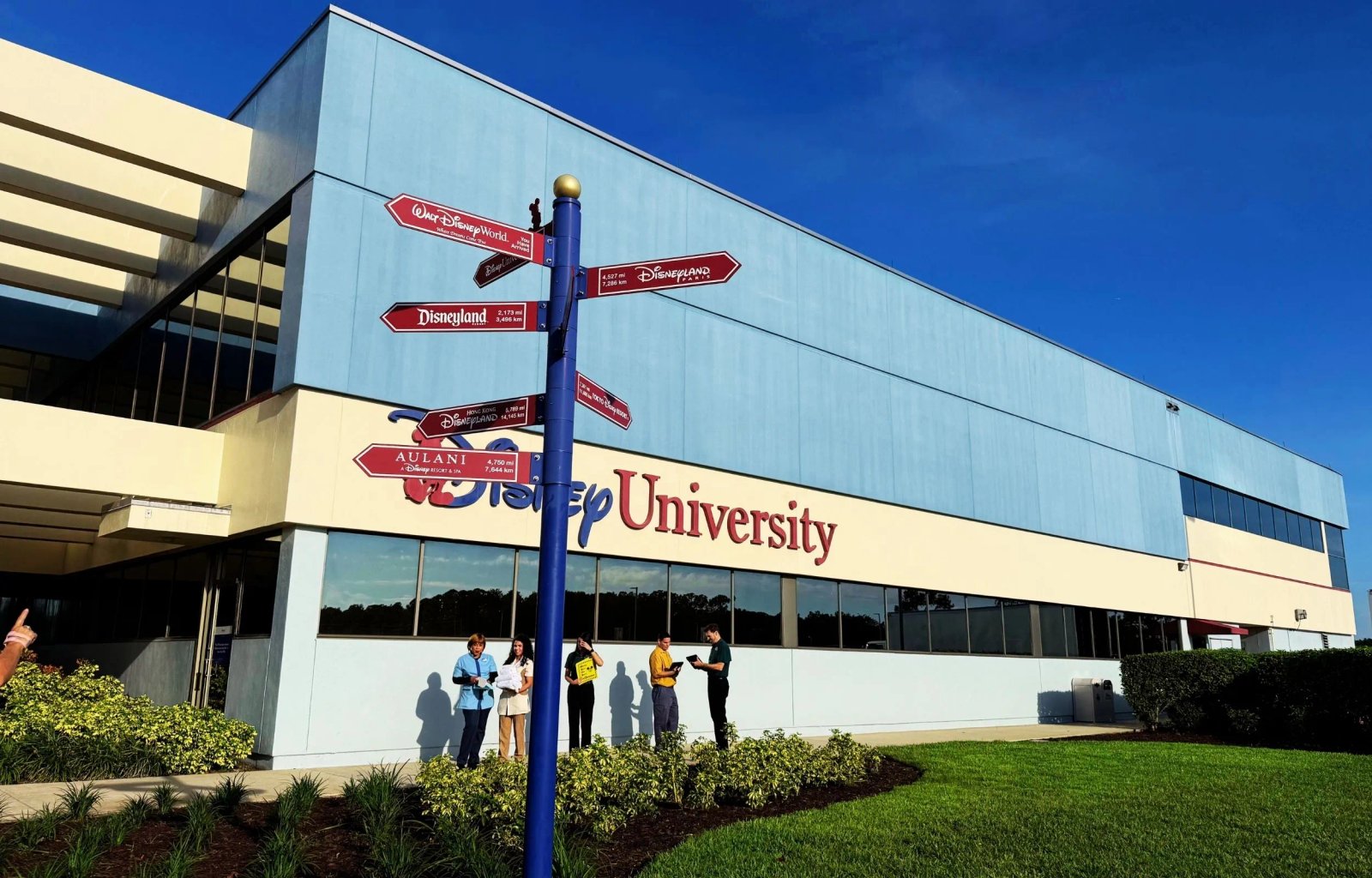
I recently spent a day inside “Disney University” in Florida, the facility where Disney prepares its “cast members” (what they call employees) for everything from cleaning hotel rooms to running massive operations. Disney operates at a scale few businesses can match. But many of the ideas behind its training are surprisingly simple, and surprisingly useful for entrepreneurs.
Lesson 1: Go Full Nathan Fielder
One of the stranger parts of Disney University feels a little like something out of a Nathan Fielder show.
Tucked away in the building are fake hotel rooms and mock lobbies where housekeepers can practice resetting rooms and cleaning bathrooms, and front-desk employees can role-play check-ins and concierge tasks.
If you’ve seen HBO’s The Rehearsal, you get the idea: Repeatedly rehearsing a task in a realistic, low-stakes environment lets you iron out the bugs before showtime.
We all screw up. These fake environments let cast members do so somewhere the customer can’t see it.
For smaller companies, the lesson is simple: Don’t let a good employee flame out because their first real attempt happens in front of a customer. Sure, some people thrive in sink-or-swim situations. But plenty of talented employees are better served by having a chance to practice, make mistakes, and improve in a safe environment.
Everybody gets better by making mistakes. The trick is creating a place where those mistakes can happen without costing you a customer.
Image credit: Seth Porges
Lesson 2: Don’t Confuse the Task With the Job
The centerpiece of Disney University is “Traditions,” an orientation seminar that lays out the company’s history and the basic principles it expects employees to carry into their jobs.
It would be easy to look at this as simply an exercise in transmitting company culture. But there’s a more practical function to it: How do you get an enormous number of people, doing wildly different jobs, to make reasonably consistent decisions?
One of the first things Traditions establishes is a shared goal. The point isn’t to give employees a mission statement to memorize. It’s to give thousands of people a common answer to a much more useful question: What are we all ultimately trying to accomplish?
That matters because no job description can anticipate every situation. Every dropped ice cream bar. Every crying kid. Every food allergy. Every unscheduled ride closure. Every Make-A-Wish dream. At some point, an employee has to make a judgment call. A clearly understood goal gives them a framework for making that judgement.
Again and again during Traditions, we were told that every cast member’s job is to personally “create happiness.” The phrasing is distinctly Disney, but the idea travels pretty well: The goal is bigger than the job description.
A parking attendant may be one of the first Disney employees a guest encounters that day, and their demeanor can set the tone. Custodial cast members clean the parks, but they also effectively double as wayfinders, offering directions to ride entrances and restrooms.
Each job has a specific function. But the function is ultimately in service of something larger.
At Disney, this matters because guests may have spent months planning a trip and thousands of dollars getting there. A bad interaction, or even a simple shrug, can carry a surprising amount of weight.
The same principle applies to much smaller companies, where the danger is often that important things disappear into the cracks between job descriptions.
If an employee notices a bug, “I’m not an engineer” shouldn’t be the end of the story; they should know where it goes. If an engineer happens to answer a call from a prospective client, “I’m not in sales” shouldn’t mean dumping the person into a voicemail abyss. Nobody needs to do everybody else’s job. But they should understand enough about the larger goal to help move something toward the person who can.
The goal isn’t to make every employee responsible for everything. It’s to make sure the things that matter don’t die in the space between “my job” and “somebody else’s.”
Lesson 3: Go Extreme With Your Dogfood
Disney’s on-site costume operation by the numbers:
46 costuming locations. 1,500 costuming cast members. More than 900 unique costume designs. 746 styles of hats. 2.5 million garments in circulation.
From parking attendants to princesses to iconic rodents, nearly everything worn in view of the paying public passes through the costuming department.
The challenge is relatable: As an operation grows to serve an enormous variety of jobs, how do you keep functionality and quality of life from getting sacrificed to scale?
For Disney’s costuming department, much of the answer comes down to two seemingly obvious ideas: Use your own product, and listen to the people who use it most.
“Dogfooding” has long been de rigueur in startup culture. But simply using something yourself may not tell you much. More useful is to deliberately use it under the conditions where it’s most likely to fail.
For Disney’s costume teams, that can mean spending hours in the parks wearing their own creations in Florida’s often-grueling heat and humidity. Those conditions have a way of revealing problems that might never become obvious inside an air-conditioned design studio.
If you make luggage, drag it through an airport when you’re running late. If you build software, try using it on an old phone with terrible reception. If you run a subscription business, actually try to cancel.
But designers can only experience so much themselves. Disney also creates frequent opportunities for cast members to offer feedback on the costumes they wear every day, surfacing annoyances and edge cases.
Bianca Cross, manager of costume design and development, pointed to the custodial uniform as an example: “This is a four-way stretch fabric, it’s breathable, can be worn both tucked or untucked, and the bottom of the pants are adjustable for wet environments,” she told me.
Those features came from listening to the people actually doing the job and iterating around the problems they encountered.
That does more than make a uniform more comfortable. It turns the people living with a product every day into part of the design process.
Plenty of companies say they listen to customers. The more useful question is whether they’ve made it easy for customers to actually talk back. Are you proactively checking in with the people who use your product the most? Is there an obvious way for someone to tell you what’s annoying them before they get annoyed enough to leave?
The people who live with your product every day are already testing it for you. You might as well make sure you’re hearing the results.
Lesson 4: Look Sideways for Talent
Disney is effectively dozens of different businesses hiding inside one company: hotels, transportation systems, restaurants, costuming, engineering, logistics. And so on.
That creates career paths that would be almost impossible to predict from somebody’s starting job.
Ivan Diaz, now director of transportation services, started in a more technical role before getting an unexpected call. “They asked me, ‘Have you ever thought about running a large organization?’” he told me. “Now I run one of the most complex transportation organizations in the country.”
The lesson for smaller companies is simple: Don’t assume somebody’s current job tells you what they’re capable of. The best person for an opening may already work for you — just in a part of the company you weren’t looking at.
Key Takeaways
- Rehearse in low-stakes environments: Create safe spaces (like Disney’s mock hotel rooms and lobbies) for employees to practice, make mistakes, and improve away from customer view.
- Connect daily tasks to a broader mission: Go beyond rigid job descriptions by giving employees a shared goal, so they can make smart judgment calls when unexpected situations arise.
- Test products in extreme conditions: Use your product where it’s most likely to fail (e.g., testing Florida park uniforms in heavy heat and humidity) and actively seek feedback from frontline users.
Disney loves to use the word ‘magic’ to describe… just about everything. It’s a hand-wave-y word that can make running one of the world’s largest and most complex companies sound like it takes little more than pixie dust.
What it actually takes is training, culture, and a whole lot of room for failure and improvement.
I recently spent a day inside “Disney University” in Florida, the facility where Disney prepares its “cast members” (what they call employees) for everything from cleaning hotel rooms to running massive operations. Disney operates at a scale few businesses can match. But many of the ideas behind its training are surprisingly simple, and surprisingly useful for entrepreneurs.
