

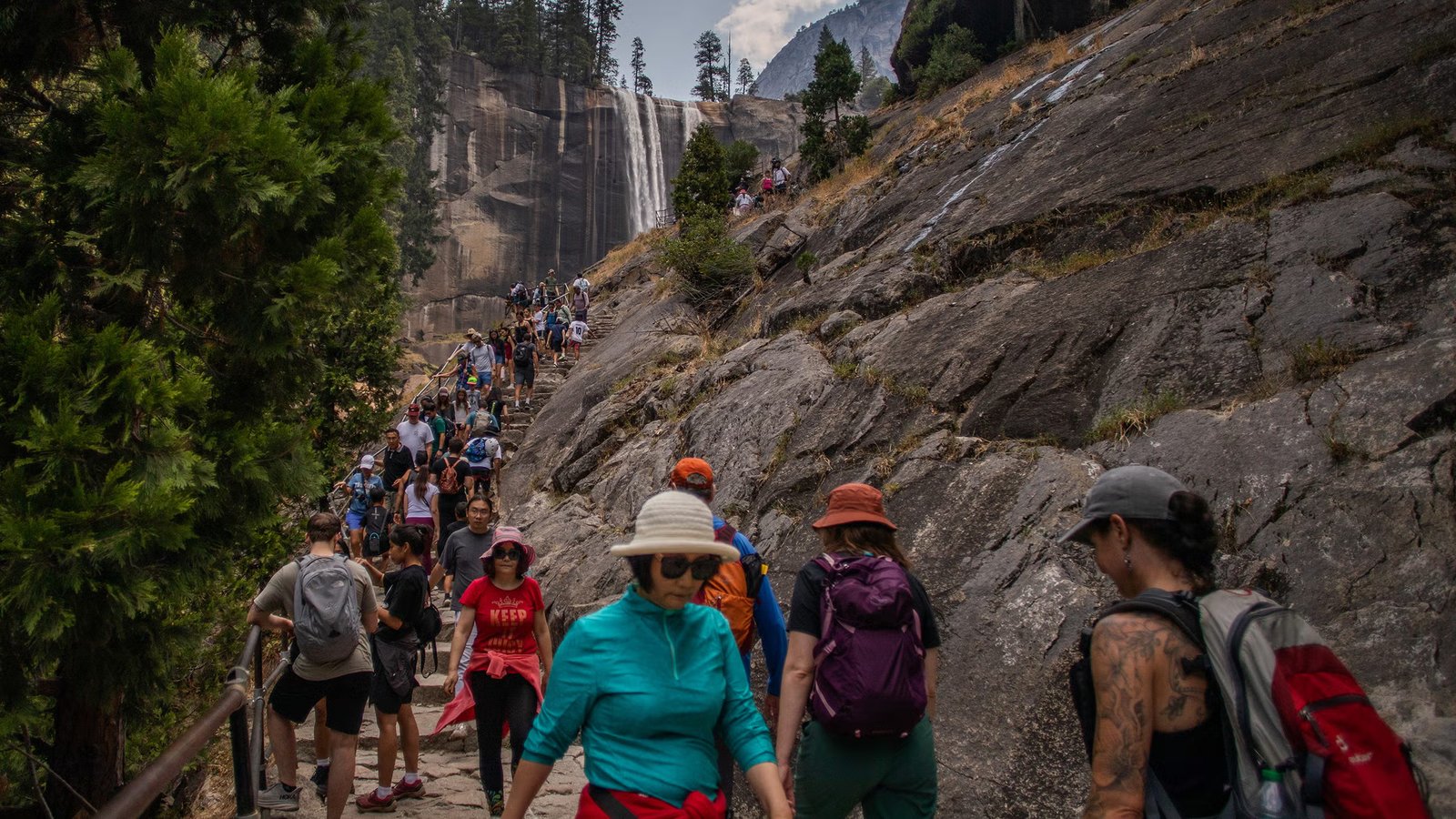
A report examining permit systems at seven national parks found that visitors from wealthier zip codes used them more frequently than those from lower-income areas.
Crowds in Yosemite (Photo: Apu Gomes/Getty Images)
Updated October 8, 2026 02:35PM
Reporter Katie Riordan interviewed the author of a new study that suggests that National Park Service reservation systems benefit wealthier visitors. Riordan also spoke to experts in the field of public lands reservations about methods to make these programs more egalitarian.
America’s national parks are busy—so busy, in fact, that many require reservations or permits for specific trails, scenic drives, or even the park itself. But new research suggests that reservation systems may benefit wealthier visitors.
Published in the open-access scientific journal Nature Communications, the study found that at seven national parks including Acadia, Glacier and Rocky Mountain, individuals who booked certain permits further in advance were more likely to come from wealthier zip codes. That’s also true for those who nabbed the parks’ most competitive reservations, the study said.
“How you allocate these permits seems to matter for who gets to recreate,” Jonathan Hughes, an economist with the University of Colorado and the study’s author, told Outside. “We adopt policies, and sometimes they generate unintended consequences.”
Hughes looked at 11 reservation systems within the seven parks that governed either timed entrances like the one at Rocky Mountain National Park, or vehicle access to a specific park area, such as the Cadillac Summit Road in Acadia National Park. The study examined these parks between 2021 and 2024. Hughes didn’t analyze reservations for amenities like campsites.
According to the research, visitors who secured reservations for the most competitive permits came from zip codes with median incomes between 3-5 percent higher than those of visitors who sought less-competitive permits. Visitors who booked reservations well ahead of time also tend to be from wealthier zip codes, the study said. Permits bought six months in advance of a trip favor residents in zip codes with 5 percent higher median income than those of residents who purchased same-day permits.
Hughes said it makes sense that many parks have turned to reservation systems to ease the strains of overuse. The National Park Service (NPS) logged more 331 million visits in 2024—a historic high. But in a signal that the NPS is still experimenting with how to best manage crowds, it abandoned a timed entry system this year at some of the most popular parks like Arches.
“People who got permits love this system because there’s a lot of good reasons to ration access. It improves people’s experience,” Hughes said. “You can have that isolation, solitude in the wilderness. Nature is protected because you don’t have people parking off the roadside, and the animals are less disturbed so there’s lots of good reasons why parks do this.”
But he said the NPS’ mission to manage their sites for the benefit of the public means everyone deserves a fair chance at access.
Hughes believes several factors may contribute to the inequality created by permits. For example, those who successfully book in advance likely have more ability to do so because of their work situation.
“Some professions you can, or maybe are even forced to, schedule your vacation many months in advance. Maybe those tend to be higher-earning professions,” he said. “Whereas in other professions, maybe your schedule is more up in the air up until a few days before you’re actually working so you have a lot less flexibility.”
An individual’s free time can also play a role. If a high-demand permit goes on sale at a specific time, a permit seeker in a lower-income job might not be able to take off work or be near a computer to buy it, Hughes said. He added that higher earners may be more familiar with the technology and the knowhow to navigate the NPS’ reservation website: recreation.gov. When speed matters for securing a competitive reservation, those lacking reliable or fast internet are at a disadvantage.
“There’s some evidence that lower income folks tend to access the internet more from phones than they do from computers so maybe that’s an issue,” Hughes said.
Hughes hopes his research informs park managers as they evaluate and adjust permitting systems while balancing the competing needs of not overburdening the landscape and creating equal opportunities for the public to recreate on it.
Managers could consider adopting a lottery system for the most competitive reservations, Hughes said, to ensure fairness. But he noted that lotteries also have a downside—people often cannot visit on the date that’s most desirable.
Will Rice, an associate professor at the University of Montana, studies equity issues related to campground reservations on public lands. Rice supports the lottery approach to reservations, and also believes that releasing permits in waves allows greater equity. Under this model, permits would become available in stages, ranging from months to weeks to just days in advance.
“We’re seeing more and more parks do this,” Rice told Outside, noting communicating these timelines effectively with the public is vital.
Rice also worked with the Leave No Trace organization to develop ethical guidelines for reserving campsites, such as not trying to create buffer zones between camping parties by booking multiple sites. He said education campaigns like this could also be designed to create etiquette norms around timed entry permits.
“There is a big piece of being considerate to others in how you responsibly obtain, use and cancel permits,” he said.
