

Published October 28, 2026 04:19PM
The best skiers make moguls look effortless—but mastering them is a whole lot of work.
“Mogul skiing is a very, very highly skilled sport,” Maddi Beck, a strength and conditioning coach for the U.S. Ski & Snowboard Team, told Outside. That means it requires intense precision and specific technique that you can really only build by spending time on the slopes.
That said, the sport also involves athletic components that can be trained in the gym—including trunk control, lower-body muscular endurance, and the ability to absorb and quickly redirect force, Beck said.
Trunk control—which in mogul skiing is basically the ability to hold your torso still while your legs quickly and abruptly change directions—helps you ski efficiently and also protects the low back from taking on too much stress as your body pounds over the bumps, Beck explained.
Muscular endurance in your legs, especially the quads, helps you maintain control and withstand the impact of all those bumps, Beck said. It also allows you to complete run after run without burning out, she added. Lastly, being able to absorb and quickly redirect force allows you to execute the rapid changes in direction that are integral to mogul skiing, she said.
With that in mind, Beck outlined seven exercises that together hit on these three aspects of fitness. Incorporate them into your workout routine now to improve performance and minimize injury risk this mogul season.
7 Exercises to Prep Your Body for Mogul Season
These exercises can help you improve trunk control, lower-body endurance, and your ability to absorb force.
Exercises for Building Trunk Control
The two exercises below are in every program that Beck develops for her athletes, including professional skiers and Olympic medalists. They work two different aspects of trunk control. The dead bug focuses on core stability, while the Pallof press helps you resist rotation through your torso.
You can add the dead bug and Pallof press to any workout, either as part of your warm-up or just before your cooldown.
1. Dead Bug
- Lie on the ground in reverse tabletop position. Raise both arms directly over your shoulders and lift your thighs directly over your hips, with knees bent and shins parallel to the ground. Engage your core so that your low back is pressed into the ground. This is the starting position.
- Inhale, then on your exhale, simultaneously extend one arm and the opposite leg as far as you comfortably can while keeping your low back pressed into the ground and your other limbs still. Pause, then reverse the movement as you inhale and come back to the starting position.
- Now repeat with the other arm and opposite leg. That’s one rep.
- Do two sets of 8 reps.
2. Pallof Press
- Set a cable machine to chest height, stand perpendicular to the anchor point with your feet about hip-distance apart, and keep a slight bend in your knees. (You can also loop one end of a long resistance band around a pole or other sturdy object.)
- Engage your core as you push the cable in front of your chest with arms straight. (FYI: your torso will naturally want to rotate toward the anchor; keep your core engaged to prevent that.)
- Hold for 20 seconds. Switch sides and repeat.
- Do two to three sets of a 20-second hold per side.
Exercises for Lower-Body Muscular Endurance
The following mini circuit workout helps build muscular endurance in the legs, especially the quads. For this group of exercises, perform each one in the order listed below for 30 seconds, moving from one exercise to the next without any breaks. After you’ve done all three, rest for 90 seconds, then repeat once more for two total rounds. Do this circuit one to two times a week.
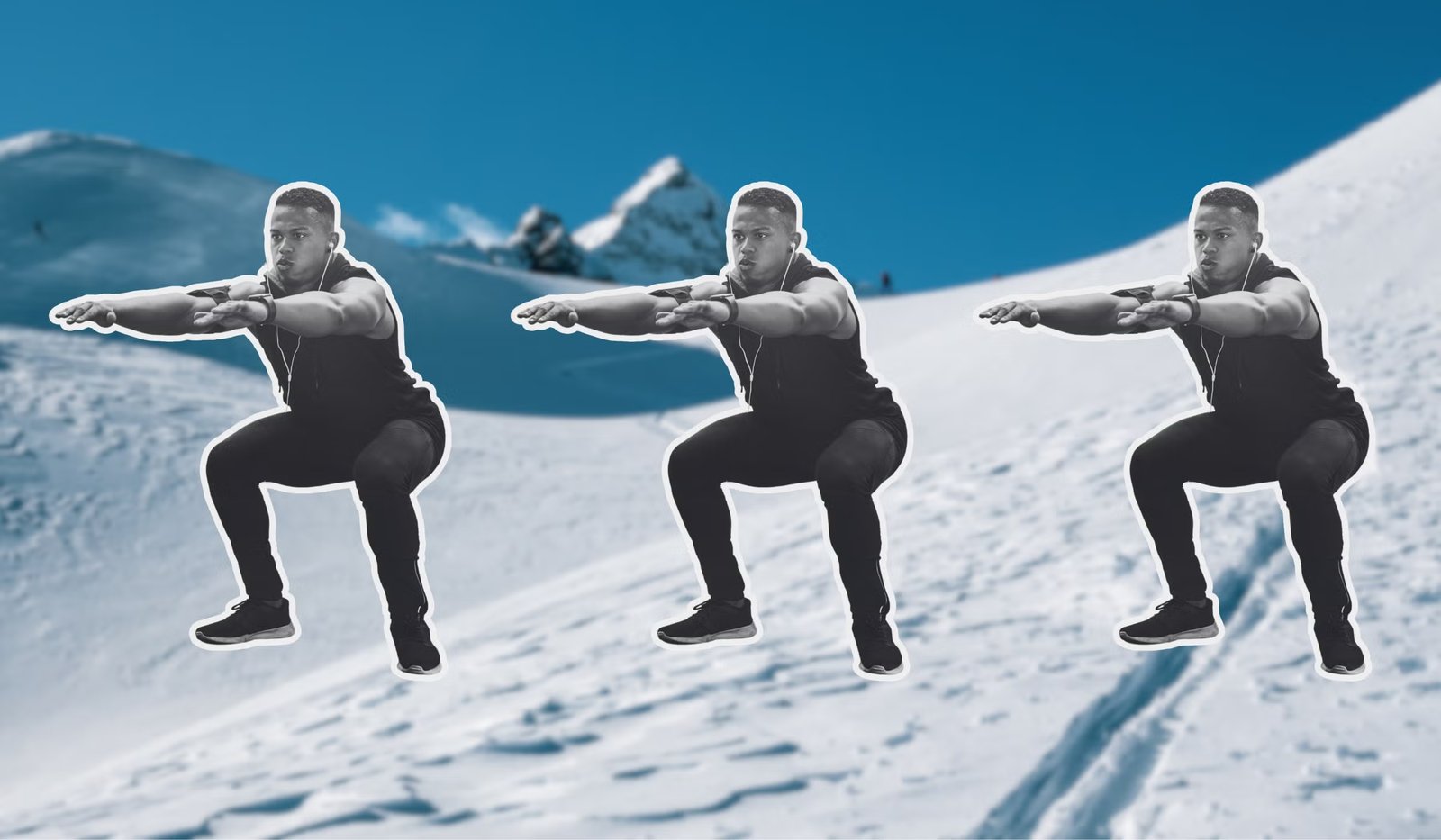
3. Bodyweight Squat
- Stand tall with feet hip-distance apart, arms at your sides. This is the starting position.
- Bend your knees and push your hips back like you’re sitting in a chair to lower down into a squat.
- Pause at the bottom for a moment, then press through your heels to return to standing.
- Continue for 30 seconds.
4. Squat Pump
- Do a squat as directed above, but instead of standing all the way up each time, maintain a deep knee bend and pulse up and down several inches. Continue for 30 seconds.
5. Squat Hold
- Do a squat as directed above, holding in the bottom position for 30 seconds.
Make it harder: Gradually progress to five total rounds. From there, up the ante by adding a fourth exercise to the circuit (such as squat jumps). Once that feels easy, take less rest in between rounds (for example, rest for only 60 seconds instead of 90).
Exercises to Improve Power and Force Absorption/Redirection
These two exercises help train your power and ability to absorb and rapidly redirect force. Because they are high-impact moves, check with your doctor if you’re dealing with an injury.
You can incorporate these exercises into your workouts twice a week. Do them at the beginning of your workout (after a quality warm-up) so that your legs are fresh. This will help you get the most out of these exercises and minimize injury risk.
Beck strongly recommends using a soft box (versus a wood or metal one) if you have access to one, as it’s gentler on your body if you catch a toe on the box.
6. Box Jump
- Stand facing a step, box, or other sturdy elevated surface with feet hip-distance apart, arms at your sides. Start with a low box height (for example: six inches) and gradually increase the height until you find a level that’s challenging for you.
- Bend your knees, push your butt back, clasp your arms together in front of your chest, and then press through your feet to explosively jump up and forward onto the box. Throw your arms to the side and land with slightly bent knees. This is one rep.
- Rest for a moment, then return to the ground and complete another rep.
- Do two sets of three to five reps for the box jump.
You can gradually progress to three sets of five reps.
7. Depth Jump
- Stand on a step, box, or other sturdy elevated surface with feet hip-distance apart, arms at your sides. Again, start with a low height and gradually increase it until you’ve found a level that’s challenging.
- Bend your knees slightly to drop off the box. Land on the ground with slightly bent knees. This is one rep.
- Rest for a moment, then complete another rep. (Optional: as soon as you land from your box drop, jump up, focusing on springing up as high as you can.)
- Do two sets of two to three reps for the depth jump.
You can gradually progress to two sets of five reps.
How to make these jumps harder: Beck recommends starting with a soft landing, which is gentler on your joints. Once you’ve worked your way up to a tall box with soft landings, go back to a lower height and do stiff landings (where you purposefully land with more impact). Gradually increase the box height again, and once that’s easy, switch to single-leg soft landings on a low box height, eventually working your way up to single-leg stiff landings on a tall box.
Don’t Forget to Do Regular Mobility Work and Conditioning
In addition to the above exercises, Beck also recommends mogul skiers regularly do cardiovascular conditioning workouts, as well as mobility drills for the hips and ankles.
Conditioning is extremely important, Beck explained. “It’s something that we prioritize pretty heavily within the national team.” That’s because it helps athletes ski longer, bigger days—and maintain proper form while doing so, which minimizes injury risk, she said. There are a bunch of different ways to approach conditioning, but as a general recommendation, Beck suggested regularly going on bike rides, hikes, or runs that last 45 minutes or more.
Ankle and hip mobility is also important because it helps you better control your skis and trunk—both of which play an important role in reducing injury. For that reason, Beck incorporates mobility drills into every workout she programs for her athletes, and she also instructs them to do mobility work on their own time as well.
Want more Outside health stories? Sign up for the Bodywork newsletter. And for tips on how to train, fuel, and recover better, sign up for the Sweat Science 101 newsletter.
