

Getting up from a low armchair often takes two attempts and a push from both hands, and the first few steps afterwards can feel unsteady. That small hesitation is one of the earliest signs that balance and leg strength are starting to fade. The good news is that both respond well to the right training, at any age.
I’ve coached adults for more than 15 years, and much of my work now is with clients aged 60 to 85 and over, in their own homes across Sevenoaks. The aim is simple. You should be able to move through your house, your garden and your town with confidence.
Why Balance Changes After 60
Balance depends on three systems working together: the muscles in your legs and hips, the sensors in your feet and ankles, and your inner ear and eyesight. With age, each of these tends to lose a little sharpness. On their own the changes are small, but together they make a stumble more likely to become a fall.
Muscle loss is the part we can influence most directly. Adults typically lose strength steadily from middle age, and the loss speeds up after 60 if nothing challenges the muscles. Targeted strength work slows it down and, in many cases, reverses it.
Protecting Your Joints While You Train
Many of my clients live with osteoarthritis in the knees or hips, and some have had a joint replaced. A painful or new joint isn’t a reason to stop moving. It’s a reason to move with more care and better technique.
For arthritic knees, I favour controlled movements through a comfortable range rather than deep bending under load. Stronger thigh and hip muscles take pressure off the joint itself, which often eases day-to-day aches. Progress is gradual and always follows how the joint responds over the following 24 hours.
After a hip or knee replacement, the priority is rebuilding confidence and symmetry once your surgeon or physiotherapist has signed you off for general exercise. People often favour the operated side for months without realising it. Simple, well-coached drills help restore an even walking pattern and a reliable standing balance.
Balance Is a Skill You Can Practise
Balance improves when you practise it regularly. Short, frequent sessions work better than one long one, because the nervous system learns through repetition. Ten minutes a day at the kitchen worktop can make a noticeable difference within a few weeks.
Training for Real Sevenoaks Terrain
Indoor stability matters, but life in and around Sevenoaks rarely happens on a flat floor. Knole Park has gentle-looking slopes that become tiring on the return climb, and its grass paths are uneven underfoot after rain. The older streets in town have kerbs, cambers and worn stone paving that catch a lazy foot.
Many gardens in Riverhead and Otford are built on steep slopes, with steps down to a lawn or vegetable patch. Kemsing and Seal have narrow lanes where you step onto verges to let cars pass. Every one of these situations needs ankle control, hip strength and the ability to recover quickly from a wobble.
That’s why I build sessions around your actual routes. If you walk to the shops in Dunton Green or along the footpaths near Weald, we train the movements those walks demand. The goal isn’t fitness for its own sake but a better Tuesday afternoon.
Practical Drills to Try at Home
Do these only if you can stand safely without help. Stop if you feel sharp pain, dizziness or chest discomfort, and check with your GP first if you have a heart condition or recent surgery.
1. Chair sit-to-stand. Sit near the front of a sturdy chair placed against a wall, feet hip-width apart and flat on the floor. Lean your chest slightly forward and stand up by pressing through your heels, using your hands on your thighs if needed. Do 5 to 8 slow repetitions, rest for a minute, then repeat once.
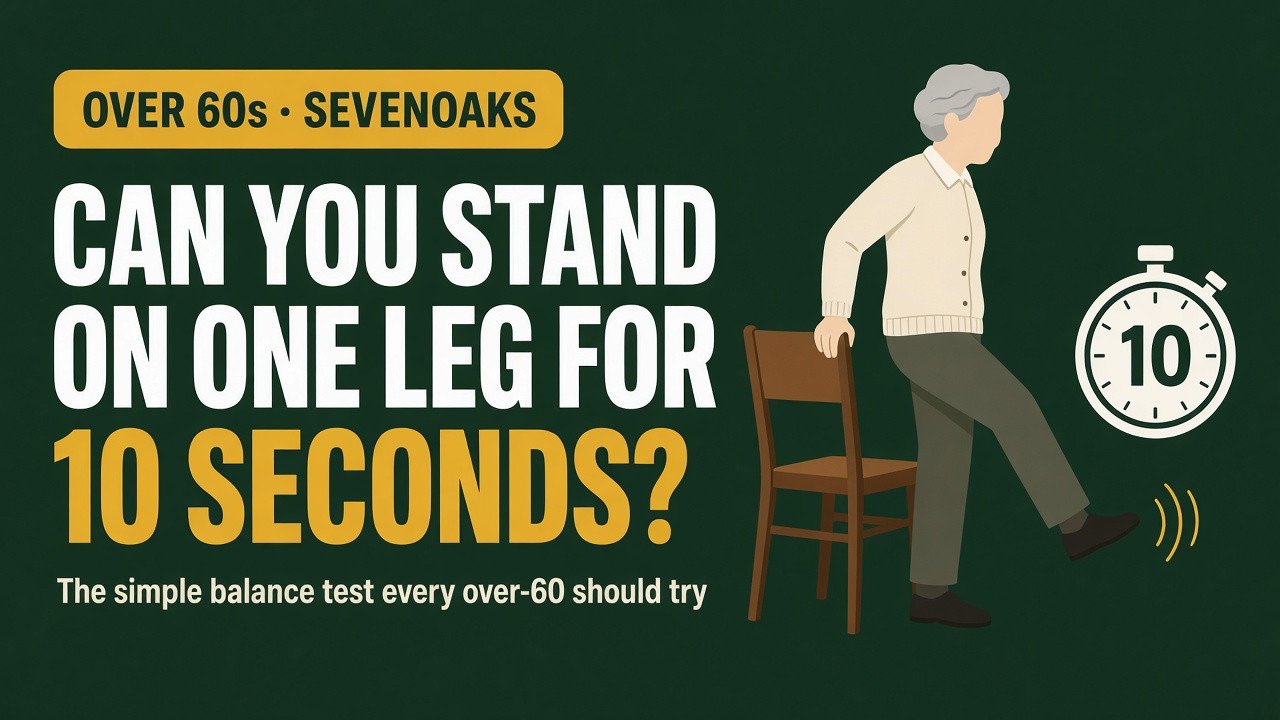
2. Worktop-supported single-leg balance. Stand facing the kitchen worktop with both hands resting on it lightly. Shift your weight onto one leg and lift the other foot just off the floor, holding for 10 to 20 seconds. Do 3 holds on each side, keeping the worktop within easy reach at all times.
3. Seated ankle circles and heel raises. Sit tall and slowly circle each ankle 10 times in each direction. Then place both feet flat and lift your heels as high as is comfortable, lowering slowly for 10 repetitions. This loosens stiff ankles and wakes up the calf muscles you rely on for kerbs and stairs.
Why Training at Home Works Better
A gym can feel intimidating, and getting there involves driving, parking and changing rooms. At home, none of that applies. We train in the space where you actually live, using your own stairs, chairs and doorways.
I bring all the lightweight kit with me, from resistance bands to a low step and soft weights. Sessions are calm and one-to-one, with every exercise adjusted to how you feel on the day. You can read more about how I work on my page about in-home senior fitness in Sevenoaks.
Food That Supports Your Strength
Before coaching, I worked as a professional chef, so nutrition advice comes with a practical slant. Muscle needs enough protein to rebuild, and many older adults eat less of it than they need. A boiled egg at breakfast, some Greek yoghurt or a piece of fish at lunch makes a real difference.
Hydration matters too, because even mild dehydration can bring on light-headedness when you stand up. There’s no fad diet involved, just ordinary food made to work a little harder. We can talk it through at the kitchen table.
A Relaxed First Conversation
If you’d like to feel steadier on your feet, the first step is an informal home visit. We’ll have a cup of tea, talk about what you’d like to do more easily, and I’ll show you a couple of simple movements. There’s no pressure and no commitment.
I cover Sevenoaks town, Riverhead, Otford, Kemsing, Dunton Green, Seal, Borough Green, Platt and Weald. You can book a home consultation online, call me on 07783988905, or email 7oakspt@gmail.com.
Frequently Asked Questions
Do I need a lot of space at home for sessions?
No. Most sessions need only the space beside a chair and a kitchen worktop. I’ve coached clients effectively in small flats and narrow cottage hallways.
What if my joints are very stiff or painful?
We start with gentle, seated movements and progress only as your joints allow. Severe stiffness often eases with regular, careful movement, and I’ll work alongside any advice from your GP or physiotherapist.
Do I need to buy any equipment?
No. I bring all the lightweight kit to every session, including resistance bands, a low step and soft weights. Between visits, your own chair and worktop are all you need.
