

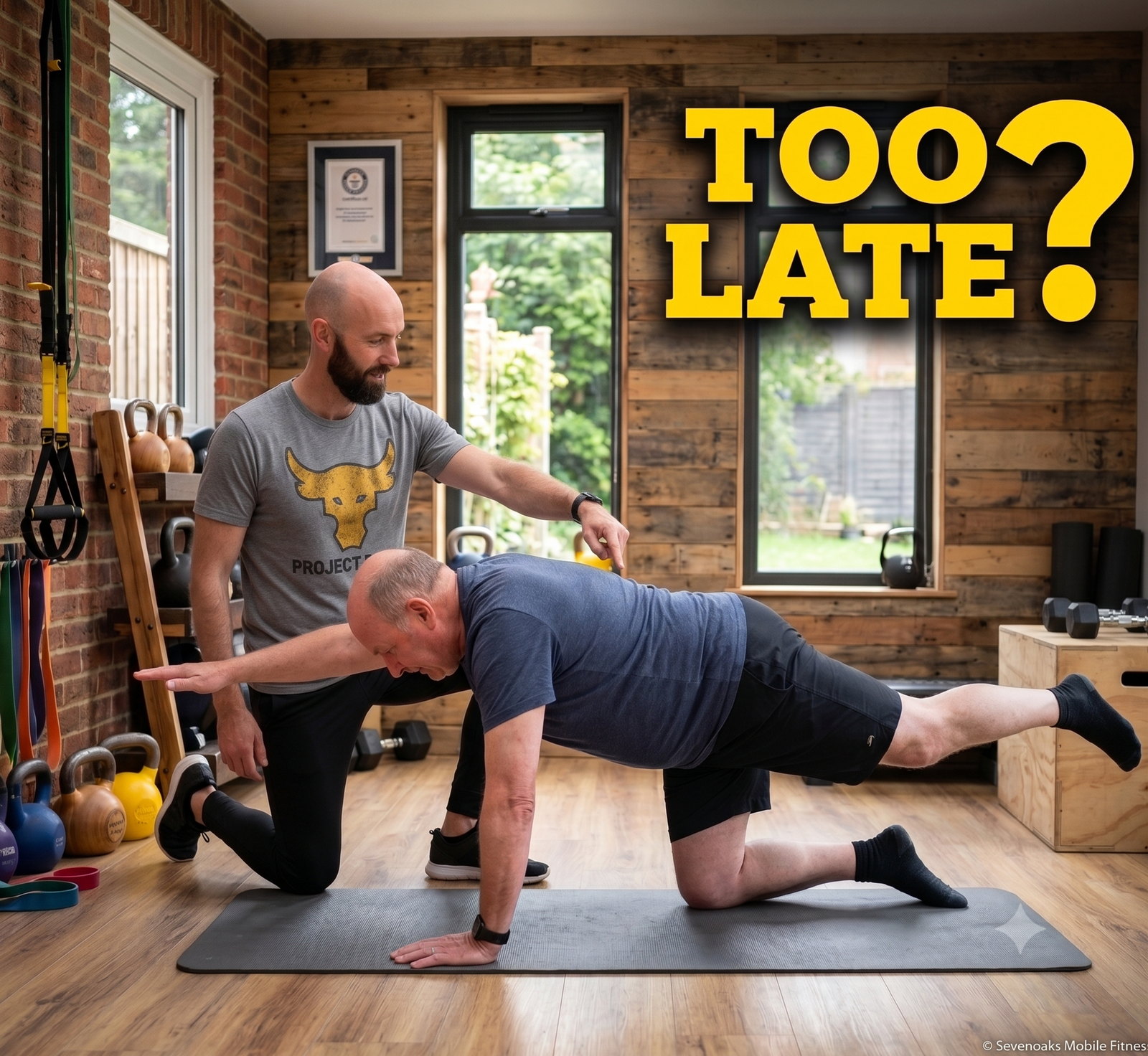
Have you ever caught yourself looking in the mirror, noticing a new ache or feeling unsteady on your feet, and asking yourself:
“Is it too late to get fit, or have I completely missed my chance?”
It is one of the most common questions I hear from new clients. But before you write yourself off, let me ask you something:
“If I had asked you ten years ago whether it was too late to start getting fit, what would your answer have been?”
You would almost certainly have said, “No, of course not. Ten years ago I had plenty of time.” Yet here is the honest truth: ten years ago, you felt the exact same hesitation you feel right now. The barrier holding you back is rarely your age, your joints, or your past inactivity—it is a trick of hindsight.
The 10-Year Hindsight Trap
In behavioural psychology, this mental roadblock is known as the “End of History Illusion.” At every stage of life, we readily recognise how much we have changed in the past, yet we mistakenly believe our present self is the final, unalterable “finished product.”
Telling yourself that “it’s too late” is often an unconscious defence mechanism. Starting something new feels vulnerable, and deciding that biology has already shut the door gives us a comfortable excuse to avoid trying.
-
The Common Myth: “Past 60 or 70, my muscles and joints are worn out and can no longer rebuild or adapt.”
-
The Clinical Reality: Muscle tissue and joint fibres retain the capacity to rebuild at 85, 90, and beyond.
A landmark clinical study conducted by Harvard and Tufts University examined men and women aged 86 to 96 in residential care. When put on a simple resistance routine for just ten weeks, the participants increased their muscle strength by an average of 113%, walked faster, and dramatically improved their daily functional independence.
Your muscle fibres, cardiovascular system, and nervous system never lose the capacity to adapt. When considering if you can rebuild muscle in older age, the answer is definitive: your body is simply waiting for the stimulus.
Building Your “Biological Cushion”
Over my 15 years coaching clients in Sevenoaks, Kent, I have seen this biological resilience in practice week after week.
A gentleman once came to me at 60 years old, convinced it was far too late to get fit. We started steadily, working on functional movement, balance, and core stability. Over the years that followed, he ran into several severe health issues unrelated to his training. Later, his medical consultant told him plainly: if he had not built that physical baseline, he would not have survived.
In medicine, this is known as building your physiological reserve. Think of it as a savings account for your health. When an unexpected illness, fall, or surgery hits, a body with a bit of muscle and stamina can weather the storm far better than one running on empty.
I see the same turnaround in clients living with rheumatoid arthritis. When joints hurt, our natural instinct is to sit still. Yet prolonged rest starves joints of synovial fluid—the body’s natural WD-40. Controlled movement circulates this fluid, eases stiffness, and builds joint stability safely.
Mental Health: Swapping the Pub for Vitality
Starting exercise late in life changes far more than your physical body; it revitalises your mood, mental clarity, and social connections.
One of my clients in his sixties lost over three stone after committing to regular movement. While the weight loss was significant, the real breakthrough was his day-to-day routine:
-
Old Pattern: Hours spent sitting in the pub, next-day brain fog, and passive socialising.
-
New Routine: Daily walks, casual sport, steady energy, and an active, encouraging community.
He replaced passive pub visits with walking and active hobbies, discovering a brand-new social circle in the process. According to the NHS, regular physical activity reduces the risk of depression and dementia by up to 30%. Routine movement breaks up sedentary hours, sharpens cognitive function, and combats social isolation.
The Chef’s Recovery Plan: Real Food
When you start exercising after years on the sofa, muscle recovery is essential. After spending a decade as a professional chef, I know that restrictive, joyless diets always fail. Your nutrition should fit how you actually live.
-
If your partner cooks: Involve them gently. Ask for simple additions rather than a total menu overhaul—such as an extra serving of roasted vegetables or beans tossed into a casserole for extra protein.
-
If you cook for yourself: Make healthy food taste rewarding. Avoid boiling vegetables into bland mush. Toss them in a drop of olive oil, black pepper, and a proper pinch of salt, then roast them until sweet and tender.
-
If you don’t like cooking: Make use of modern convenience. There are now excellent ready-meal delivery services providing balanced, whole-food options with zero prep required.
The “Fridge Rule”: A 2-Minute Test
You do not need gym memberships or specialised equipment to prove it is not too late to get fit. Use this simple benchmark:
“If you have enough energy to walk to the fridge and put the kettle on, you have enough energy to start moving.”
Any movement that breaks up prolonged sitting sends an immediate repair signal to your cells.
Option 1: If You Can Walk
-
The 5-Minute Out-and-Back: Walk down your road for two and a half minutes, turn around, and walk home. Do this once a day to establish the routine before worrying about speed or distance.
Option 2: If Standing Is Difficult (60-Second Seated Circuit)
Sit upright in a firm chair and run through this gentle routine:
-
Seated Sky Punches (20s): Reach hands upwards in an alternating tempo.
-
Seated Knee Lifts (20s): Raise one knee towards chest, lower with control, switch sides.
-
Seated Leg Extensions (20s): Straighten your lower leg out in front, squeeze thigh, lower slowly.
Safety Notice: Always speak to your GP or a medical professional before starting a new exercise routine, particularly if you manage a long-term condition or joint issues.
Get in contact today to book your free Sevenoaks consultation.
If you live in the Sevenoaks area and would like some friendly, expert support to get moving safely, please get in touch.
I offer a free, no-obligation initial consultation where we can chat about your baseline, address any mobility concerns, and see how tailored personal training can help you rebuild strength, confidence, and everyday independence.
Frequently Asked Questions
1. Is 60, 70, or 80 too late to start getting fit?
No. Clinical research shows that muscle fibres, joints, and bones adapt to exercise at any age. Even individuals in their 90s can double their strength with gentle, progressive resistance training.
2. Can you really rebuild muscle mass after age 60?
Yes. While muscle loss occurs with inactivity, it is not permanent. Resistance movement and protein stimulate muscle rebuilding regardless of your biological age.
3. What are the safest exercises for joint stiffness?
Low-impact movements such as chair exercises, supported sit-to-stands, short flat walks, and water-based exercises promote blood flow without overloading joints.
4. How does exercise help with arthritis?
Movement circulates synovial fluid, which lubricates cartilage and eases joint friction. Strengthening surrounding muscles also takes direct pressure off the joint capsule.
5. How quickly can an older adult notice improvements?
Balance and ease of movement improve within 2 to 3 weeks. Visible gains in muscle tone, stamina, and day-to-day energy follow within 6 to 8 weeks.
6. What is a “physiological reserve”?
It is the biological safety cushion your body builds up through movement, helping you recover faster from sudden illnesses, surgeries, or falls.
7. How can I exercise safely with poor balance?
Start with seated chair exercises or hold onto a sturdy kitchen worktop or heavy dining chair to build strength without any fall risk.
8. What should I eat to support recovery?
Eat adequate protein (eggs, fish, poultry, beans, Greek yogurt) to repair tissue, paired with vegetables roasted in olive oil for anti-inflammatory nutrients.
9. How many days a week should an older beginner exercise?
Aim for 5 to 10 minutes of gentle daily movement (like a short walk), or 2 to 3 structured 20-minute gentle sessions per week.
10. Do I need to join a gym to get fit in later life?
No. Bodyweight movements, household items (like food tins for light weights), and sturdy furniture provide all the resistance needed to build strength at home.
Ready to Take Your First Step?
If you live in the Sevenoaks area and would like some friendly, expert support to get moving safely, please get in touch.
I offer a free, no-obligation initial consultation where we can chat about your baseline, address any mobility concerns, and see how tailored personal training can help you rebuild strength, confidence, and everyday independence.
