

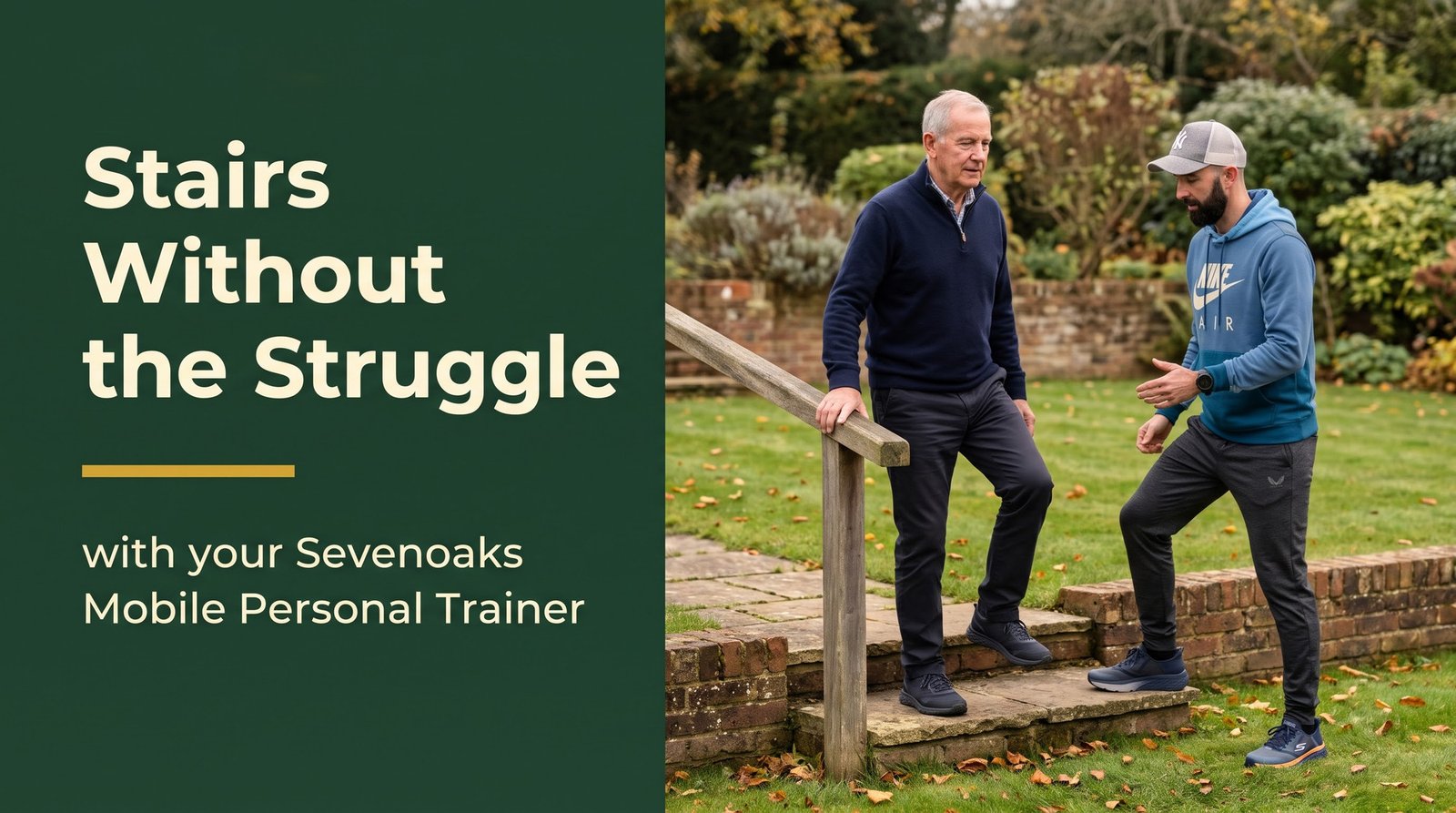
Quick question. When did the stairs start to feel like a decision?
Maybe you’ve begun taking them one at a time, leading with the “good” leg. Maybe you grip the banister on the way down like it owes you money. Or perhaps you’ve quietly stopped walking up the hill into town and started driving instead.
None of that is laziness. Your legs have lost a bit of strength and control, and both can absolutely be trained back at home.
Why Going Down Is Harder Than Going Up
Every step up asks your thigh muscle to shorten and push you upwards. Every step down asks that same muscle to lengthen while it’s working, lowering your whole body weight smoothly onto the step below. Think of it as your brakes.
And there’s the key. We practise the accelerator all day long. We rarely practise the brakes.
The truth is, when the brakes are weak, the leg doesn’t lower you. It drops you. The knee wobbles, you land with a thud, and that thud goes straight through the joint. That’s why so many knees ache more coming down than going up.
Add a bit of fear and it gets worse. You stiffen up, lock the knee and jar it even more.
Joints Love Strong Muscles
Here’s the simple bit. Your muscles are your joints’ shock absorbers.
Strong thighs soak up the load on every step down. Strong muscles on the outside of the hip keep your knee in line instead of letting it collapse inwards. When they’re lazy, the knee takes the strain.
Balance matters too. On every stair you briefly stand on one leg, and wobbly is when people reach for the wall and miss.
Sevenoaks Is Not a Flat Town
Sevenoaks sits up on a ridge, so getting almost anywhere means a climb or a descent. There’s the walk up from the station into the town centre, plus station stairs and footbridges whenever you catch a train.
Add sloping driveways, split-level gardens and garden steps, slippery with wet leaves this time of year.
A flat gym floor doesn’t prepare you for that. That’s why I train people at home, on their own stairs and steps.
Three drills to try at home
Use the bottom stair, with a firm hand on the banister or wall throughout. Wear supportive shoes, not socks or slippers.
1. Bottom-step step-ups. Place your whole foot on the bottom stair and push through the heel to stand up tall, then step down with control. Keep your kneecap lined up with your second toe, not drifting inwards. Do 6 to 8 on each leg, resting as you need.
2. Slow step-downs. Stand on the bottom stair facing up, holding the banister, and lower one foot back to the floor, toes first. Lower as if the floor were thin ice and you’re testing it. Slow. So slow: this is the move that trains your brakes. Do 5 on each leg.
3. Side step-ups. Stand sideways to the bottom stair, banister on the same side as the step. Place the nearer foot fully on the stair, then press through that heel to lift yourself up, bringing the other foot alongside. Step back down with control. Keep your hips level and your knee in line with your toes, not caving towards the other leg. Do 5 to 8 on each side.
Safety. A little muscle effort is fine. Sharp pain, swelling or the knee giving way is not, so stop and speak to your GP or physio. If you’ve had a recent knee or hip operation, check with them before you start.
Little and Often Wins
You don’t need an hour. A few minutes on the bottom stair, two or three times a week, makes a difference.
It isn’t a quick fix. Strength comes from turning up regularly, not one heroic Saturday.
As things improve, we make it harder: a higher step, an even slower lowering, a light weight in one hand. That’s progressive strength, and it stops you going back to square one.
Why Training at Home Works
I’m a 100% mobile personal trainer, with over 15 years’ experience and a Level 3 qualification. I train adults aged 60 to 85+ across Sevenoaks, Riverhead, Otford, Kemsing, Dunton Green, Seal, Borough Green, Platt and Weald.
Let’s Have a Look at Your Stairs
If the stairs have started to feel like a decision, let’s change that. Book a free home visit. You put the kettle on, I’ll watch how you manage your own stairs, and we’ll talk about what’s getting harder.
There’s no sales pitch and nothing to sign. You decide afterwards.
Frequently Asked Questions
Why do my knees hurt more going down the stairs than up?
Going down asks your thigh muscles to control your weight as they lengthen, which is harder than pushing up. When that control is weak, the knee takes the jolt.
Are step-ups safe if I have arthritis in my knees?
For many people, yes, if you start low, hold on and move slowly. Sharp pain or swelling means stop and check with your GP or physio.
Why do side step-ups help my knees?
They strengthen the muscles on the outside of your hip, which stop your knee rolling inwards on every step.
Should I lead with my good leg on the stairs?
For now, “up with the good, down with the bad” is a sensible rule if one knee is sore. Training the weaker leg means you rely on it less over time.
So, how do you take your stairs? One at a time, or two at a time with your arms in the air?
Let me know. Here’s to a strong, steady winter.
Daniel Welstead, Personal Trainer in Sevenoaks
