

Published October 29, 2026 02:08PM
To my right were the Apuan Alps, scarred white from two thousand years of marble mining. To my left, a few miles off, the sea. And directly beneath me: asphalt, a narrow shoulder, and the persistent attentiveness of not getting clipped by Fiat Pandas and silent electric Citroëns.
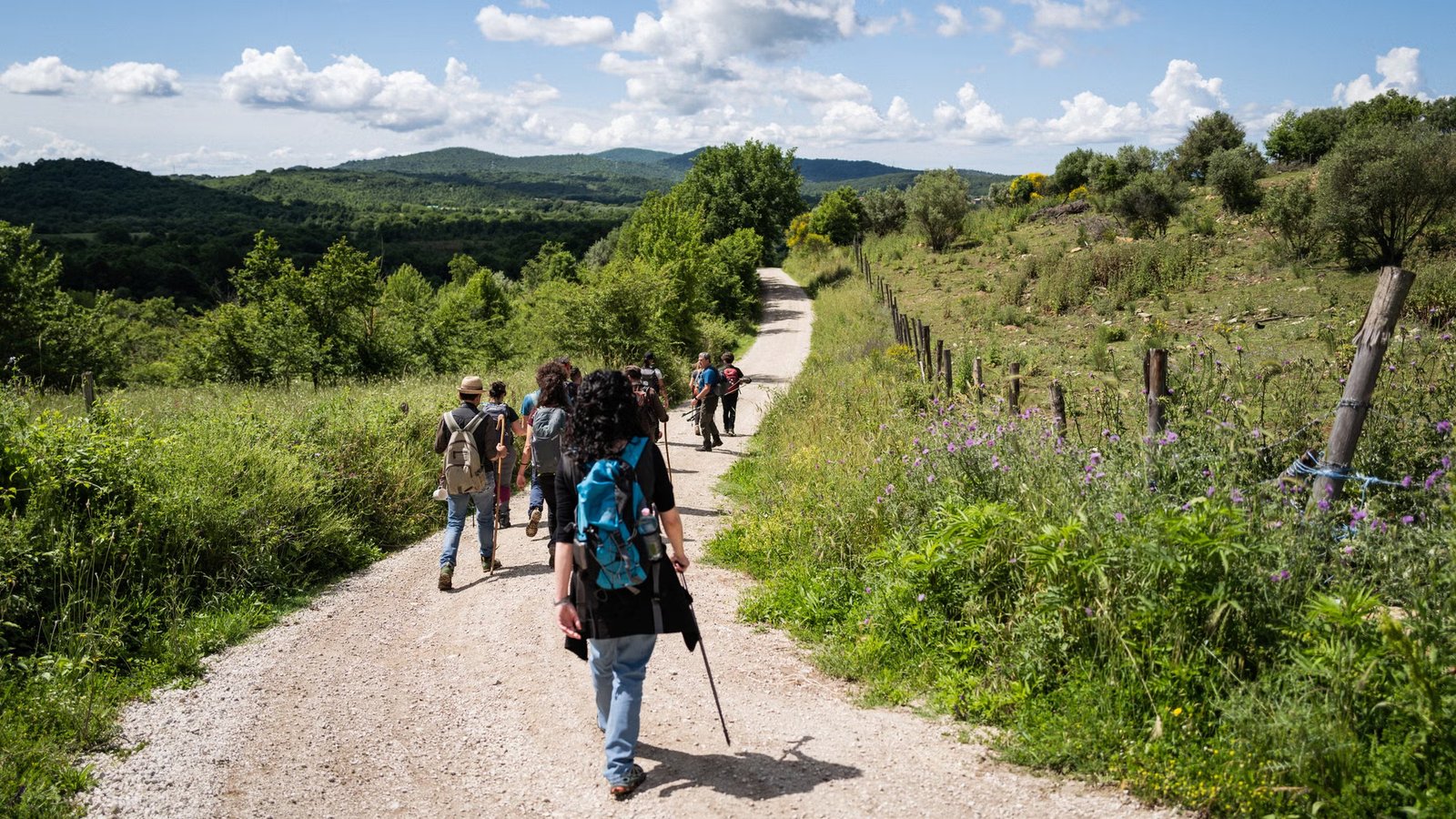
I was walking a stretch of the Via Francigena, the medieval pilgrim route that runs from Canterbury to Rome, from Camaiore to Sarzana. It’s, how do you say, gritty Tuscany. This is not the Tuscany of postcards. In Carrara I got the industry of marble instead: giant cubes of it hoisted by cranes, sitting in open lots like unclaimed luggage, waiting to become countertops in bougie kitchen remodels. Less likely to become the next David.
I’d come to meet a friend at the 100-mile mark of her Via Francigena walk, a centerpiece of her sabbatical; I’d do the next 50 or so miles with her. Which is to say I didn’t really look into what I was getting myself into. I was along for the ride no matter what. If I’d pictured anything, it was the Tuscany she’d been describing from the trail for weeks. South of Siena, the route rolls through the Val d’Orcia and the Crete Senesi with its white gravel roads, cypress-lined ridgelines, as well as San Quirico, Radicofani perched on its volcanic cone. North of Siena you get the stunning San Gimignano and Monteriggioni. The stuff that launched a thousand Under-the-Tuscan-Sun fantasies.
The Via Francigena is roughly 1,250 miles and, at a pace of 12 to 15 miles per hour, per day, takes about 90 days. Few attempt that. Most walk a section that for one- or two-weeks, usually in Tuscany, and revisit it over a lifetime. Many just do the final 60 or so miles into Rome, the minimum on foot to earn the Testimonium, the official completion certificate, which is why the last stages are the most crowded. If my friend’s stretch was the greatest hits of the Via, this would be the B side.
I had gotten a taste of the more genteel school of pilgrimage walking on the Camino de Santiago a stretch of hiking routes that are primarily in Spain, with chef and humanitarian José Andrés. A slow pace during the day, long lunches, even longer dinners. And I’ve made peace with my position on this spectrum: I like the idea of roughing it in a hut. I also like putting on clean clothes at night and being a tourist. There is a slang term for this kind of Camino walking that applies to the Via Francigena as well: turigrino, a Spanish mashup of turista (tourist) and peregrino (which roughly translates to pilgrim or someone who wanders to distant lands). It’s sort of a pejorative, at least if you ask the more Type 2 end of the spectrum. But I like clean clothes and a nice cold glass of bubbly Franciacorta at the end of the day.
I would not, it turned out, be getting the full turigrino treatment. The morning before my flight, my friend called. She’d been slackpacking most of her trip. That’s where you walk with a daypack while a service ferries your real luggage ahead to the next hotel. But she’d searched hard, asked around, and on our stretch, no such service existed.
Mentally, I pivoted from a Type 2 Light vacation–walking with some water and some gummy bears to Type 2 Heavy: walking with everything. Fine, except I was leaving in 12 hours and my actual backpacks were all in storage. There would be no run to REI. I went with what I had: a running hydration pack/vest with slightly ambitious storage, never once worn, missing one of its two chest straps.
I hated that pack. Then I hated it some more. Then I accepted it the way you accept a blister. Starting out, it felt terrible; eventually you resign yourself to the terribleness, and somewhere past that resignation. Around day three I arrived at something like affection, the Stockholm-syndrome phase of gear ownership. I will still probably give it away.
Nobody tells you about the unfashionable stretch of a famous walk: nobody is on it. Over the entire leg we encountered perhaps six other hikers. Everyone else we passed was simply living their life because, well, they lived there. For days, we seemed to be the only tourists in Italy, a feeling that, if you’ve ever bottlenecked your way through the ancient streets of Florence or Rome in summer, you know is supposed to be impossible.

The numbers back the feeling up. Even in 2025, which was a Jubilee year in Rome and the best year in the Via’s modern history, only about 12,000 people collected a Testimonium, and the route’s governing association estimated that roughly 100,000 set foot on some piece of its 2,000 kilometers all year. The Camino de Santiago issued 530,919 Compostelas in the same twelve months. The Via is growing fast, with completions roughly doubling in each of the past two years. But it’s growing from almost nothing, which makes it, for now, a rare thing for Italy: a famous place that’s not overrun with tourists.
In Carrara, your mind wanders in two directions at once. What would these mountains look like if they’d never been mined? The scars are obvious, bright white, visible from the sea. But then: What would the world look like without the David, the Pietà, London’s Marble Arch?
Beauty still presents itself, even if it’s not as obvious as a postcard. My notes and photos from this trip conjure more poetic memories. Bay laurel crushed between my fingers, smelling like adobo about to happen. Fresh-foraged mint chewed on the trail. Queen Anne’s lace, which I can now report does in fact sort of taste like carrots. Blackberries that seemed to materialize precisely when you needed a little sweetness. My first pomegranate on the tree. Chestnuts in their spiny husks, which make them look like terrestrial sea urchins, which I’d first met on the Camino with José. An olive grove leaning over the trail, depositing pits from last year’s harvest, or the year before that, or before that. Redwoods are awesome, but there’s something magical about the longevity of an olive tree. And always, up ahead, another hilltop town with its own strange story of how it came to be.
And then there was the dining, which on this stretch requires zero effort, zero reservations, and zero contending with other tourists. Baccalà and a primo of cacciagione in Camaiore. In Seravezza, a rustic seafood risotto, salted like the sea a few miles off, and better for it. In Massa, maltagliati cut from corn flour, known locally as curchua, and at a restaurant called Origine, calamarata, fat rings of pasta doing an impression of the calamari they’re named for, tangled with prawns, followed by polpo over a cassava mousseline with gremolata: a plate more Milan than marble town. This is the journey I will remember as getting hooked on Franciacorta—Italy’s answer to Champagne. So much better than Prosecco, so rarely seen in the States. I made a nightly ritual of it. Every table around us was locals, eating where they always eat.

The crescendo came at Locanda de’ Banchieri, a one-time Malaspina residence that spent centuries as a post station taxing the marble trade out of Luni’s ancient port, now a Michelin-starred inn run by Giacomo Devoto, a chef from Sarzana. This is where our walk would end. With wood-fired bread under a ragout and butter of Tuscan black kale. Croxetti, coin-like Ligurian pasta, in a white pesto of San Rossore pine nuts and marjoram. A kitchen doing what we’d been doing by accident for days: taking in the landscape.
Even the cars, in the end, weren’t so bad. My most memorable encounter of the whole walk was a shirtless old-timer easing past me in an ancient Fiat pickup who smiled, raised a hand, and offered a single word: “Calma.”
The walking is still walking, even when you’re not putting in the full miles, and that’s okay. Few people talk about the low-grade boredom of these paths—the long connective tissue of road shoulder you endure to get to the things that are photo-worthy. But maybe that’s the ratio of any trip worth taking. It can’t be a screensaver all the time. And would you even want that, in Italy, where the too-perfect is always too crowded? The crowds sort themselves to the pretty parts. The rest they leave to you.
Calma.
