

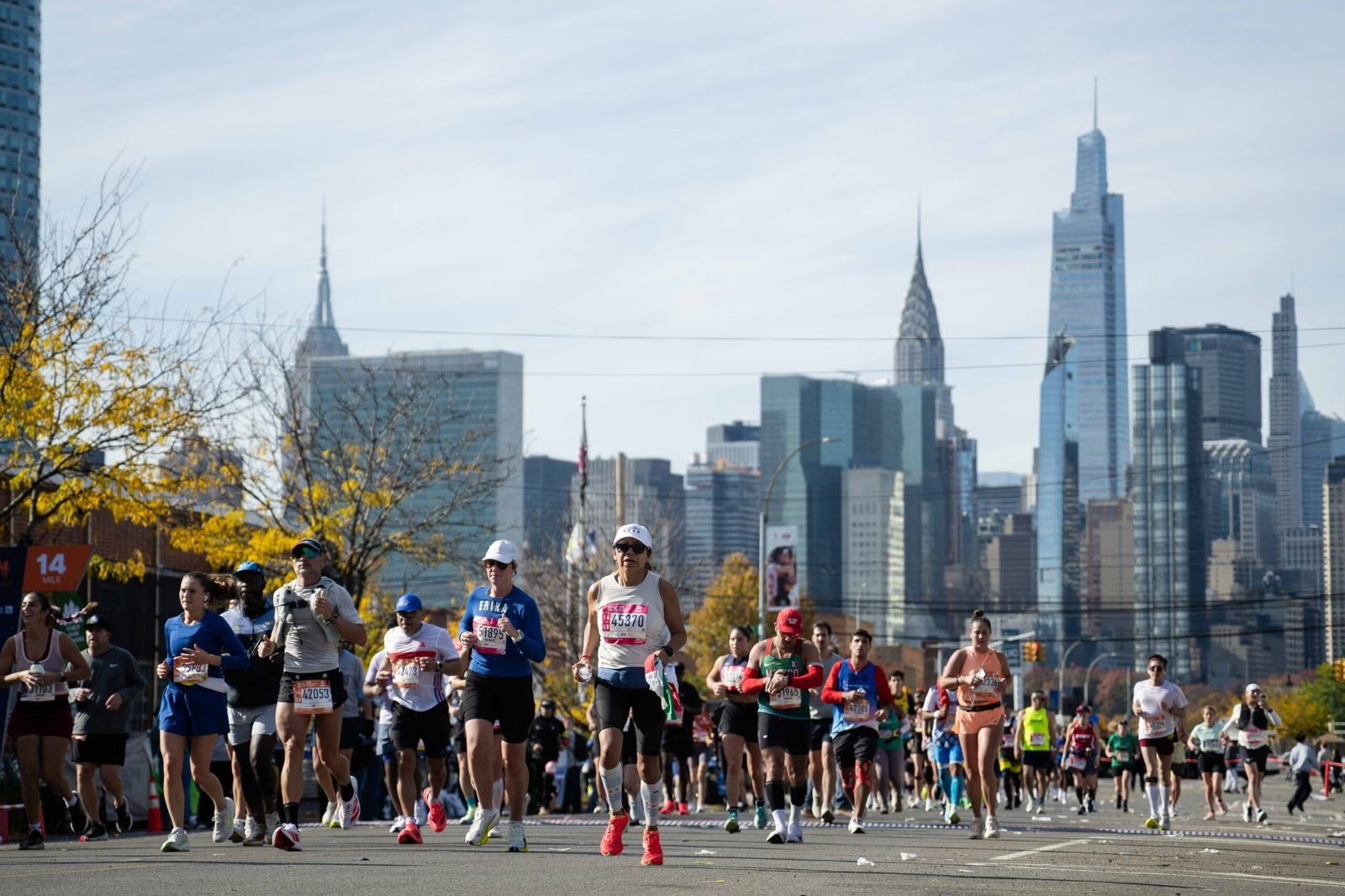
Published November 2, 2026 02:40PM
The Monday before my second New York City Marathon, I was at Avenue Sky Lounge at the Peak, perched on the 101st floor of 30 Hudson Yards, for the after-party to the New York premiere of Everest: The Other Side. A good room for thinking about big climbs.
Rich Roll, the ultra-endurance athlete and podcaster, was there. We got to talking about Sunday. He admitted he was nervous. A year and a half earlier, after spinal fusion surgery, his surgeon had told him to forget about running. If a man who has built a life on going long was nervous, I figured I was allowed to be, too.
I drifted to the window to look at what we were nervous about. Far to the south, the Verrazzano-Narrows Bridge, where the marathon starts, was a thin strand of light. Turn around, and there was the dark rectangle of Central Park, where it ends. In between: everything. Brooklyn, Queens, a corner of the Bronx, the long canyon of First Avenue.
You can look at the route on a map forever to try to familiarize yourself with the course and come up with a race plan—don’t bomb up or down the Verrazzano because you’ll pay for it on the Queensboro Bridge, keep it steady in Brooklyn, give it everything on Central Park South. I’d run this course before. And still, from up there, no matter how much I’d planned, I had to ask myself: I signed up for what?
Six days later, there was no backing out. At 4 A.M. on Sunday I was on the F train. This being the morning after Halloween, I had company: a car full of people in costume, Darth Vader and Rosie the Riveter among them, ending their night as I was starting my day. It was also the morning the clocks fell back. The whole city got an extra hour of sleep. Nearly 60,000 of us didn’t get to sleep in, though.
From midtown, a bus to Staten Island. Traffic on the West Side Highway, a road I’ve run hundreds of times, the site of most of my training runs. (Prospect Park’s hills would have been the smarter choice more often, if I’m honest.) Out the window, the sky over Brooklyn went purple, then pink. Brooklyn, where nearly half this race is run, has been my home for most of my life now.
They say the best thing about Jersey City is its view of Manhattan. At 6 A.M. it’s the other way around: the sun rises behind you and lands gold on Jersey City’s glass towers, which throw it back across the old Hudson.
That’s how you measure 26.2 miles in New York. By subway, by bus, on foot, from the air. And, finally, by running it.
This one was going to be special no matter what. Fifty years ago, in 1976, the marathon broke out of Central Park, where it had been run in laps, and took to the streets of all five boroughs. About 2,000 people entered that first city-wide race, only 88 of them women. Last year nearly 60,000 finished.
The New York City Marathon is a place where achievement comes in many sizes, and the stories it produces are unusually varied. Andreas Almgren of Sweden won the men’s race in 2:06:01—in the first marathon of his life. Kenya’s Sheila Chepkirui won the women’s race for the second time in three years. American Jess McClain caught two-time champion Hellen Obiri in the final strides to take second, the first American on the podium here since 2018. Marcel Hug won his eighth wheelchair title; Catherine Debrunner won hers by more than eight minutes.
The stories farther back are just as good. Rich Roll made it to the start and then to the finish. Now 60, he’d trained on just two five-mile run-walks a week, careful not to push his fused spine. And he didn’t run it for himself. He served as run support for former Army Master Sergeant Cedric King, a Purple Heart recipient who lost both legs above the knee to an IED. Afterward, Roll wrote on an Instagram post that the secret to a big life is to make it about “something much larger than yourself.”
William Goodge, a British ultrarunner, crossed the line in Central Park to finish his 50th marathon in 23 days, one in every state, a run that began in Honolulu on October 9. It earned him a Guinness World Record and money for Stand Up To Cancer, in honor of his late mother.
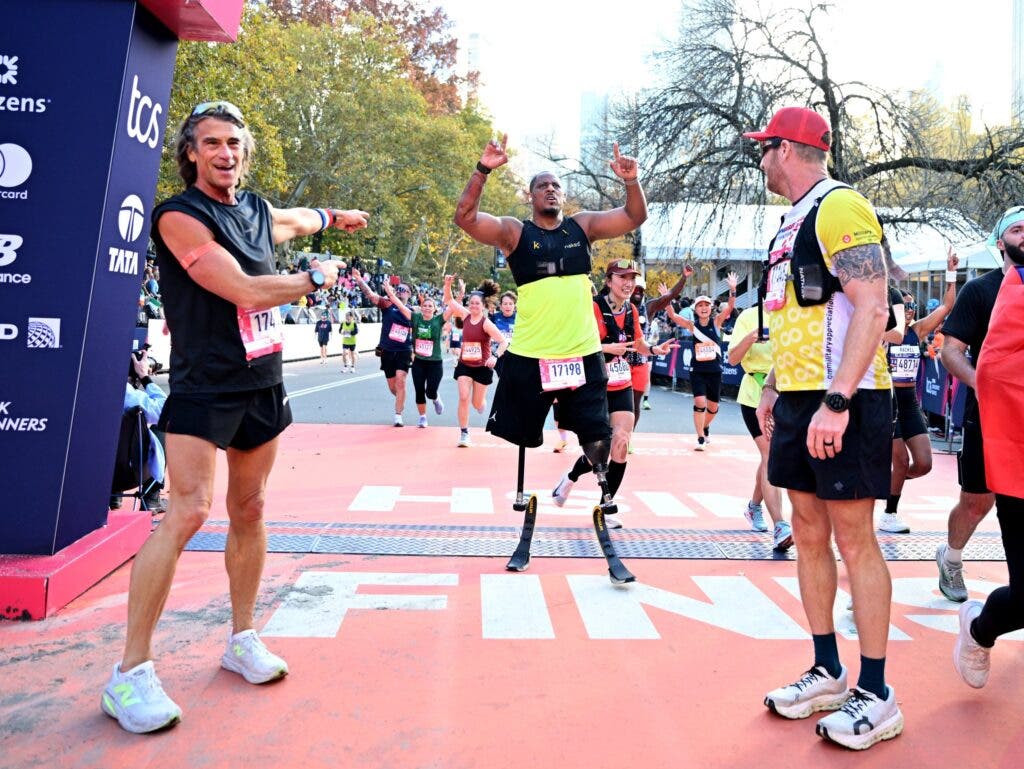
And then there’s Dave Obelkevich, 83, who has finished every five-borough New York City Marathon since that first one in 1976. On Sunday he lined up for number 49, his daughter beside him.
This is also the rare race where watching the last finishers come in is a highlight. This year the last one home was James Thomas, 78, known to his running friends as Marty. He crossed the line around 11:20 P.M., long after the winners had probably gone to bed. It was his 43rd New York City Marathon; he ran his first in 1980.
People call marathon Sunday one of the best days in New York. The reason is community: the bands along Fourth Avenue in Bay Ridge; the hush, then the noise, through Williamsburg as if they never stopped partying from the night before; the roaring crowds when you come off the silence of Queensboro Bridge onto First Avenue; gospel in Harlem; the strangers who yell your name when you need it the most.
This year, I’d need them more than I’d hoped.
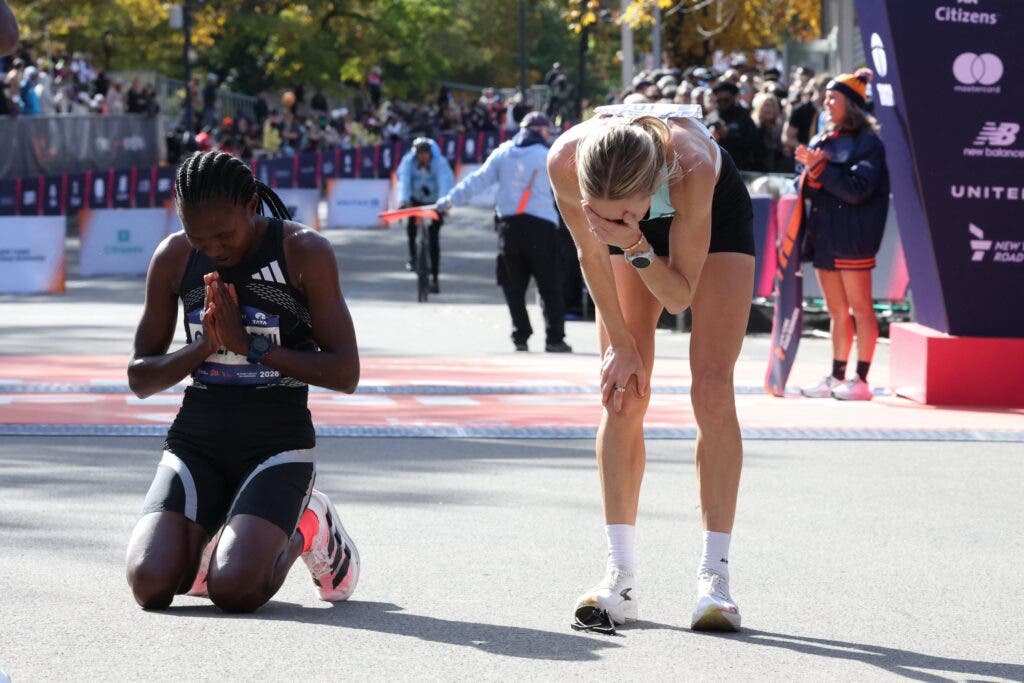
My race did not go as planned. The wheels came off on the Queensboro Bridge, as they do for so many. Even people who have never run New York know its reputation for unraveling runners’ dreams. It’s quiet. No crowds, no boost of energy. People are cursing. They’re cramping. If you feel good here, you have a fighting chance. If you don’t, you might be cooked. It turns out I was cooked. I knew I would finish, but the bridge let me know it wasn’t going to be the PR I’d hoped for.
Still, my blowup at the London Marathon in April had taught me something: If you can’t lock into the pace you want, lock into joy. So I power-walked when I had to, to keep my legs from fully cramping. But whenever a kid stuck a hand out, I ran for the high five. And when someone shouted my name with enough conviction, I started running again, as if the words were magic. The signs helped keep me entertained. The best riffed on the Elizabeth Holmes meme: “There’s only two miles to go, why would I deceive you?” (Spotted at mile 18.) And, this being New York: “Run If You Hate Wemby.”
I don’t think I have ever enjoyed Sour Patch Kids as much as the ones a pint-size candy dealer with a giant sack of them pressed into my hand at mile 21, somewhere in Harlem, with five miles still to go. Sour, then sweet.
On the subway home, draped in the orange poncho, I talked with other finishers and unpacked the day. Some were elated simply to have finished. Others were crushed by times I’d have been thrilled with. It reminded me: it isn’t about times. Mostly.
At the dinner table that night, over take-out Kung Pao chicken, my kids and I unpacked it again. I told them I wasn’t happy with my result. That I have a lot to think about in how I train for the next one. But I got it done, and I got through it mostly injury-free. (Toenail count pending.)
My younger daughter was proud of something too. At her second cross-country meet, she ran a minute and a half faster than her first. She’s learning to push herself, gently.
Then we talked about what keeps you going when things get hard. My older daughter said she reminds herself that humans were built to run. That this is what our bodies were made to do.
I’ll take that into the next training block. And be more prepared for the Queensboro Bridge.
