

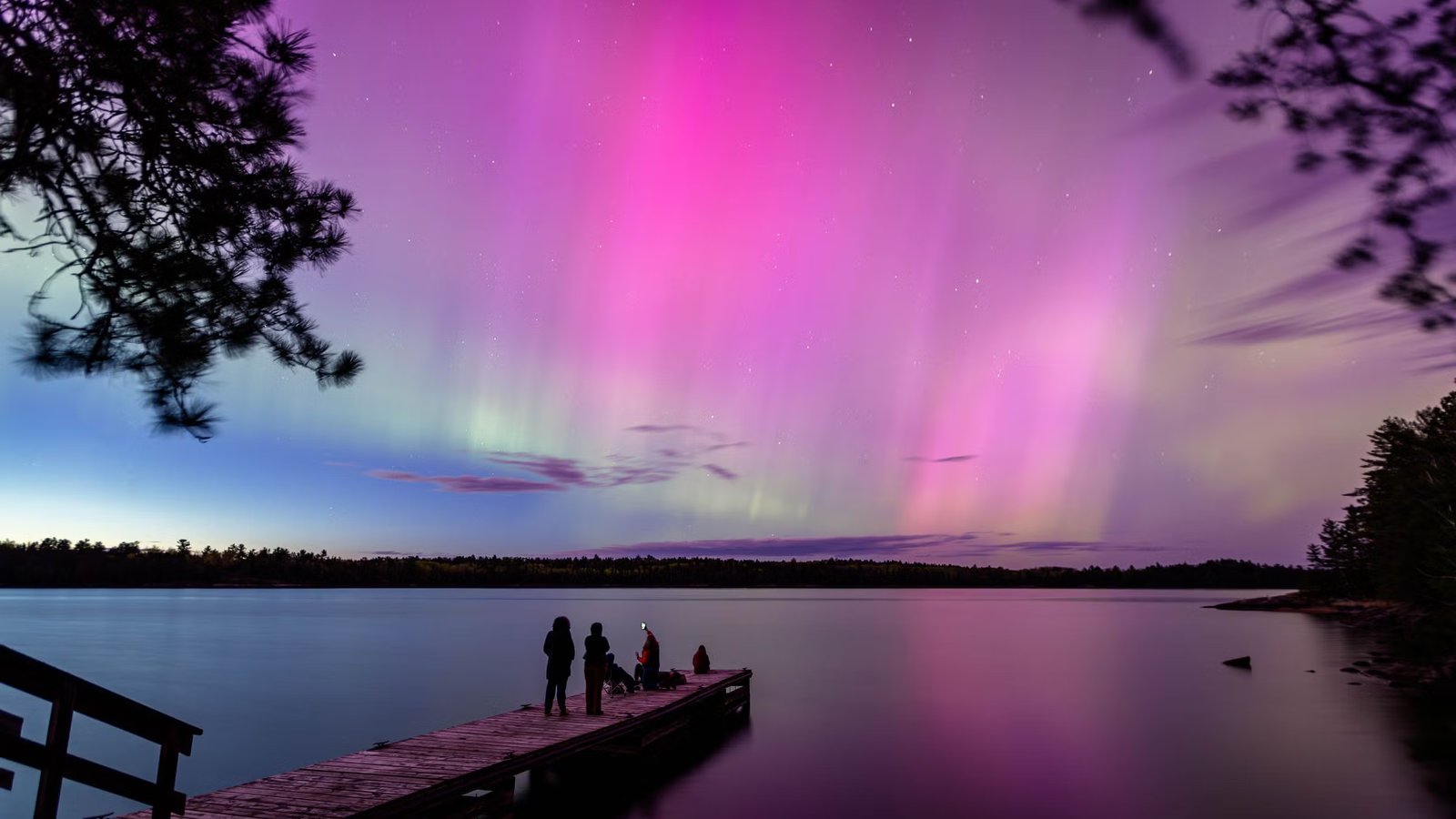
DarkSky International granted this remote preserve its top global conservation honor for shielding rare night views and connecting classrooms nationwide to the stars. This recognition comes as new industrial threats loom near the park’s watershed.
Voyageurs National Park Dark Sky. (Photo: Daniel Dendler)
Published November 12, 2026 03:05AM
For people living beneath the artificial glow of city lights, a sky filled with thousands of stars can seem like something out of science fiction. According to a recent National Park Service report, 80 percent of Americans cannot see the Milky Way from their homes.
But at Minnesota’s Voyageurs National Park, a roughly five-hour drive from Minneapolis, some of the darkest skies in the country reveal the heavens in dazzling detail. And thanks to the park’s growing lineup of in-person and virtual programs, you don’t have to travel to the North Woods to experience the magic.
This week, Voyageurs received one of the highest honors in conservation: DarkSky International’s 2026 Dark Sky Place of the Year award. The annual award honors individuals and organizations dedicated to protecting nighttime environments.
“What makes this award so meaningful is that it isn’t about Voyageurs being a beautiful place to see the stars. We were certified as an International Dark Sky Park in 2020 for that,” Christina Hausman Rhode, executive director of Voyageurs Conservancy, its nonprofit partner of the park, told Outside.
Since earning its International Dark Sky Park certification in 2020, Voyageurs has introduced some 8,300 students to the wonders overhead through its Virtual Dark Sky Classroom, welcomed nearly 6,000 people to Park After Dark and other nighttime programs, and drawn more than 1,300 visitors to six annual Star Parties. Add to that roughly 40,000 students nationwide who participate in Boreal Stargazing Week each year, and it’s clear the park’s reach extends well beyond its 218,000-acre boundary.
This honor recognizes what has happened since, Rhode added: “A shared commitment by the National Park Service, Voyageurs Conservancy, and our gateway communities to protect these skies and share them with as many people as possible.“

Voyageurs also stands out because it’s about 40 percent water—covered by interconnected glacial lakes—a fact that adds to its stargazing prowess. Sweeping views are unobstructed by foothills, and its 30 calm lake surfaces act as mirrors reflecting the constellations and making the dark-sky experience all the more impressive. This is no Great Smoky Mountains National Park with its 12 million annual visitors either. With roughly 200,000 visitors each year, Voyageurs offers plenty of wide open space to take in the starscape.
“Voyageurs doesn’t just protect some of the darkest skies remaining in North America,” Ruskin Hartley, CEO and executive director of DarkSky International, told Outside via email. “It’s the people behind that protection.”
Hartley said that from the land managers and rangers to community partners, there’s a shared commitment at the park to preserve the night through responsible lighting, as well as to share the park’s wonders with the public.
The Dark Side of Success
The recognition comes at the end of a particularly challenging year for wilderness conservation in northern Minnesota. In April, Congress passed and President Donald Trump signed a resolution that reversed a 20-year mining ban covering roughly 350 square miles of Superior National Forest near the neighboring Boundary Waters Canoe Area Wilderness. The move reopened the door to proposed copper and nickel mining operations.
The threat to Voyageurs? Well, what happens in the Boundary Waters doesn’t necessarily stay in the Boundary Waters. The two protected landscapes are linked by the Rainy River watershed, a sprawling network of lakes, rivers, and wetlands. (Incidentally, the Boundary Waters and Voyageurs, along with Ontario’s Quetico Provincial Park, form one of the world’s largest dark-sky regions.)

“Copper mining from a proposed Twin Metals mine would absolutely impact Voyageurs,” says Libby London, communications director for the nonprofit Save the Boundary Waters.
Once pollution reaches the water, it can spread quickly for several hundred miles, explains Pete Marshall, communications director for Friends of the Boundary Waters Wilderness, another nonprofit organization that’s been advocating for the Boundary Waters area for 50 years. Governor Tim Walz signed an executive order in August to block the state from permitting copper mines in the watershed, but that order expires three months after Walz leaves office.
In July, lightning-sparked wildfires fueled by hot and windy conditions forced the rare closure of Boundary’s entire million-acre wilderness, upending summer travel plans and prompting evacuations. Out of an abundance of caution, Voyageurs officials banned campfires and charcoal grills for six weeks.
Against that backdrop, Voyageurs’ Dark Sky Place of the Year award is a welcome conservation victory.
Turning Off the Lights
Protecting the night sky at Voyageurs has required more than simply keeping the lights off, of course. The park has had to rethink how it uses light in the first place. Under a new lighting management plan, outdoor fixtures were replaced with dark-sky-friendly alternatives that direct light downward rather than into the sky. National Park Service staff also began regularly visiting five locations throughout the park to measure the darkness using a sky quality meter, a device that measures the brightness of the night sky. On a scale where 22.0 represents the darkest natural night sky, Voyageurs averages an impressive 21.45—meaning that when the sun goes down, the stars really do come out.
And while the award puts Voyageurs in the spotlight, the park’s greatest achievement may be what happens when the lights stay out. For Rhode and the Voyageurs Conservancy, the hope is that the recognition inspires others to look up—and take action.
