

Published November 27, 2026 02:01AM
What should you do when your favorite trails aren’t being maintained? The question was sparked by a recent story in the Los Angeles Times about a concerned hiker who lugged nearly 100 pounds of construction materials up Mount Baldy. The hiker proceeded to install a DIY retaining barrier to widen a crumbling section of trail across a well-known section called Devil’s Backbone in August.
According to the LA Times, the hiker is named Mark Orr. On Reddit, some commenters thanked Orr for taking the initiative to improve a popular and dangerous trail, where hikers have fallen to their deaths in the past. Others saw videos of the repairs and raised concerns. Would Orr’s project—constructed from aluminum sheeting, steel wire, and rebar—really hold up against years of erosion and heavy foot traffic?
Within just a few weeks, runoff carved a deep hole in the dirt below the retaining wall, proving the naysayers right.
“The first thing is, it was nothing but well-intentioned by somebody who loves the mountain and wants it to be safer for everybody,” Orr told the LA Times. “I totally get that my first crack at this, I didn’t do everything right, and I’m actively working with the San Gabriel Mountains Trailbuilders to get it right before this winter.”
As a longtime trail worker, I can’t condone Orr’s trail work on Mount Baldy, even if his heart was in the right place. But after years of building trails and working with volunteers, I also know that unauthorized trail work happens all the time. I’ve seen poorly constructed drainage ditches, wobbly rock staircases, and retaining walls I didn’t trust to hold my body weight.
I have also seen hikers clearing away brush, pruning branches, and cutting and then removing downed trees that have fallen across the trail. I see people with chainsaws strapped to their dirt bikes or loppers in a side pouch of their backpacks. The work these hikers, cyclists, and dirt bikers do is sometimes illegal. It’s also necessary. Without them, our trails would be in worse shape. And given the state of our public land management agencies, I can’t blame them for choosing to go rogue.
But amongst ad hoc trail work, there’s a sliding scale between harmful and helpful. And I have some thoughts on when and where it’s justified to do unsanctioned trail work. Spoiler alert: if you’re planning on building walls, moving boulders, or cutting down trees, you need to go back to the drawing board.
Professional Trail Workers are Disappearing
One of my friends, a U.S. Forest Service trail manager in Tennessee who asked not to be named in this story, has gone to great lengths to empower local citizens to perform trail work themselves. Thanks to his efforts, volunteers are now certified to use chainsaws on Forest Service land and operate independently. When they come across downed logs or a brushy trail, they don’t have to seek permission to organize a trail maintenance day. They just get to work.
Unfortunately, not every national forest has the manpower to do this. Land management agencies like the Forest Service and National Park Service are in the midst of unprecedented budget cuts and staffing shortages, and our trails are suffering. Since President Trump’s second inauguration in January 2025, the Forest Service has shed more than 5,000 jobs, including thousands of field-going employees like rangers and trail workers. An internal Forest Service report leaked last year came to a dire conclusion: “Many districts are unable to complete basic trail maintenance. Backcountry trails are being abandoned. Deferred maintenance is exponentially compounding.”
For 2027, Trump is proposing a further 44 percent cut to the Forest Service’s operations budget, which covers employee salaries. The agency has been gutted. Some forest districts no longer have even a single trail worker.
The Forest Service says that it hopes to offset these challenges through its volunteer program, which it overhauled in 2024. But the agency is now so decimated that some districts can’t even provide mandatory training to volunteers. If you’re a would-be volunteer hoping to use a chainsaw to clear your favorite Forest Service trail, you’re supposed to take a three-day training course first. But many ranger districts no longer offer chainsaw training, forcing volunteers to find a non-profit that offers a similar course, which usually means hours of travel and paying for overnight accommodations.
Go Through Official Channels First
Despite those challenges, you should reach out to these agencies and local groups before picking up a tool and heading to the trail. In some cases, you can get in touch with the organization, or land manager, that’s legally responsible for trail maintenance, like the city, county, or state parks and recreation department. In other situations, it may be easier to contact a volunteer group that’s already connected with your local land managers.
“Contacting your local land manager or volunteer group is how you learn the basics,” Sam Donnelly, the acting executive director at the Tahoe Rim Trail Association told Outside. “It also builds goodwill and makes things official. Land managers can sign an individual volunteer agreement with you if there’s no volunteer organization in the area. All of this helps to prove that you want to show up and put in the work.”
Donnelly would know. Maintaining the 165-mile Tahoe Rim Trail is a joint effort between the organization he leads and three national forest units, a state park in Nevada, and another non-profit group—not to mention dozens of volunteers.
He understands that some people want to speed up the process by doing unsanctioned trail work. But he does not encourage it. “It’s a trust-building thing,” he said. “We didn’t get here overnight, but we have the impact we do now because we’ve done things the right way.”

Even if you’re convinced there’s no one out there maintaining your local trails, you might be pleasantly surprised. A directory of trail groups on Pinkbike lists over 1,600 organizations in the United States. Shoot your local group an email, and chances are they’ll be happy to put you to work. In areas with established groups, it might take a while until your favorite trail or pet project makes it onto the calendar. But if you show up consistently, take classes and get first aid certified, you can likely become a trip leader and have input on which trails need attention.
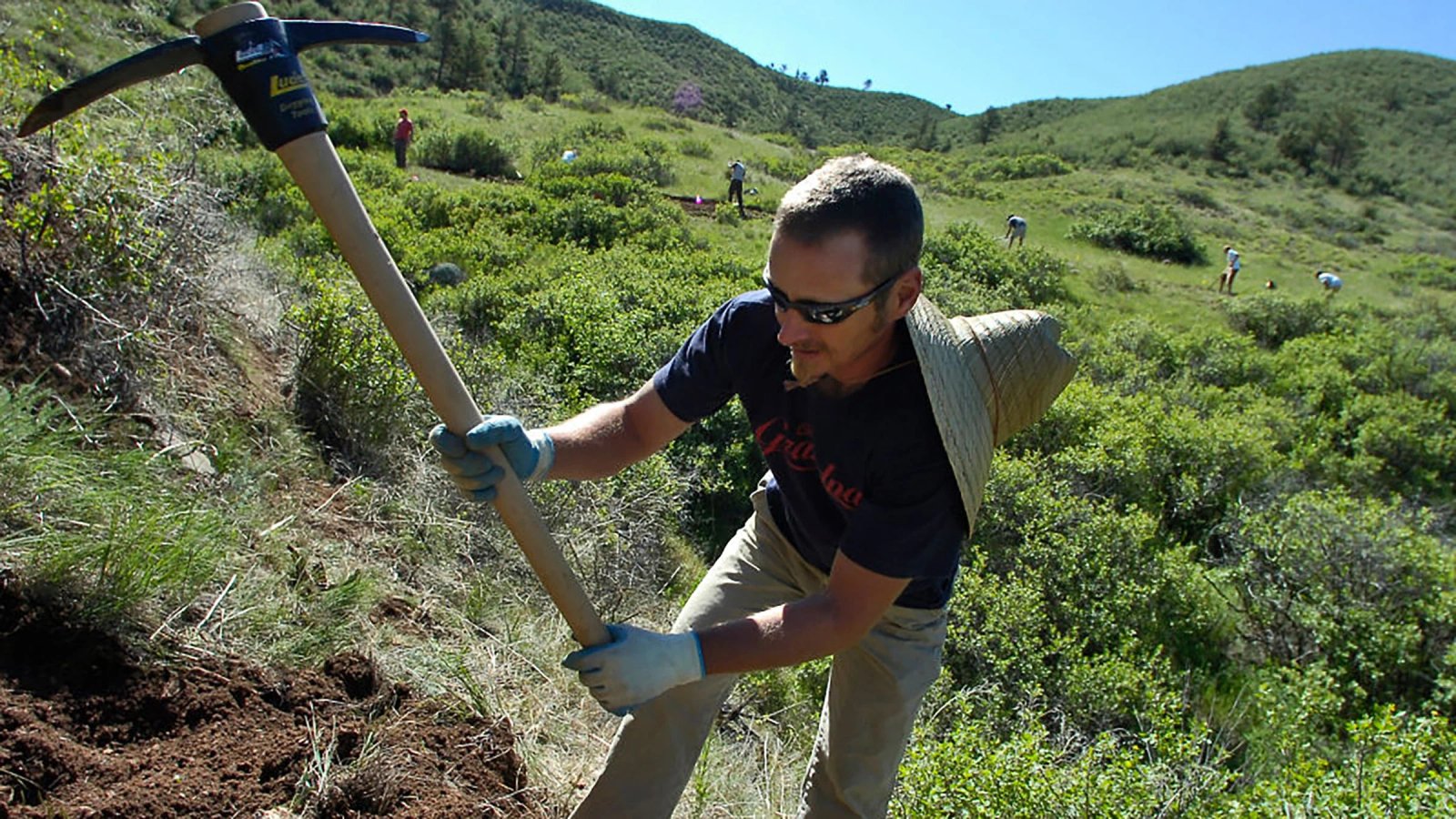
In areas where trails are more remote and less trafficked, volunteer trail work is often a more casual affair. My mother, a lifetime hiker who lives in central Pennsylvania, was handed a pair of loppers and told she was in charge of maintaining a three-mile section of the Mid-State Trail—without any oversight—on her very first day as a volunteer. All it took was one email and a 15-minute demonstration, and she was official.
Even if a volunteer group in your area isn’t very active, it’s probably worth reaching out. A group might not have enough active members to plan work trips, but could still provide valuable intel. They can connect you with land managers, loan you tools, or give you keys to unlock gates for quicker trail access. Plus, your volunteer hours may count towards them receiving a funding grant in the future.
Trail Work Is Harder than You’d Think
If you’re truly unable to work with a land manager or volunteer group, I believe there are times when unauthorized trail work is the right choice, even if it is prohibited by the letter of the law.
Trail work exists on a spectrum in terms of complexity. The most complicated tasks, like building bridges, erecting retaining walls, and constructing new trails from scratch, are really engineering projects. The simplest tasks, like trimming back overgrown brush, require almost no training. Most trail work exists in a gray area between these two extremes.
Complex trail-building projects are not the place to be doing unauthorized trail work. For one thing, they’re often far more involved than most people realize. Even building a small retaining wall takes a lot of effort. The rock or lumber used in the wall generally extends far underground, and is reinforced with rebar and lag screws. The structure is filled with tons of crushed rock and dirt. Staircases, water bars, grade dips, and switchbacks are all similarly complex projects.
“Trail building, just the science of it, has come a really long way,” Donnelly said. “There’s a lot more thought put into it than you’d expect. A retaining wall is a good example. It takes weeks to build one so that it will last a hundred years. A normal person who thinks they can just go out and do trail work on their own is probably just creating more work for the people who come after.”
Even if you think you know what you’re doing, you could expose yourself to legal trouble by taking on serious trail improvements without approval. Rerouting even a small section of trail often requires an environmental review, as does building a new bridge or boardwalk. You could build a perfect retaining wall, and land managers will still remove it to comply with the rules and regulations they must follow. If you’re interested in this kind of work, you need to volunteer with an official organization.
It might not be glamorous, but the dead-simple tasks like pruning and cutting branches are really the only ones appropriate for unofficial trail work. The main reason for this is that routine maintenance doesn’t change a trail’s character. You aren’t deciding whether a new retaining wall is appropriate on a wilderness trail. You aren’t building berms for mountain bikes on a multi-use trail. You aren’t digging ditches across the trail where you think water erosion is an issue. All you’re doing is restoring the trail to what it is supposed to look like in the first place. As long as you don’t leave “punji sticks”, the sharp stubs that are created when you don’t prune a branch flush to the ground or a limb, it’s hard to go wrong. For myself, that means tossing a small hand saw or pair of loppers in my day pack when I go hiking or riding in areas where I know trail maintenance is spotty. I’ll spend an hour of my time cutting back any brush that touches my body as I walk past.
It’s boring work, and I rarely finish brushing out an entire trail before I have to move on. I don’t get the same sense of accomplishment from pruning branches as I do from moving boulders to build a staircase or cutting down trees to build a log bridge. But it’s important work, it’s hard to mess up, and no reasonable land manager would give you grief for doing it. In general, trails won’t disappear when a bridge gives out or a staircase falls apart, so long as the rest of the trail is in good condition. But if the entire length of a trail disappears under brush and downed logs, it might be abandoned entirely, or even removed from official maps. Once a trail is decommissioned, it’s far more difficult and costly to build a new trail to replace it, because new trails require lengthy environmental reviews. Simply put, if you love a trail, doing the easy, routine maintenance to make sure it remains passable is the best thing you can do.
