

Published March 18, 2026 07:32AM
A few years ago, Berne Broudy went to her happy place. On most days, like that day, that meant being on a mountain bike riding singletrack trails with friends near Burlington, Vermont. But that day was not most days. A man she’d never met arrived for the group ride. Greg Durso, who is now 40, suffered a sledding accident in 2009 that left him paralyzed from the waist down. He mounted up on his three-wheel adaptive bike and the group rolled off.
The Hinesburg Town Forest offers classic New England riding with hand-built “rake and ride” trails that roll over roots and rocks with short, punchy climbs. None of that presented a challenge to these experienced bikers. The narrow wooden bridges, however, were a different story. A two-inch mountain bike tire had plenty of room to roll across. Durso’s 36-inch-wide adaptive bike, however, could not.
“Greg is clearly an accomplished mountain biker but we kept having to stop to carry him across the bridges because they were six inches too narrow,” recalls Broudy, a writer and president of the Richmond Mountain Trails a non-profit that builds and maintains trails in this swatch of Vermont. “We have volunteers. We have lumber. This seemed like an incredibly fixable problem.”
That problem eventually did get fixed, but it was what happened along the way that literally blazed new trails in the mountain biking world. It showed how a simple shift in perspective can profoundly expand the riding experience for everyone. It helped reframe how trails are designed, who they’re built for, and what mountain biking can look like when access isn’t treated as an exception.
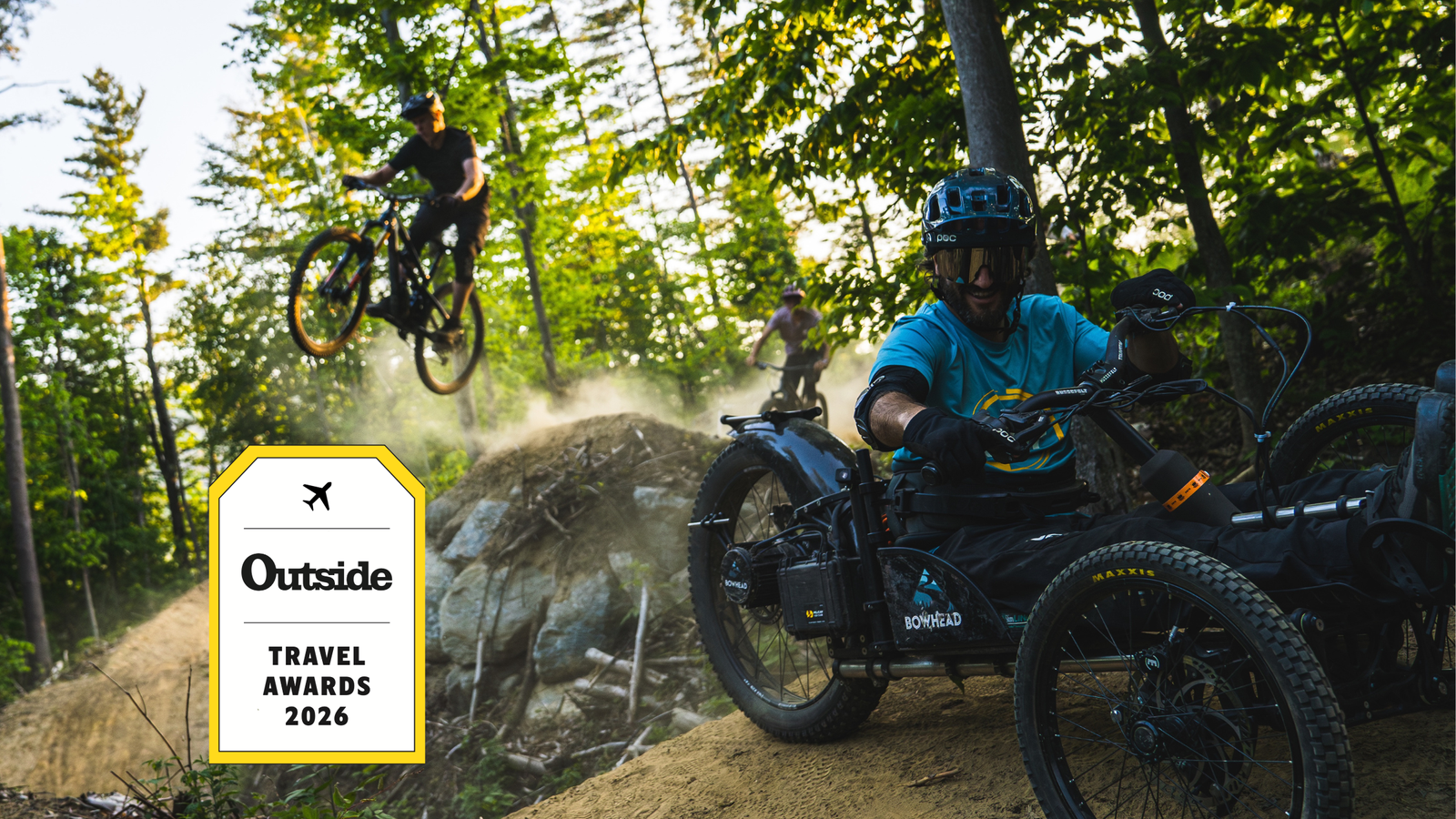
Now, about 30 miles east of Burlington, you’ll find The Driving Range, the first fully adaptive mountain bike trail network in the country, maybe even the world. Built from the ground up, the network, which officially opened in 2023, allows adaptive riders to bike independently, progress their skills, and ride alongside friends with no special accommodations.
“That’s the genius of it,” says Durso, who co-led the project. “You would never know it’s an adaptive trail network.”
What makes a trail adaptive rests in the details: clear sightlines for riders closer to the ground, no tippy off-camber climbs, and trail widths that match the girthiest of adaptive-bike wheel spans, about three feet. Plenty of such trails already exist — think Jackson Hole, Park City, and Whistler just to name a few — but often through retrofits of existing trails. What sets The Driving Range apart is how every main line was built specifically with adaptive riders in mind. No shunting them to a bypass.
“A lot of times people think adaptive trails have to be easy and dumbed down,” Durso says. “We did the exact opposite of that.”
The Driving Range is relatively small with about 4.5 miles of trails winding through a maple syrup operation on land donated by the owner of nearby Bolton Valley Resort. In hilly Vermont, though, that mileage goes a long way. Short, steep climbs, rocky tread, and tight turns mean those miles feel long. Multiple laps can easily turn into hours. It’s become a destination. Cruise the trailhead and you’ll see cars from neighboring states and Canada.
A movie about the project, Best Day Ever, has won multiple awards, including the 2025 Best Film: Mountain Sports category and the Audience Choice Award at Banff Centre Mountain Film Festival. It also won the Audience Choice Award for Overall Documentary at the Heartland International Film Festival.
The Rise of Adaptive Adventure
The success of the Driving Range didn’t happen in a vacuum. Vermont ranks as one of the richest mountain biking states in the country, with more than 1,200 miles of trails spread across a small, densely packed landscape. The Vermont Mountain Bike Association, which supports 28 local chapters statewide, has spent years working alongside Vermont Adaptive and the Kelly Brush Foundation to understand how its existing trail systems could better serve adaptive riders.
That effort has grown into a statewide adaptive assessment program, with more than 150 miles of trail now designated as adaptive-friendly or adaptive-optimized, meaning either safely passable or purpose-built for adaptive bikes. The key is to do the work with adaptive athletes, not for them, says Nick Bennett, executive director of VMBA.
“Adaptive riders don’t suddenly want to ride easy trails after their injury,” he says. “They want the same progression, the same challenge, the same fun everyone else wants.”
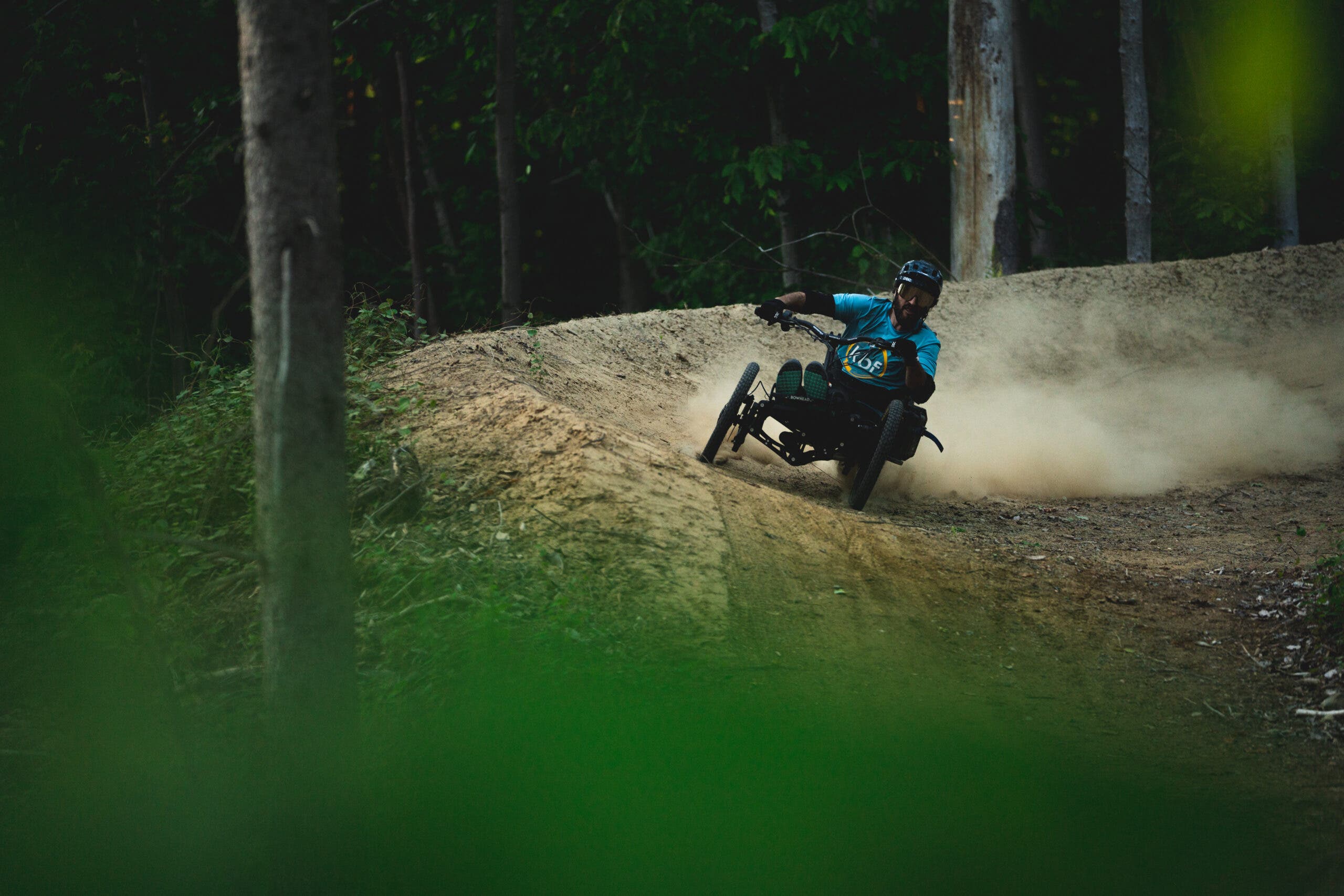
Part of why this is happening now and not decades ago comes down to technology. Adaptive mountain bikes have undergone a quiet revolution in recent years. Reliable e-assist motors, improved battery life, and articulating front suspensions—most notably from brands like Bowhead—have transformed what riders can handle. Three-wheel bikes can now lean into corners, climb steep grades, and navigate technical terrain that would have been unthinkable not long ago.
“The technology finally caught up,” says Joe Stone, co-founder of Dovetail Consulting, which advises land managers and trail groups across the country on adaptive access. “It changed everything.”
Stone points out that the potential interest in adaptive trails is far larger than most people might assume. More than 65 million Americans live with some form of disability, including roughly 13 percent with a significant mobility limitation. Many of those people aren’t visible on trails today, not because they don’t want to be there, but because the opportunity hasn’t existed.
“If you open the door,” Stone says, “people will go through it.”
That’s why projects like the Driving Range are increasingly being viewed not as niche experiments, but as models. In mountain bike mecca Bend, Oregon, the local mountain bike association in summer 2025 used a tax visitors pay to stay in town to build a new, ground-up downhill system specifically with adaptive riders in mind. In southwest Colorado, the 1,800-acre Durango Mesa Park is being developed as one of the largest bike parks in the country, with adaptive trails incorporated from the outset. Public land agencies, including the Forest Service and National Park Service, are also rethinking how all trails are assessed and shared.
For Broudy, the takeaway isn’t about claiming firsts or checking boxes. It’s about what happens when barriers disappear. “I hope adaptive trails make people curious and interested,” she says. “It just makes it more fun for everyone. I mean, how great is it when you have even more friends to ride with?”
