

Published March 19, 2026 10:11AM
Over the 15 years I’ve worked for Outside, I’ve tested more than 300 jackets. A new batch arrives each fall, and each spring, most leave my closet for the donation box. But there’s one type of jacket that always sticks around in my garage: the breathable midlayer.
I hoard these jackets because they work so well here in New Mexico, where I live. They keep me warm in the ski mountain parking lot at 6 a.m. when it’s 15 degrees, but let off extra heat once I get on the skin track. They also fit well under a shell when I ride the lift. Lots of companies make a high-quality midlayer, but I love the Black Diamond First Light Stretch Hoody, Arc’teryx Atom Hoody, the Patagonia Nano-Air Hoody, and the Stio Dawner Hoody. Fellow Outside gear tester Frederick Reimers echoes some of those picks and names a few more in his 2026 guide to midlayers.
Over time, I’ve developed what I consider a “dialed in” ski kit that I can depend on for anything—anchored around this type of midlayer. There’s never been a question about what to pack, and I preach about my kit to anyone who asks for layering advice.
This winter, however, everything changed. After a decade of feeling like these standard, well-vetted breathable midlayers were a forever piece in my setup, I noticed that several brands have called the midlayer formula into question. That’s minor news for some people, but for me, as a midlayer evangelist, it’s been a shock.
Patagonia Goes Ultralight
I first noticed the change with Patagonia’s Nano-Air Ultralight Freeride Jacket. When I saw one in October and tried it on, I was immediately dismissive. It felt more like a windbreaker with a wispy-thin layer of insulation than a serious layer for winter weather. I thought the piece was a marketing gimmick for Patagonia, an attempt to expand or diversify their Nano-Air line.
But then I started talking to people like Joe Jackson, a long-time gear reviewer at Outside, who had tested the Ultralight for nearly a year and was a total believer. He was backed up by Corey Simpson, Patagonia’s in-house PR rep, who’s always shot straight with me. Both of them argued that the Ultralight is the future.
Patagonia’s Nano-Air Ultralight Freeride Jacket
The difference between the Ultralight and the midlayers I named earlier is that the Ultralight uses 20 grams of synthetic polyester insulation instead of 60. On paper, 20 grams sounds like almost nothing, but it turns out to be a smart, strategic amount.
Maggie Elder, a senior designer at Patagonia who designed the Ultralight, told me that while 60 grams has been the standard for midlayers, they had discovered that it was too much for people who were working hard. “I was watching people use their Nano-Airs for the first 10 minutes of a skin and then packing them away until the sun went down,” she said. “People I was skiing with weren’t complaining or saying this is too warm, but they were choosing a different system.”
The more I thought about it, the more I had to (begrudgingly) agree. I’d spent years skinning in 60-gram breathable midlayers and was always sweaty at the top. That didn’t bother me because the jackets dry quickly, but I’d never considered whether a similar jacket with less insulation would be better.
Turns out Patagonia had been working on a 20-gram version for years. The problem was they couldn’t immediately find 20-gram insulation that stayed inside the liner and face fabrics. Elder and her team had a closet full of pillow cases made from jacket liner fabrics that they would stuff with various iterations of the insulation. Then, they’d put the pillow cases through abrasive torture tests to mimic the wear and tear a user might subject a jacket to over a decade’s worth of use.
Finally, Patagonia landed on a version that was stable enough and built the climbing-focused Nano-Air Ultralight, followed by the Freeride—the same jacket, but with pockets and a roomier cut. Elder took early versions of Freeride to a company ski test in Argentina and said the athletes who used the jacket refused to hand it back after testing.
“I think what we’ve landed on is a piece that might be annoying for five minutes at some point in your day, but for 90 percent of what you’re doing, it’s going to be perfect. It’s a piece that you can put on and leave on and has a much wider range of use,” Simpson said.
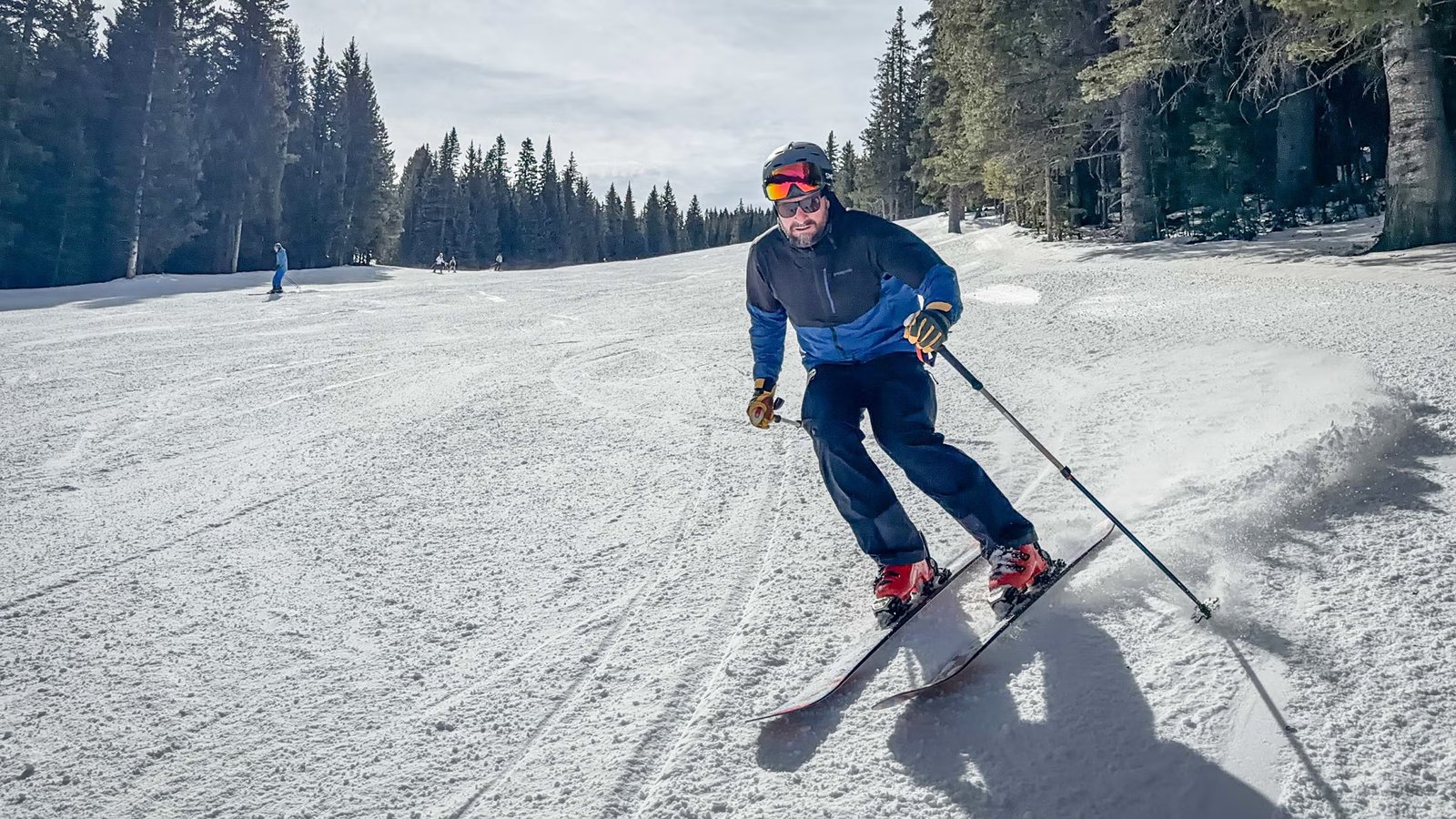
To test Simpson’s claim, I wore the Freeride non-stop for the past week while skiing in Santa Fe and bike commuting and running errands here in Albuquerque. There were moments when I worried I’d made the wrong choice, like sitting on the lift at 11,000 feet with the wind tearing through the thinner construction, which left me slightly chilled. But those moments were fleeting. I was plenty warm any time I was exerting energy, and I was actually much more comfortable and noticeably less sweaty when working hard, such as while carrying all my kids’ ski gear from the car to the lift or during a bootpack to reach a patch of better snow.
On the bike, the jacket cut the wind on a 35-degree morning but breathed exceptionally well when I huffed up a hill, never once leaving me too hot. Running errands, I was in temps as low at 40 degrees and as hot at 65. While I felt like I might be approaching my limit on the warm end, I never once felt like I had to tear it off.
Flylow and the TC Vest
The case for moving away from more traditional midlayers was further solidified when I hung out with Dan Abrams, the co-founder of Flylow, who is also arguing that the traditional insulated midlayer is not the way to go.
To replace it, Flyow offers a couple of different options, but the one that most occupies the same new midlayer space is the TC Vest, which launches in Fall 26.
An obvious fact: Vests, thanks to their lack of sleeves, will always breathe better than jackets. The TC’s design makes it even a better midlayer option than a traditional vest. Inspired by a vest Abrams bought in Japan, the TC has a v-neck and high cut that sits right at your belly button so it feels like it’s barely there compared to a more traditional down or synthetic vest that goes for full core coverage. It’s also ultra thin, which helps with movement, but it’s packed with a high-loft synthetic insulation called Air Flake, which, while light and feathery, provides a surprising amount of warmth.
To stay warm on cold days, Abrams and others at Flylow layer the TC over a wool or polyester flannel. Both options are slightly thicker and warmer than traditional baselayers but don’t inhibit the vest’s breathability.
I’ve had an early sample of the TC Vest for several weeks and started out a skeptic, but am now a convert. There were times when my arms were cold—on early-morning dawn patrols and when the wind was howling on the lift—but my core never got chilled, and I never once got too sweaty while skinning or skiing.
Accepting the Future
I’m not emptying my garage midlayer stash just yet. Like a good used car, my favorite breathable midlayers function just fine and have served me well over the past 10 years. But like people converting to hybrid or electric cars, I’ve seen the future—and I foresee the day when I’ll eventually relegate my current midlayers to the thrift store and replace them with something like the Patagonia Nano-Air Ultralight or Flylow’s TC vest.
I think the major shift I (and many others) will have to go through is an acknowledgement that we’ve been too hot for too long. By shifting to thinner midlayers, we might be cold at times, but those moments will come and go quickly. The majority of the time, our temperature will be better regulated—and we’ll be more comfortable.
