

It’s 8:45am on a rainy weekday morning in Paris, and I’m standing in what used to be a traffic lane in a busy neighborhood near the city’s largest train stations. Less than a block away, cars are streaming by in the rush hour commute. But here, workers have torn up the pavement and replaced it with a newly-planted park with trees, a protected bike lane, and a wide gravel path for pedestrians. Where cars once drove, someone is walking his dog.
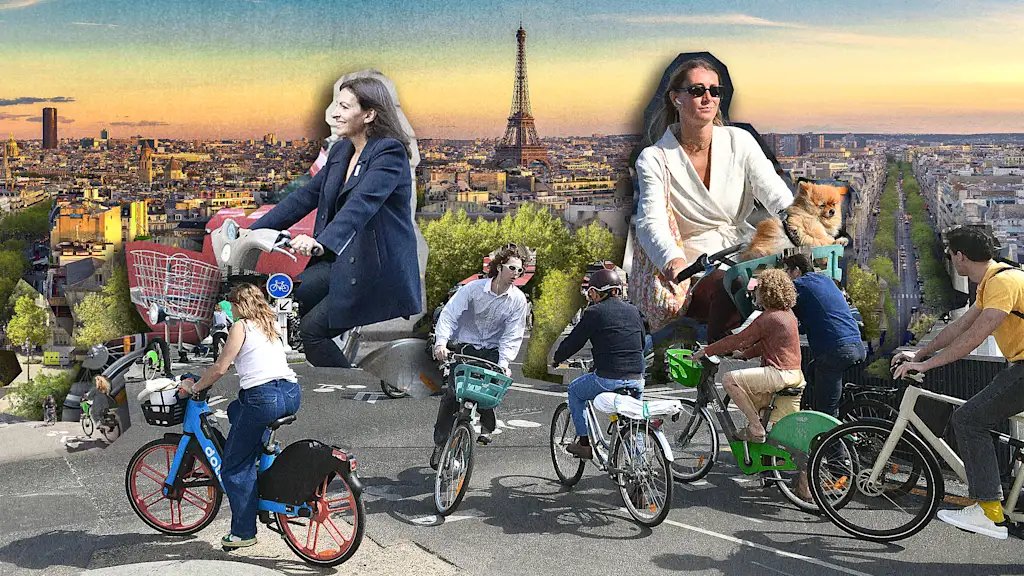
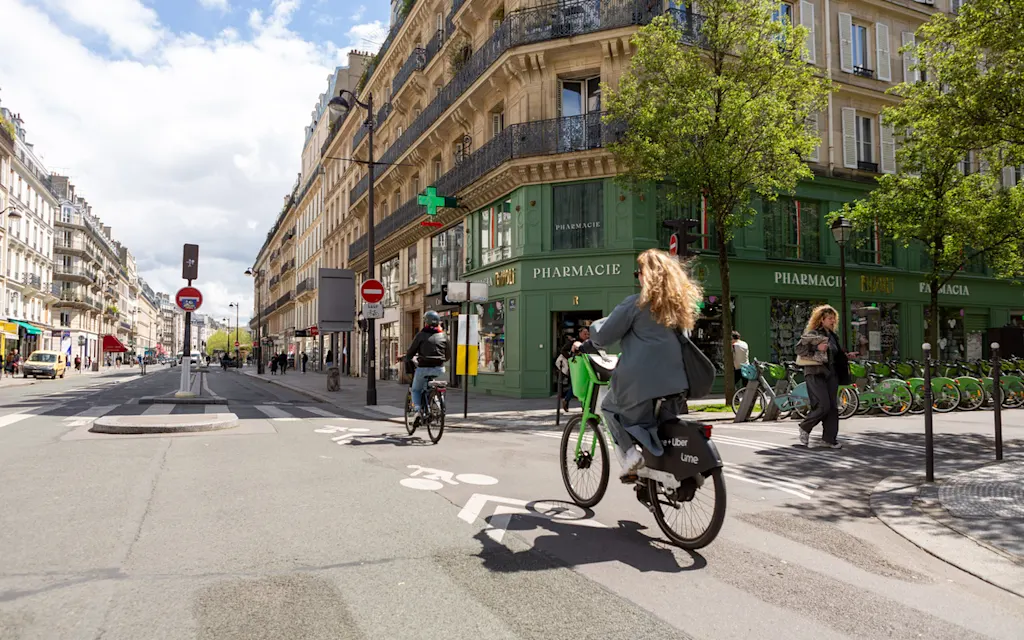
It’s one of hundreds of streets in Paris that have been redesigned over the past decade as the city radically transformed to reduce pollution and make neighborhoods more livable. In front of elementary schools, around 300 streets have been closed to cars. Last year, voters approved a plan to close another 500 streets to traffic. Thousands of parking spots have been swapped for trees. More than 900 miles of bike lanes now thread through the city. On the Rue de Rivoli, a major road that at one point had seven lanes dedicated to traffic and parking, the city flipped the street: most of it now belongs to bikes, with only a single lane left for cars.
As I walked around the new park, a crowd of city officials gathered for an opening ceremony. I asked someone nearby what the area had looked like before, and he pulled blueprints out of his briefcase to show me. A traffic island had been surrounded by a sprawling roundabout. On the western side of the intersection, there were multiple lanes of traffic and rows of parked cars on each side. The new park replaced that entire part of the street.
It was the last official event for Paris mayor Anne Hidalgo, a few days before the next mayoral election. Over two terms in office, from 2014 to 2026, Hidalgo led one of the fastest and most comprehensive street redesign campaigns ever attempted in a major global city.
“This project is symbolic of what we’ve done over the last 12 years, reshaping the streets and the city,” Christophe Najovski, the city’s deputy mayor in charge of green spaces and biodiversity, told me. “This used to be a roundabout where cars were turning around. Now it’s a real square. Pedestrians can enjoy the space that was formerly given to cars. We’ve planted a little urban forest with more than 100 trees. This is what we’re trying to make: a city for the people, and also a city that will be adapted to climate change.”
In other cities known for their commitment to cycling, like Copenhagen and Amsterdam, bike and pedestrian infrastructure evolved incrementally over decades. Hidalgo pushed major changes forward despite opposition from drivers and some residents. At the event, she listed some of the city’s related projects, like the Place du Catalogne, where another sprawling concrete roundabout is now filled with hundreds of trees. “There are many people who would tell you that this was not possible,” Hidalgo said in her remarks. “But we persevered.”
This is the story of how urban innovation can happen quickly at a large scale, and how a leader used political risk-taking and moments of crisis to force change in a legacy system dominated by cars. For other car-centric cities, it’s an example of how streets can begin to be reclaimed for people.
