

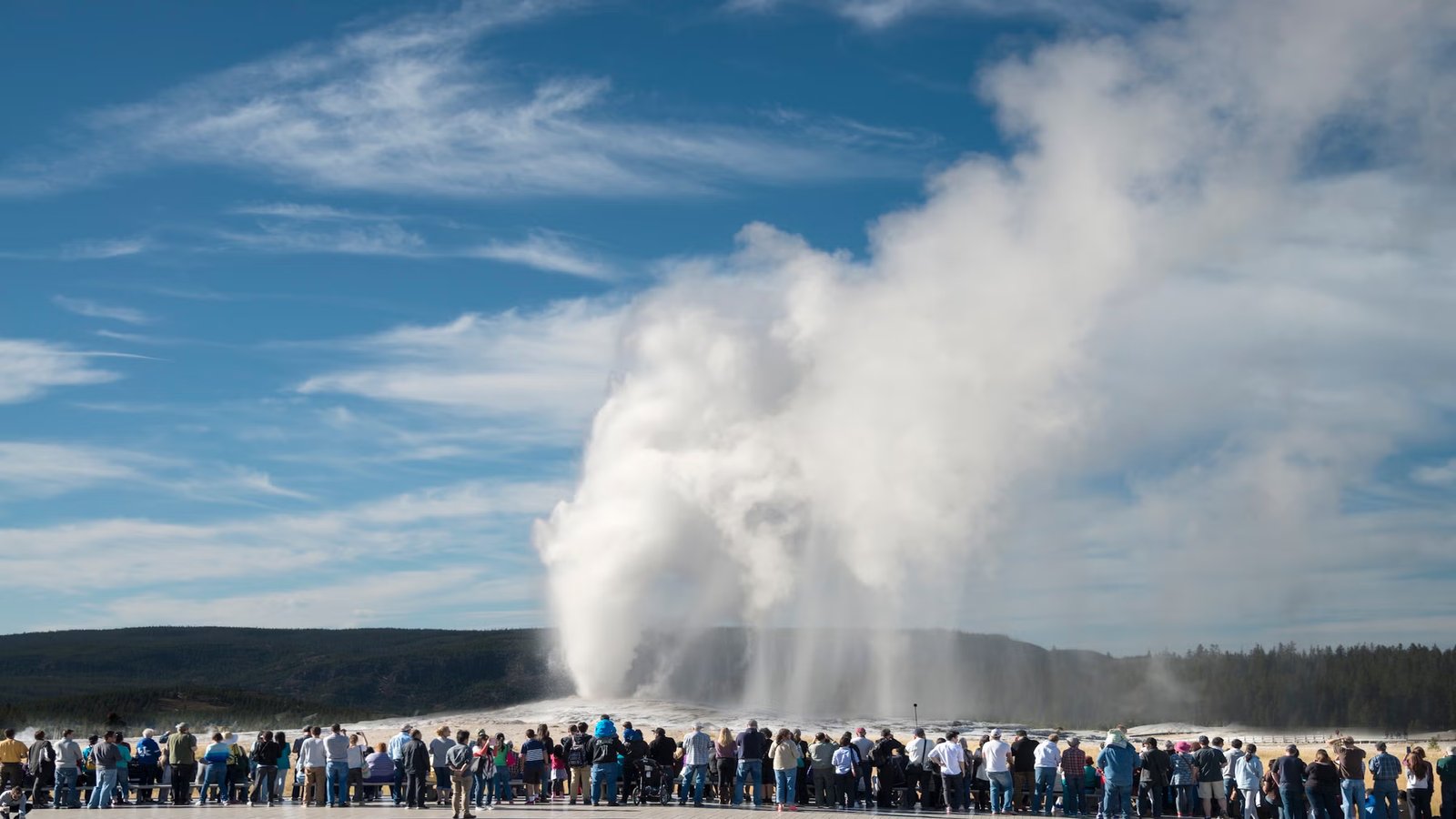
Scientists finally measured exactly how much water Yellowstone’s most famous geyser shoots into the air during a given eruption.
Old Faithful is one of the most well-known, but Yellowstone National Park is home to about half of the world’s geysers (Photo: Ed Freeman/Getty Images)
Published April 28, 2026 11:05AM
If you’ve ever wondered how many bathtubs’ worth of water Old Faithful spews upwards on any given eruption, then you’re not alone. A team of researchers in Yellowstone National Park asked that very question and, through a series of experiments, determined the answer to be roughly 140 tubs, or an average of 7,370 gallons annually.
“This means that an average Old Faithful eruption is equivalent to four to five concrete mixer trucks or about 140 standard household bathtubs!” wrote the researchers in a statement. “It would take about 90 average Old Faithful eruptions to fill an Olympic-size swimming pool, which typically holds approximately 660,000 gallons.”
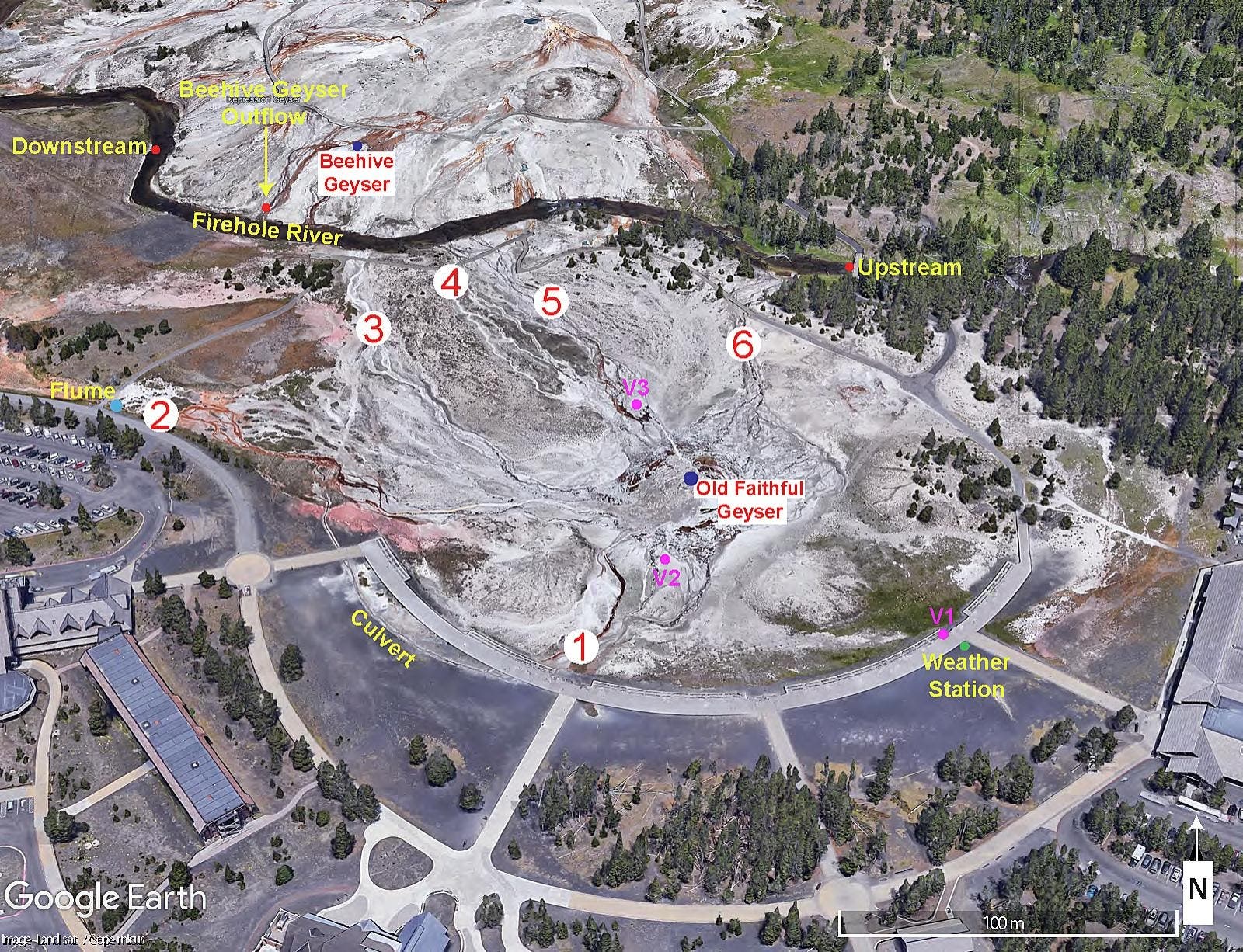
Scientists from the U.S. Geological Survey (USGS), the University of California, and the National Park Service quantified the total volume of water erupted during 45 eruptions of Old Faithful Geyser in April 2025, along with the associated heat and mass. They did so by placing a portable flume in one of the geyser’s outflow channels and determined how much water flows into the geyser from the nearby Firehole River. Paired with the amount of steam and heat released during an eruption, they determined that eruptions ranged from 3,223 to 11,703 gallons. Shorter eruptions, unsurprisingly, erupted less water than longer ones, lasting between three and five minutes.
The study, published in the Journal of Volcanology and Geothermal Research, is among the first of its kind to formally estimate the volume of water erupted from a single geyser explosion. Annually, the geyser also discharged 63 tons of chloride, 3.9 tons of fluoride, and 63 gallons of arsenic.
Natural geysers are rare: there are fewer than 1,000 worldwide. Approximately half of those are found in Yellowstone National Park, which the scientists wrote “reflects the special conditions needed for their formation.” Not only do geysers require water and heat, but also a certain underground architecture—essentially subsurface piping—to facilitate the geothermal activity. Aside from geysers, there are more than 10,000 other features found in the Yellowstone area, including fumaroles, mud pots, and thermal springs.
Perhaps the most well-known of the world’s geysers is Old Faithful, so-named for the regularity of its eruptions every 90 to 94 minutes every day, according to the USGS. Old Faithful is located in the park’s Upper Geyser Basin, the densest concentration of geysers on the planet, with about 150 geysers in just one square mile.
Although impressive, the findings don’t prove that Old Faithful is the park’s most powerful geyser. About three miles to the southeast of Old Faithful is Lone Star Geyser, a solitary geyser accessed by a 2.4-mile service road. The volume here ranges from 4,068 to 7,423 gallons on average—that’s 140 bathtubs’ worth.
Steamboat Geyser in Norris Geyser Basin—the tallest eruptive plume in the world—spewed on average between 35,400 and 142,125 gallons of water between 2018 and 2020.
“Measuring the volumes of water erupted from Old Faithful is important because it can serve as a baseline to better enable detection of changes resulting from earthquakes, climate variability, changes in subsurface heat, and infrastructure development,” wrote the researchers. “This in turn can inform the management of tourism around one of the most iconic natural wonders in the US National Park system.”
The study authors say that their new framework for studying geysers may improve researchers’ ability to monitor future changes in geyser activity.
Tips for Viewing Old Faithful Eruptions
Seeing Old Faithful is a bucket list item for many National Park enthusiasts, but the area can often feel overcrowded and rushed. Here are some smart strategies to make the most of your Yellowstone geyser viewing:
- Timing: Old Faithful erupts every 90 minutes, and park rangers post predicted times at the visitor center daily. Early mornings and late evenings tend to be less congested.
- Check In: Rangers at the Old Faithful Visitor Education Center can offer additional insight into other geyser eruptions nearby that may be less crowded. While Old Faithful is Yellowstone’s headline act, there are dozens of other hydrothermal features within a quick walk.
- Viewing Points: Many visitors will pack into the main viewing area, but the boardwalk offers slightly different angles and fewer people for a better viewing experience. ‘
- Pack Your Patience (And Layers): Weather in the Rocky Mountains can be unpredictable, even in the summer. With many eruptions in the early morning or late evening, prepare for temperatures to drop—and maybe even a snow squall.
