

To figure out how “use it or lose it” applies to muscles, consider some that we keep using throughout our lives.
(Photo: thianchai sitthikongsak / Getty)
Published May 14, 2026 03:05AM
The fundamental chicken-and-egg question about getting older is: Do you lose muscle because you stop using it, or do you get less active because your muscles no longer work like they used to? As with all good dilemmas, the answer probably lies somewhere in the middle. But where? It’s a very tricky question to study, because it’s almost impossible to find people who are doing exactly the same things in their sixties as they were in their twenties.
A team at the University of Vienna, led by a sports scientist named Gustavo Schaun, has come up with a neat way of exploring this question: focus on some muscles that most of us never stop using. In the Journal of Sports Sciences, Schaun and his colleagues report the results of a study comparing the age-related decline of leg muscles with that of jaw muscles, under the theory that most of us will keep chewing vigorously for as long as we’re able to.
Jaws vs. Legs
The researchers recruited three groups of ten women: a young group between the ages of 18 and 30, a middle-aged group between 40 and 50, and an older group between 65 and 75. All of them were healthy and physically active; none of them had dentures or major tooth issues that interfered with chewing. The size of their quadriceps (upper leg) and masseter (jaw) muscles was measured with ultrasound; the strength of these muscles was measured with a leg-extension machine and a bite force sensor.
Here’s what the data on muscle size looked like for the three groups, with jaw muscles in gray and leg muscles in black:
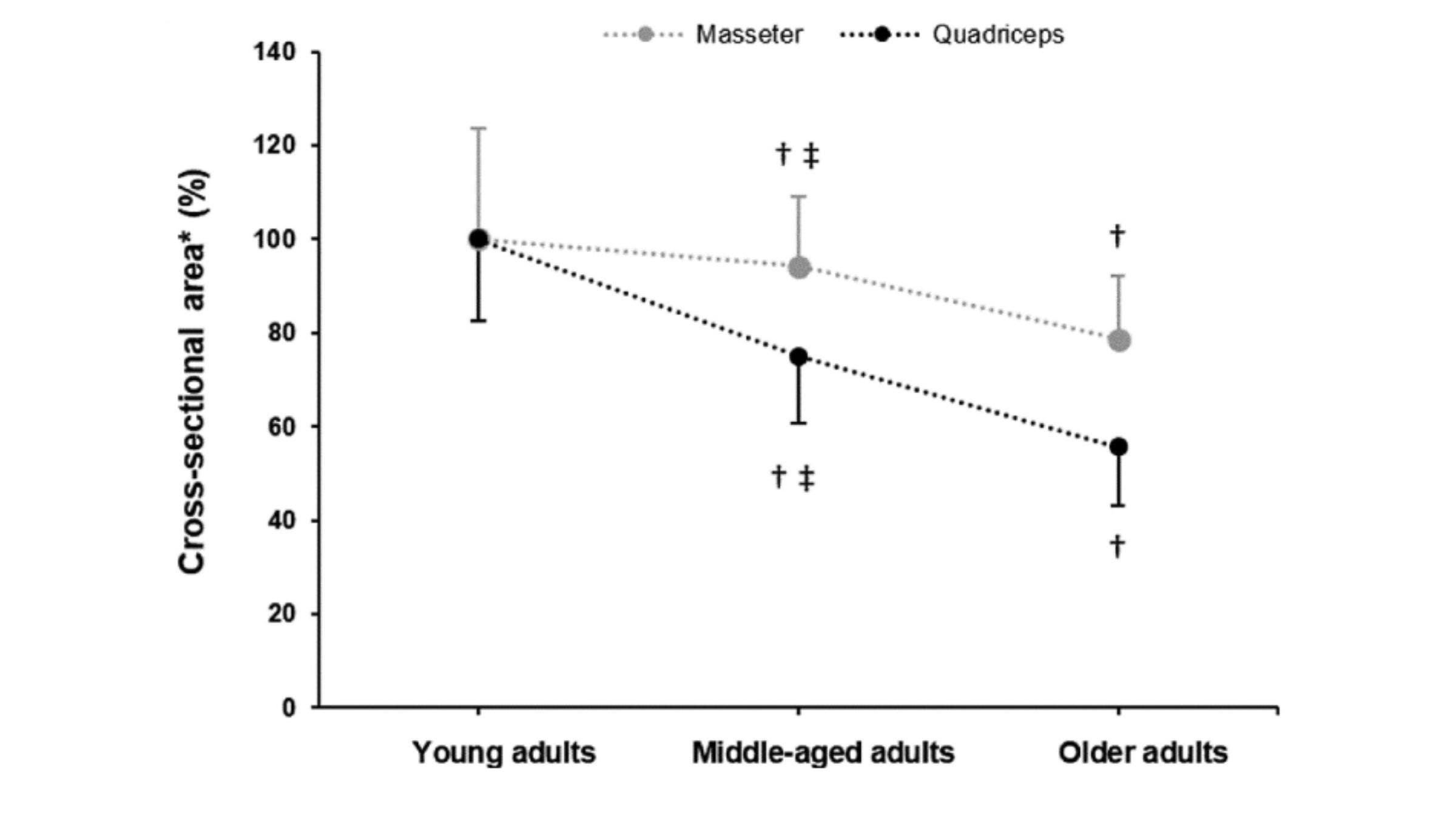
On average, the rate of decline from young to old was 1.02 percent per year for leg muscles, compared to 0.49 percent per year for jaw muscles. In other words, you lose leg muscle twice as quickly as jaw muscle, presumably at least in part because life gets too busy to be as active as you used to be, but never gets too busy to eat. Or to put it another way, we might take this as suggesting that about half the age-related muscle loss in your legs is an inevitable result of aging, while the other half is a consequence of our lifestyle decisions.
There are some caveats to note. This is a cross-sectional study, meaning that we’re comparing different groups of people rather than following the trajectory of the same people across a half-century. That means we can’t assume that it’s an apples-to-apples comparison. Maybe young people these days have grown up eating soft, ultraprocessed food, so their jaw muscles are scrawny compared to previous generations, which gives the illusion of a slower rate of decline for those muscles.
More puzzlingly, the strength tests produce a different picture. Here’s the corresponding graph for decline in muscle force, again with jaw muscles in gray and leg muscles in black:
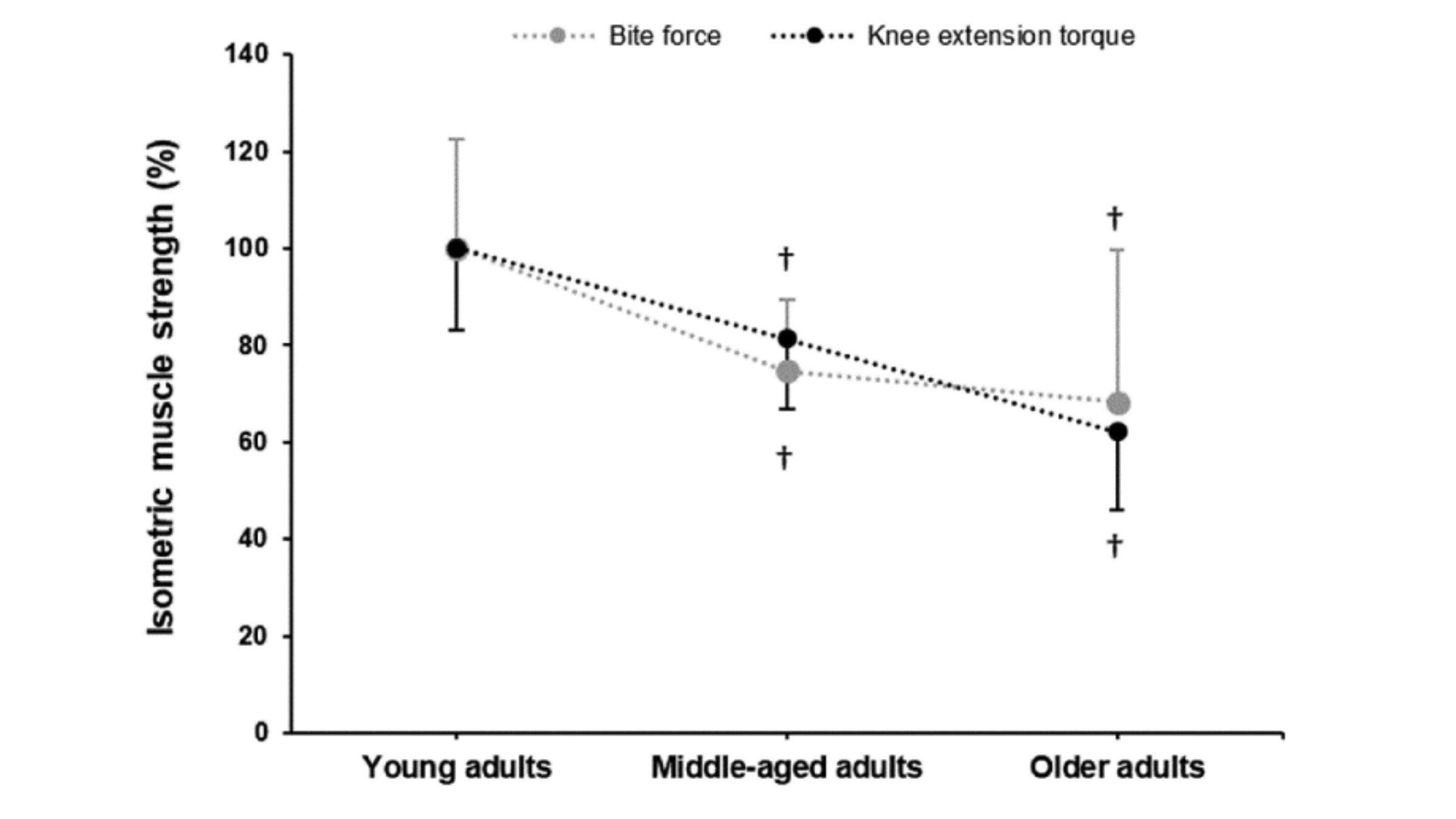
In this case, muscle force seems to decline at basically the same rate in both leg and jaw muscles. This discrepancy isn’t totally unexpected: strength and muscle size don’t always move together, because strength depends not only on how much muscle you have, but also on how effectively your brain is able to harness those muscle fibers. When you first start doing resistance training, for example, your initial strength gains will be primarily neuromuscular, the result of more efficient signals from your brain to your muscles, long before your muscles get bigger.
Still, it’s not clear why leg and jaw muscles should have different relationships between size and strength. There are some intrinsic differences between the two types of muscles that might play a role. For example, quadriceps muscles have more fast-twitch fibers than jaw muscles, and fast-twitch fibers are more vulnerable to atrophy from disuse. Also, leg muscles are connected to the brain via the spinal cord, whereas jaw muscles are innervated by a cranial nerve directly from the brain; the two types of nerve connection might respond to age or disuse differently.
Use It or Lose It?
Given the mismatched results for muscle size and strength, we shouldn’t read too much into this data. Still, it’s tempting to note the agreement between the muscle loss curve and a previous attempt to quantify how much age-related fitness loss is inevitable.
A few years ago, I wrote about a study that pooled data on aerobic fitness and training records in masters athletes to determine whether training could ward off the effects of age. In non-athletes, VO2 max typically declines by about ten percent per decade after the age of about 25. Athletes who kept training at a fairly constant level were able to limit that decline to about five percent per decade. Overall, the researchers concluded that roughly half of the age-related decline in aerobic fitness was due to aging, while the other half was due to changed physical activity patterns. That’s similar to what we might conclude from the jaw-versus-legs comparison.
In practice, of course, the world is never quite that neat and predictable. A decline of ten percent in a decade seldom plays out as one percent per year. Instead, you’re sailing along smoothly, holding back the sands of time, until some catastrophic event—an injury, an illness, a promotion at work—steals a year of training and subtracts five percent from your fitness and muscles all at once. The main message I take from studies like this isn’t that I must always do at least as much training as I did last year. That’s never a bad goal, but it isn’t always possible. Instead, it’s that I shouldn’t pre-emptively dial back my adventures as a concession to aging. I’ll keep on moving—and chewing—as vigorously as my body permits.
For more Sweat Science, sign up for the email newsletter and check out my new book The Explorer’s Gene: Why We Seek Big Challenges, New Flavors, and the Blank Spots on the Map.
