

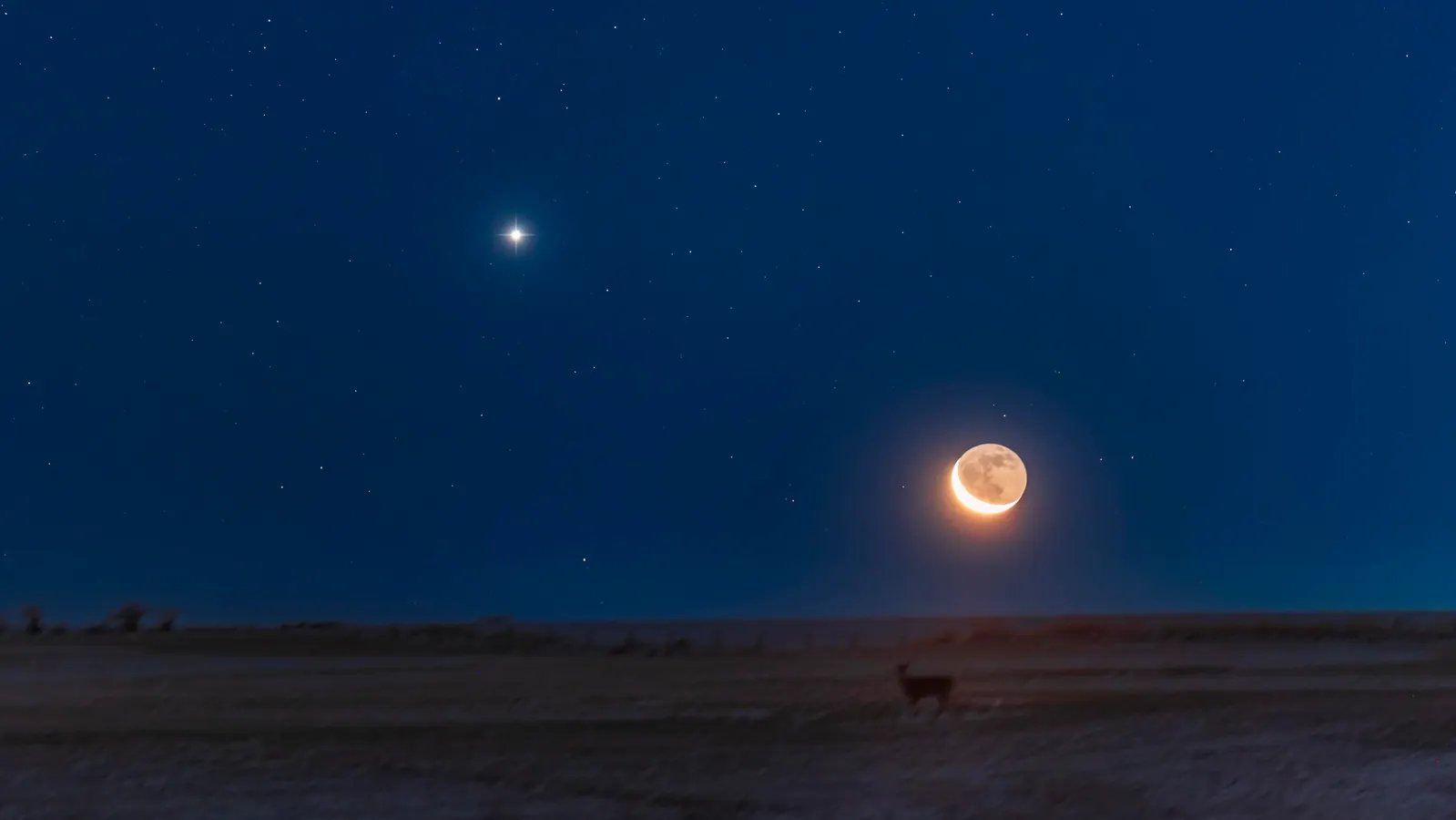
A delicate crescent moon pairs with brilliant Venus after sunset Monday, creating one of May 2026’s easiest and most beautiful skywatching events. . (Photo by: Alan Dyer/VWPics/Universal Images Group via Getty Images)
VWPics/Universal Images Group via Getty Images
Skywatchers are in for one of the prettiest celestial sights of the month on Monday, May 18, as a delicate crescent moon appears beside dazzling Venus low in the south-western sky after sunset.
The pairing will be visible to anyone with a clear horizon, requiring no telescope or astronomy experience — just the naked eye.
Venus, often mistaken for a bright star, will shine intensely from about 30 minutes after sunset, while the young moon will hang just beneath it in a striking close conjunction — the best of 2026.
The brief but beautiful display is part of May’s ongoing “planet parade,” which currently features Jupiter and Venus after sunset (soon to be joined by Mercury) and Mars and Saturn before sunrise.
On Monday, May 18, a slender 7%-lit waxing crescent moon will appear only a couple of degrees beneath Venus shortly after sunset.
NASA/JPL-Caltech
When To See The Crescent Moon And Venus Pairing
On Monday, May 18, a slender 7%-lit waxing crescent moon will appear only a couple of degrees beneath Venus shortly after sunset. The sight will become visible low in the south-western sky around 30 to 45 minutes after sunset, depending on location, and remain visible for roughly two hours before setting below the horizon.
Venus dominates the evening sky at the moment, blazing far brighter than any surrounding star. Because of its brilliance, the planet has earned the nickname “Evening Star,” though it is, of course, a neighboring world orbiting the sun closer than Earth. As an inner planet, it is visible only close to sunrise and sunset.
When To See Jupiter Join The Sky Show
The crescent moon’s journey through the twilight sky continues over the following evenings. On Tuesday, May 19, the now 15%-lit waxing crescent moon shifts toward Jupiter, appearing below the giant planet after sunset.
By Wednesday, May 20, the moon moves above Jupiter and forms a graceful line with Gemini’s bright stars Castor and Pollux.
Meanwhile, Venus and Jupiter themselves are slowly moving toward each other night after night. Their apparent approach will culminate in a spectacular conjunction on June 9, when the two brightest planets in the night sky appear exceptionally close together after sunset.
Watching their changing positions over several evenings — particularly June 9-11, when they will be very close — offers one of the clearest demonstrations of planetary motion visible to the naked eye.
A 9 percent waxing crescent moon lit with Earthshine sets behind a church on December 25, 2022, in Jersey City, New Jersey. (Photo by Gary Hershorn/Getty Images)
Getty Images
When To See ‘Earthshine’
The moon at this stage of its orbit is often called the “old moon in the new moon’s arms” because it’s possible to see the whole of the moon.
With just a thin crescent of sunlight on the lunar surface, the human eye (and certainly binoculars and cameras) can detect light on the darkened region of the moon. It’s called Earthshine, and it’s sunlight reflected from Earth onto the moon. You’ll easily see it as twilight deepens as you watch the Venus-crescent moon conjunction.
Why This Week Matters For Stargazers
Simple naked-eye events like Monday’s moon-and-Venus conjunction are among the most rewarding skywatching experiences because they are accessible to almost everyone. Unlike meteor showers or eclipses that can require precise timing and travel, conjunctions between the moon and bright planets can be enjoyed from city streets, suburban backyards or parks. Light pollution is the scourge of skywatching, but never let anyone tell you that light pollution makes it pointless — it’s a lie!
With Venus blazing in the twilight and a thin crescent moon beside it, Monday evening offers one of the easiest and most photogenic astronomy sights of spring that anyone can enjoy.
Wishing you clear skies and wide eyes.
