

Updated May 18, 2026 02:47PM
One of the most amazing feats of athleticism on Mount Everest this year was done by an unemployed software engineer who lives out of a van.
His name is Bartek Ziemski, and he’s a ski mountaineer from Poland.
If you haven’t heard of Ziemski, don’t feel bad. Ziemski’s relative anonymity in the world of high-altitude mountaineering is intentional. Unlike many climbers, Ziemski does not maintain a presence on social media, and he does not have a portfolio of brands sponsoring his exploits and plastering him across the Internet.
“I’m not a mountaineer at all,” Ziemski, 37, told Outside. “I just do it for fun.”
When I first met Ziemski at Mount Everest Base Camp on May 12, he was strolling across the lower slopes of the Khumbu Glacier with a pair of skis strapped to his back. His long blond-streaked hair stuck out from under his helmet. His ski pants were patched with duct tape. He walked briskly, like someone who had just returned from an early morning jog.
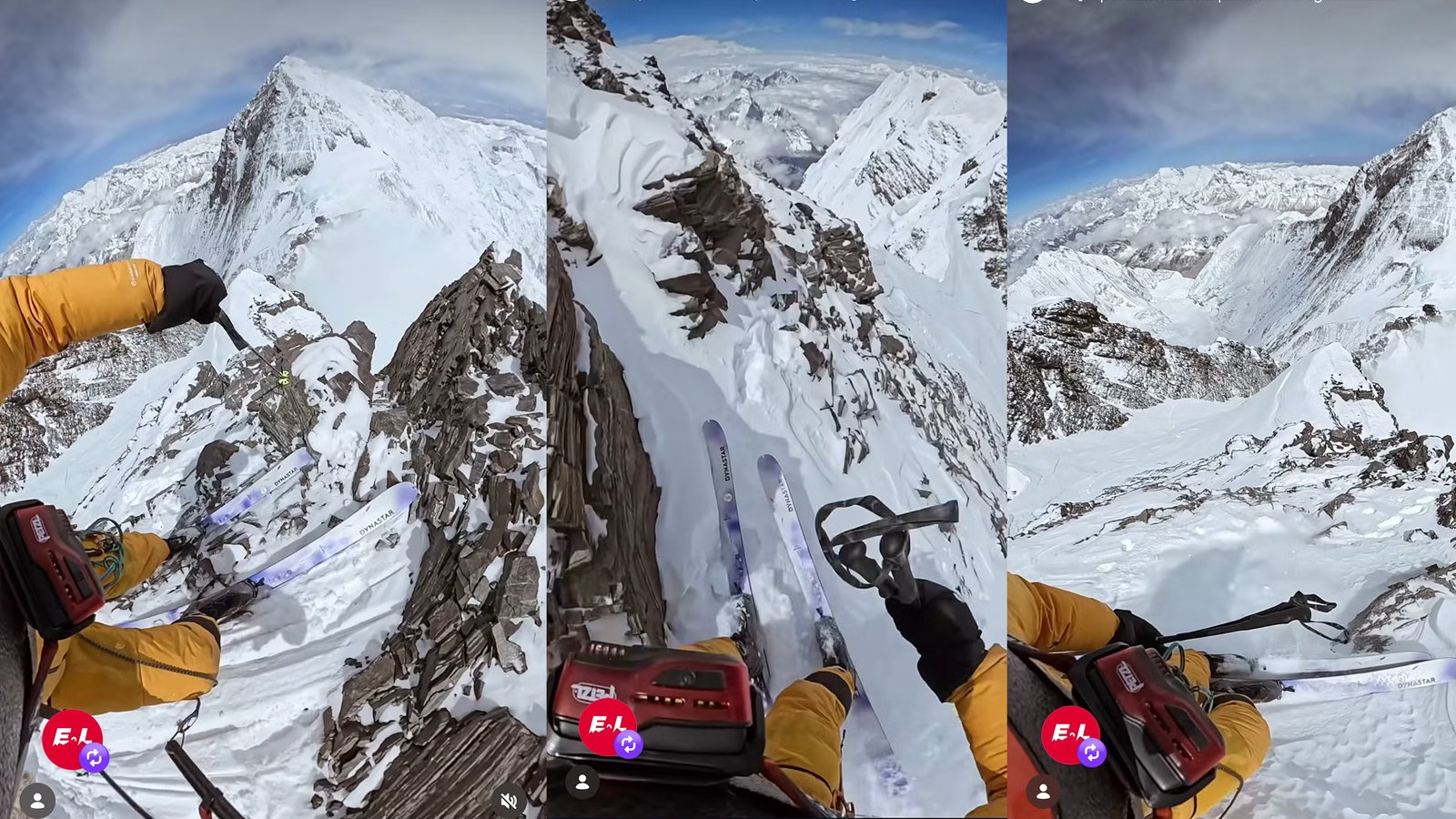
In reality, Ziemski had just completed a mind-bending ascent of Everest’s adjacent peak, Lhotse, the world’s fourth-highest mountain, followed by a harrowing ski descent of the mountain’s steep, icy face. He then skied through the treacherous Khumbu Icefall, all the way back down to Mount Everest Base Camp.
He did the entire thing without supplemental oxygen.
“The ski down was exhausting, because it’s a high mountain, so I needed to stop a few times on the way down,” Ziemski said.
Ziemski is the latest in a long line of Polish climbers who prefer adventure and achievement over fame and sponsorship. His quiet competence in the mountains is refreshing in a Base Camp populated by selfie-seeking climbers. Lhotse marked Ziemski’s eighth ski descent of an 8,000-meter peak. But he says he’s not chasing records or fame.
The line Ziemski descended on Lhotse is one of the toughest in the world of ski mountaineering. Ziemski isn’t the first to complete it—but he is the first to descend the peak from the summit to Base Camp without stopping, and without the use of bottled oxygen.
In 2018, acclaimed ski mountaineers Hilaree Nelson and Jim Morrison made the first ski descent of the Lhotse route, coming down from the summit through the tight 50-degree couloir they titled “Dream Line,” to Camp II at 21,000 feet. They rested there before removing their skis and walking out through the Khumbu Icefall. Their descent, supported by a large high-altitude team and a film crew, earned Nelson the prestigious National Geographic Adventurer of the Year award, and helped propel both athletes to the upper echelon of their sport.
Ziemski’s expedition couldn’t have been more different. He arrived in Nepal in early April and acclimatized by climbing the 21,200-foot Mera Peak before hiking to Base Camp. Like Everest climbers, Lhotse climbers stay in Base Camp and must ascend the Khumbu Icefall and Western Cwm (pronounced “coom”) at the base of Everest. Both sets of climbers utilize the same Camps I, II, III and IV. The route up Lhotse deviates above 26,000 feet.
Ziemski’s plan was always to summit Lhotse as early in the season as possible, to avoid whatever crowds or climbing infrastructure that might jeopardize his descent. Once April turns to May, the Khumbu Icefall can become congested with climbers completing their acclimatization hikes onto Everest. And rope-fixing eams on Lhotse sometimes string safety lines across the ski line and couloir that Ziemski planned to descend.
“That’s why I pushed, why I did it quite early,” he said.
But Ziemski’s arrive-early strategy was stymied by the massive serac in the Khumbu Icefall that delayed the climbing season by several weeks.
In early May, Ziemski joined the rope fixing team from expedition outfitter Imagine Nepal to find a possible way around the serac. He also scouted his ski descent through the Khumbu Icefall during the mission.
After rope fixers eventually charted a route through the Icefall, Ziemski followed them up to Camp IV at 26,000 feet. As the rope fixers continued up Everest, Ziemski rested in Camp IV before making his summit push at 1 A.M. on May 12.
He had to break trail to the top of Lhotse, as he was the first climber of the season to head to the summit.
“Half was super hard snow, nice to walk, and half was deep snow,” he said.
At the summit, Ziemski clipped into his bindings. But shortly after starting his descent, he encountered another hurdle. The pinnacle of Lhotse was covered with snow, but just a few meters below, the snow gave way to rocks.
“The top was not covered,” he said. “But I could down climb on skis, and the rest of the coloir was covered with snow, so it was good.”
The snow higher up was hard and wind-packed; lower down, it had been worked by the sun into ice. He descended through tight turns down the steep and icy Lhotse Face, and past Camp III at 23,000 feet.
This section of the descent is hallowed ground in the world of ski mountaineering. In 1970, it was where Japanese climber Yuichiro Miura recorded the first skiing descent of Mount Everest. Miura’s fateful attempt was captured on film, and the expedition served as the backdrop for the Academy Award-winning documentary The Man Who Skied Down Everest. The clip shows Miura attempting to navigate the icy, rock-strewn, steep face before crashing and falling several thousand feet.
Miura survived the descent.
Ziemski navigated this section, too, before skiing across the Western Cwm and onto the Khubu Icefall. He wove past huge seracs as he followed the climbing route. He jumped over small crevasses and clambered across the long aluminum ladders fixed by other climbers.
At Base Camp, Ziemski noted the differences between Everest and the other 8,000-meter peaks he has skied. The atmosphere at Base Camp hardly felt remote, he said.
“I really appreciate adventures and skiing in mountains,” he said. “But even on Lhotse I was seeing like hundreds of sherpas going to the South Col with supplies, and it didn’t feel remote, you know. When I skied Gasherbrum II in Pakistan, I was alone there. There, you could feel the remoteness and the kind of adventure. Here you feel like you’re in a city, almost.”
Along with a few hundred other climbers at Base Camp, I watched Ziemski on May 12 ski through the final sections of the icefall. He was visible to the naked eye to everyone in Base Camp.
Ziemski skied with precision and efficiency, linking quick turns down the steeper pitches before cutting right into a small snowfield at the foot of the glacier. There he took off his skis and jogged the last few hundred feet to camp.
When he arrived, he stepped onto the astroturf platform outside his dining tent. The scene was congratulatory, as other climbers and guides stepped out to celebrate him. Ziemski seemed quietly awestruck.
People draped white ceremonial scarves around his neck and took selfies. He seemed extremely uncomfortable. I pulled him aside for a few questions about the descent and what he had in mind next.
As it turns out, Ziemski isn’t finished with his ski ambitions at Base Camp.
“Unfortunately,” he said, “I also bought a permit for Everest.”
