

Published July 22, 2026 03:29AM
Waist-deep in a cypress swamp is not an ideal place for second-guessing. Nor, at least for most sober people, is it the place to dangle one’s arm into murky holes and hope something large inside takes the flesh for bait. On a muggy May Thursday, I have the pleasure of doing both.
An arm’s length away, Vinny “Bu” Wozniak flashes a cheeky grin, then coaches me through the art of noodling, also known as hillbilly handfishing, logging, or hogging. All of these terms refer to catching catfish by hand, a tradition once reserved for rural outlaws and now finding broader appeal in the digital age. Wozniak tells me to sink down, feel for the nest’s opening, then paw around the sides of the hole. My palm must face down toward the lake bed, he says, and my fingers must stay tightly clenched—critical if I want to go home with all ten. Then, I must simply hold my breath and wait for the bite.
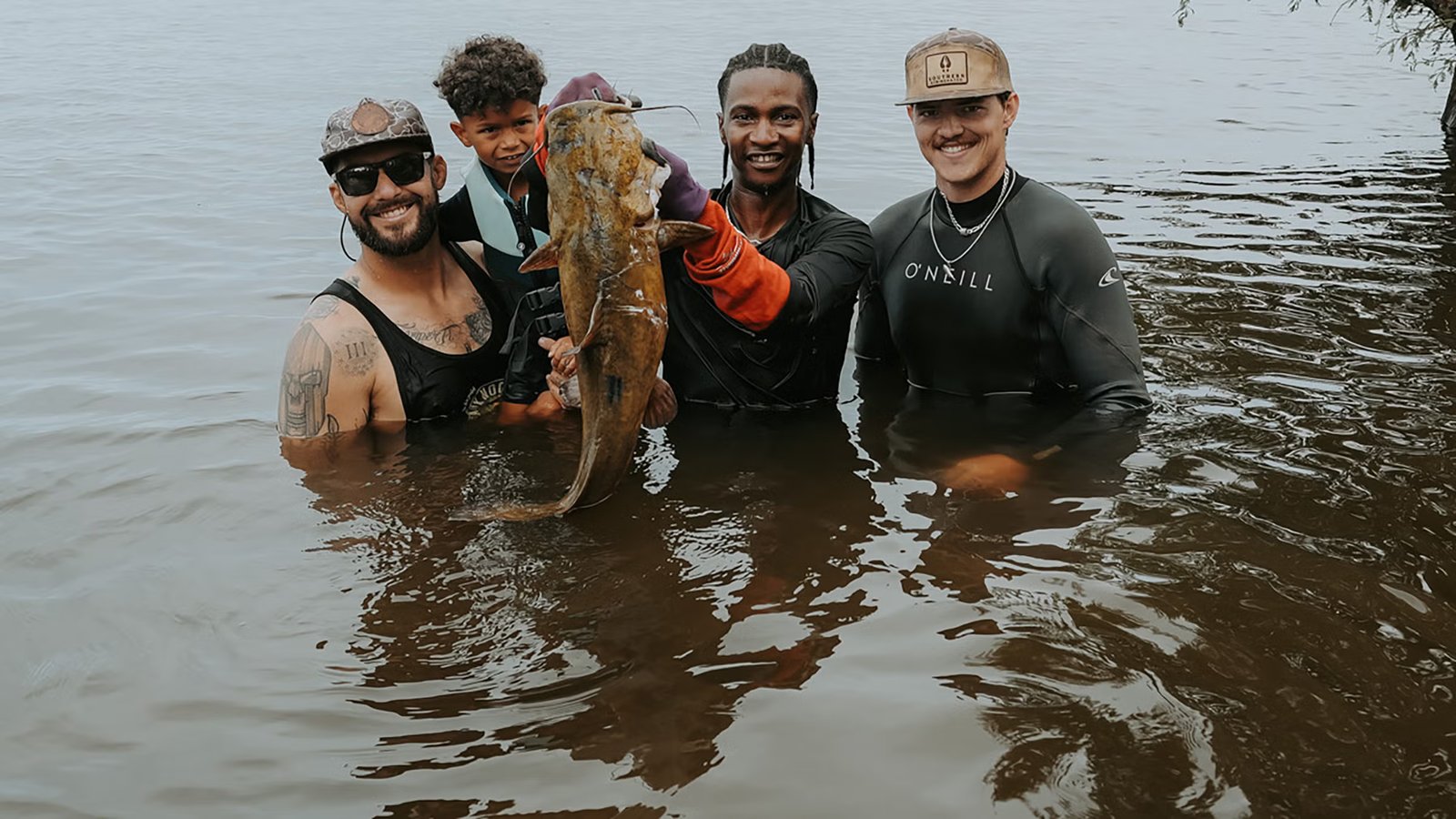
Beside Wozniak is Remmy Bearden, an affable 25-year-old who moments earlier had dropped into a squat in the water, grimacing like he’d been hit in the crotch. Bearden had shimmied his leg through the entrance of a catfish nest when something bit his Achilles. The pain was a good sign: likely a male blue catfish guarding his brood, ornery after days without food.
“You don’t catch a blue, a blue catches you,” Bearden said with a grin. “This one is scary.”
I’m giddy in a way that only comes from fear of the unknown. Despite all the Internet videos I’d seen of noodling—many of them children and bikini-clad women laughing as they wrestled the prehistoric fish to the surface—waiting to get bit for the first time is maddening.
But I’m too far into this journey, which began with a four-hour drive to the northwest corner of Louisiana, to turn back now. So I plunge into the swamp, using Bearden’s foot planted near the nest’s entrance as my only guide. After a few moments with my right arm dangling, I feel a smooth surface, then a sudden jolt. The blue catfish, Ictalurus furcatus, is an omnivorous predator that will eat just about anything it catches, and its needlelike teeth sink into my hand. The fish thrashes, shaking its jaw like a pit bull in a game of tug-of-war. I try to drag it out of its hole, but just as suddenly, the blue catfish lets go and recedes into the dark.
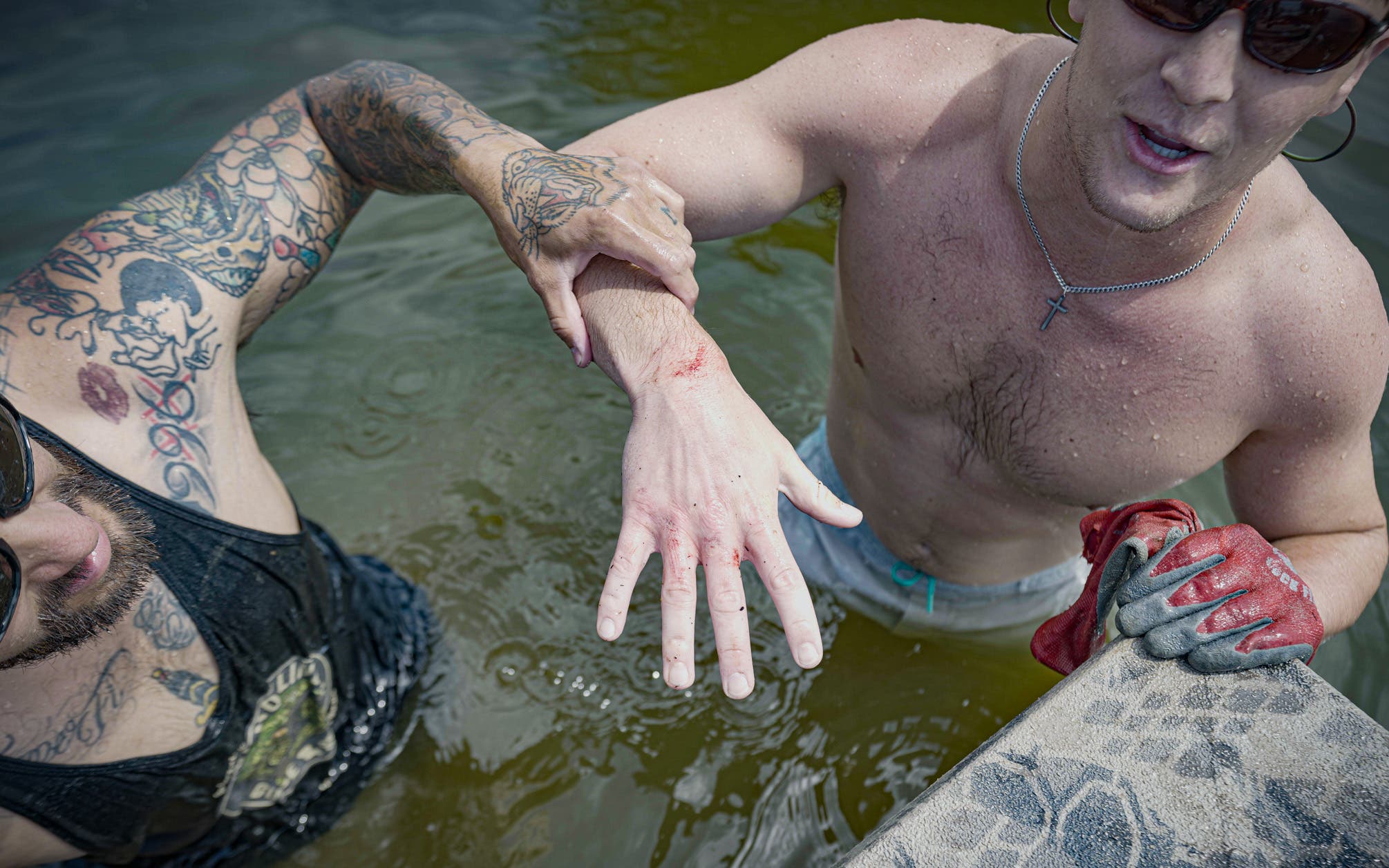
After coming up for air I pull off my mechanic’s glove and glance at my skin, where a thin layer of blood is slowly oozing. “You ain’t fishing until you’re bleeding” is an unofficial motto in the noodling world, and the fishing has finally begun. Wozniak and Bearden pump me up like ringside boxing coaches, and I plunge below for more.
At around 8 A.M. earlier that day, Wozniak greets me at a boat launch on the Louisiana side of Caddo Lake, a muddy bayou straddling the Louisiana-Texas border. He is sporting a thick beard and tank-top revealing a mural of tattoos. The 30-year-old first discovered the sport while watching an episode of the animated series King of the Hill, where Kahn, the show’s Laotian character, tries to pass as a redneck by sticking his hand in a bucket of chum and lowering it into a pond.
“I was like ‘Oh, let me try that,’” said Wozniak, who, around 2018, began learning the craft from a buddy named Blake Pell. “Eventually I realized that’s not how you do it.”
With varying sets of regulations, noodling is legal in 17 states. While it has never been explicitly forbidden in Louisiana, state lawmakers officially legalized the method in 2022. Shortly after, Wozniak launched Geaux Noodling, a Shreveport-based guide service dedicated to showing others the art.
Wozniak’s timing couldn’t have been better. Many sources I interviewed for this story suggested the social media era has led to a noodling boom. You can find hundreds of videos on Instagram and TikTok of men and women catching monster-like catfish with their bare hands. There are budding noodling online celebrities and influencers too, like Alyssa Hall, whose million TikTok followers often watch her duck under Alabama swamps with her two children close by.
The online boom appears to be fueling noodling tourism in the form of guided outings. Today, folks come from as far as Vietnam and Australia to handfish with Skipper Bivins, a noodling celebrity who was the star of Animal Planet’s hit reality show Hillbilly Handfishin’. Bivins, 63, also operates a guided noodling service in Waurika, Oklahoma, called Big Fish Adventures, and documents his noodling exploits on Instagram, Facebook, and YouTube.
“It’s on TikTok it’s on Facebook, you can see it anywhere,” Bivins said. “Now anybody that’s got a six pack and enough nerve can go try their hand at noodling.”
Wozniak, who visited Oklahoma to perfect his craft with Bivins, is a testament to how it may be gaining popularity. After discovering his obsession through King of the Hill, he promotes his business on social media and gets nearly all his customers—including me—from there. He charges $400 a person for his noodling tours.
Most of them, he said, “have never even held a fishing pole.”
This year alone, his Instagram has more than doubled its followers.
“I’ve had over 400 messages in a month about noodling,” he said. “It’s getting better each year.”
Over a plate of fried catfish at Herby-K’s, a watering hole in nearby Shreveport, one local said he’d learned of noodling through Hannah Barron, an Alabama-based noodler who poses in bikinis with massive catfish for 1.8 million Instagram followers. With all the social media hype, however, it remains unclear how much of the tradition of noodling as a way of forging rural community ties—versus a side quest for influencers—has been preserved.
“Where it’s legal, it’s going to be diffused,” said Mary Grigsby, an anthropologist at the University of Missouri. “It may be the same practice, you may catch a fish, but it’s not the same experience going with a tour guide.”
Bivins, as well as Wozniak and Bearden—both creatures of the swamp—don’t seem to mind.
“I just get the satisfaction of seeing someone else get out of their comfort zone to do something like this,” Wozniak said.
“I want other people to be as excited as what I’m excited about,” Bearden added.
Might this potential algorithm-fueled noodling renaissance be harmful to the actual fish? Obviously, ripping a full-sized male catfish from the thousands of eggs it’s tasked with protecting doesn’t seem to improve chances of passing on its genetic line, even if the fish is released after the encounter. But Kendall Robbins, a fisheries biologist for the Oklahoma Department of Wildlife Conservation, said there is little evidence noodling has an effect on populations, at least not yet.
Since 2024, Robbins has tagged more than 300 flathead catfish in Grand Lake, Oklahoma, a popular spot for both noodlers and rod-and-reel anglers, and plans to tag another 700 to study their population dynamics. So far, only three flatheads, which have similar breeding tendencies to blues and channels, have been recovered by noodlers, and the only assumption he’s been able to make is that flatheads seem to return to the same spawning hole each year and may even raise multiple nests with separate females.
“We don’t know exactly what noodling pressure does to flathead populations, but we also don’t know what rod and reel pressure does,” Robbins said. “We really don’t know a lot about flathead catfish in general.”
Another study found similarly low noodling pressure on catfish in the years after Texas legalized the practice. Simply put, there probably aren’t enough handfishers out there to make a real dent in the catfish population.
“It’s not something we worry about too much,” said Austin Griffin, another fisheries biologist for the Oklahoma Department of Wildlife. “There are places these fish can spawn where people just can’t get to them.”
It’s overcast. The water is smooth as glass, and the air is thick after an early morning downpour. During the spring and early summer, when the temperature is just right to support catfish hatchlings, Wozniak rarely sleeps, working the night shift at a Goodyear tire manufacturing plant before spending the day in Louisiana lakes. Riding in his mudboat are Ronald Makaramba and his 5-year-old son. Makaramba, a former college soccer player from Tanzania, is documenting the day with a camera and drone, determined to capture the inherent virality noodling lends itself to in exchange for a free introduction to the high-adrenaline culture.
Bearden, a logger in nearby Texarkana, pulls into the dock with another mudboat and invites me aboard. A former high school football standout with a habit of stroking his thick mustache with his thumb and forefinger, Bearden began learning from Wozniak after marrying his wife’s sister. He describes the outdoors as his “happy place” and hunts just about anything.
“If you can hunt it, fish it around here, I do it,” he said. “If there was a grasshopper season, I’d go around stomping those things.”
Also on the boat is Dakota Hearod, a newer, quieter member of the team, who served in the same Marine Corps reserve unit as Wozniak. Unlike Bearden and Wozniak, Hearod doesn’t have a catfish tattooed on his buttocks quite yet. But all three proudly brandish knuckles scarred from catfish teeth.
Bearden shoves off the dock and zips past clusters of rusted pump jacks. Rising from the water like ghostly obelisks, they’re relics of the world’s first offshore oil development, after a Gulf Oil foreman spotted bubbles rising from Caddo Lake more than a century ago. The lake takes its name from the Indigenous Caddoan people, and while some locals say the lake was formed by earthquakes in the 1810s, most geologists believe it was created earlier, when the Great Raft—a vast logjam on the nearby Red River—backed up the water and flooded the surrounding lowlands. Today, Caddo Lake comprises one of the largest shallow cypress swamps in the world.
A few minutes pass, and we make the first stop near a patch of cypress. Like duck hunters, noodlers tend to be a bit secretive, and Wozniak asked me to spare specifics about the locations of his “honey holes”—angler parlance for prime fishing spots.
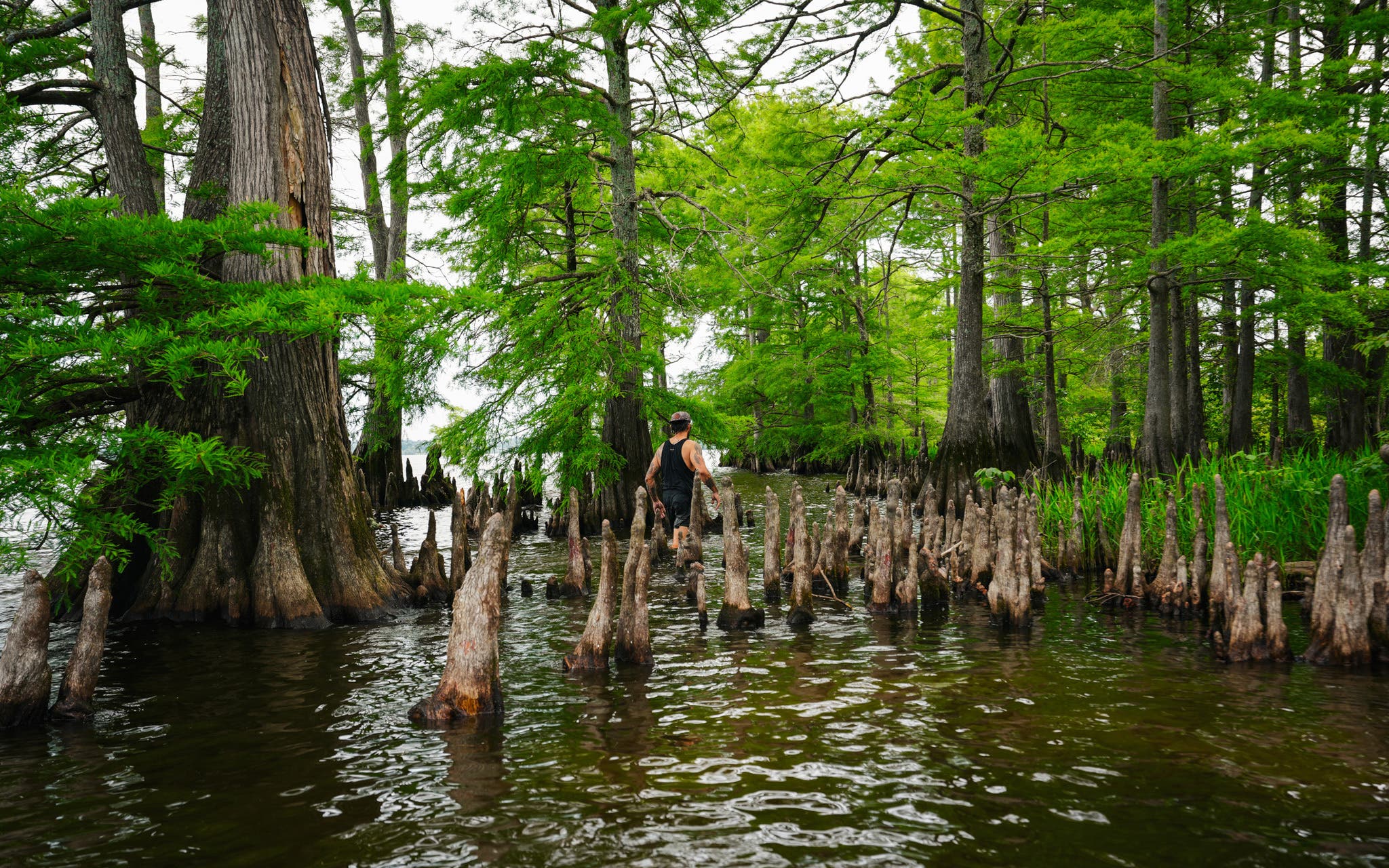
The three men jump in and begin a slow, ritual-like backward walk, feeling for nests with their heels among the knobby cypress knees.
“I get that fish to bite my foot, turn my foot just right, pull it to the entrance, then try to get my hand on it,” said Bearden.
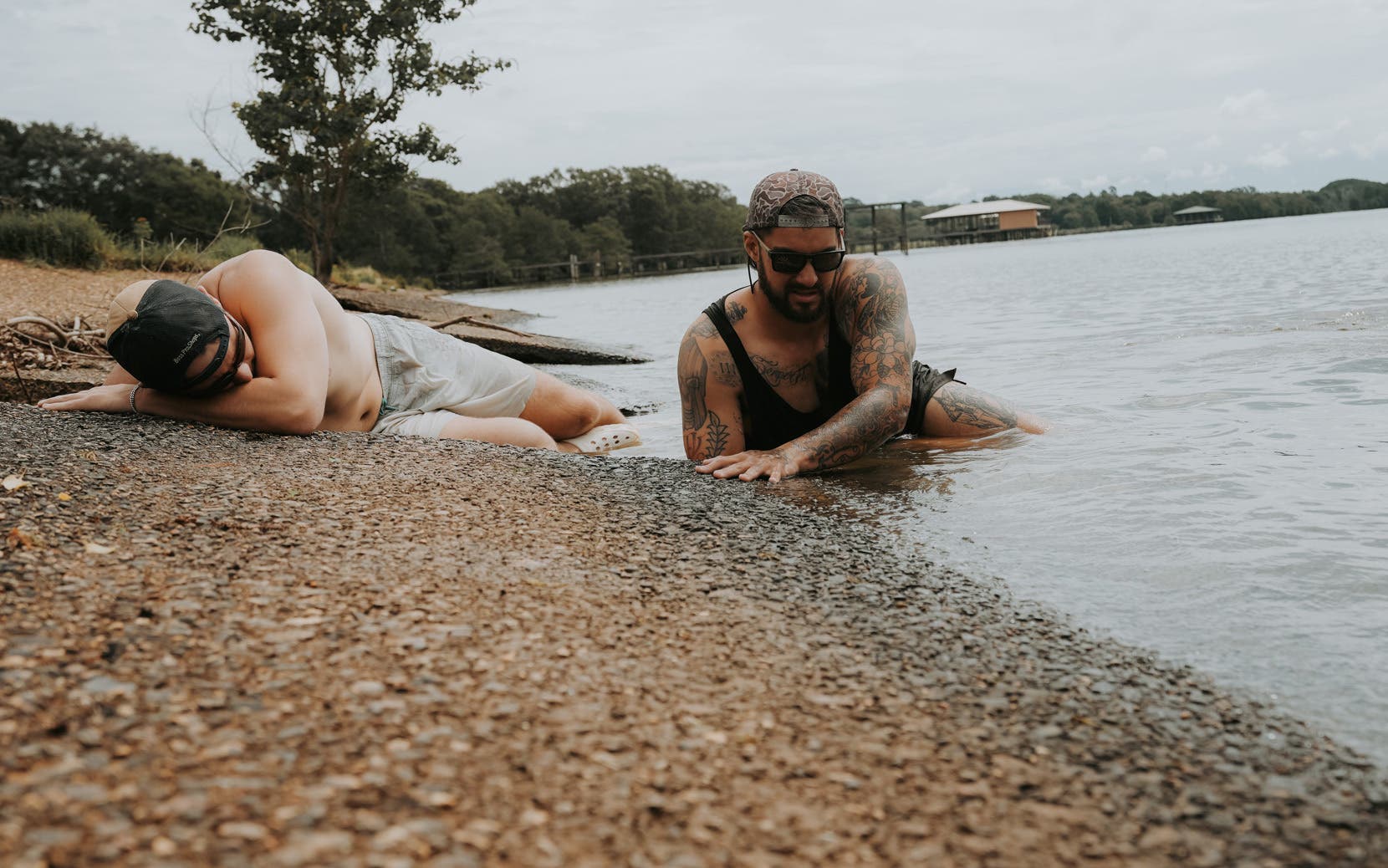
In Louisiana, noodlers are allowed to construct their own catfish nests to lure the fish, and my guides strategically position cut-out tractor tires covered with rubber platforms around the lake, as well as old cast-iron bathtubs. Of course, there are also “natural holes” where channel, blue, and flathead catfish spawn, like hollow tree trunks and slabs of concrete. Throughout the day, we take turns splaying out on our bellies, prying under boat ramps along the shore. It’s these dark, protected crevices that males search out, then lure a female catfish into with their pheromones. She’ll then lay up to thousands of eggs into the mud before a male inseminates them.
Seasoned noodlers can tell if a hole is occupied simply by its texture. A smooth surface is a good sign a male has cleared out detritus to make way for its offspring, and is likely guarding the hole. The male will also constantly fan the water to keep its eggs oxygenated.
“If you come into a hole and it’s really mushy, a catfish probably hasn’t been in there,” said Wozniak.
After no sign of fish, we try another cypress grove. Makaramba is brave enough to be the first to jump in, and soon he’s plunging in and out of the murk, which looks like olive juice. His son and I watch hopefully from the safety of the boat over a chorus of screaming cicadas and bullfrogs.
For the next ten minutes or so, the lanky Tanzanian bobs up and down in the water, struggling to get a grip on the fish. It turns out to be a flathead catfish, known in Louisiana as an “Op” or “Opeleusus”, which are much less aggressive than a blue catfish and therefore much harder to catch for the rookie. At one point, Makaramba attempts to wedge it against the side of the hole, but the fish proves too slippery.
“Grab the fish, man! Grab the fish!” yells Wozniak.
Finally, Makaramba shoves his hand in the Op’s mouth, then thrusts the other through its gills. Noodling, especially for first-timers, is a team sport, and Wozniak dips under to assist. Within seconds, the two finally wrestle the fish to the surface.
“Let’s go! Fuck ya! African cowboy!” Makaramba yells towards the camera I’m recording him with.
His son shrieks with a mixture of delight and amazement. He asks to hold the 20-pounder, but instead settles for gingerly touching its tail. Makaramba poses for a quick picture with the flathead before it flops out of his hands and disappears back into the murk.
It’s hard to pin down who was crazy enough to first try noodling, though near identical practices have been documented as early as 1775, when historian-trader James Adair described Native Americans in the southeastern United States wrapping cloth around their hands and sticking them under the edges of rocks. He wrote:
“They dive under the rock where the large cat-fish lie to shelter themselves from the scorching beams of the sun, and to watch for prey: as soon as those fierce aquatic animals see that tempting bait, they immediately seize it with the greatest violence, in order to swallow it. This is the time for the diver to improve the favourable opportunity: he accordingly opens his hand, seizes the voracious fish by his tender parts, hath a sharp struggle with it against the crevices of the rock, and at last brings it safe ashore.”
Whether or not the technique was common among Native Americans, or how it spread to rural white populations remains a mystery. In a 2004 Journal of Popular Culture article, Deborah Salazar wrote that by the 1920s, the term “noodling” as a fishing technique had been documented in Missouri, and became a part of the Southern dialect by the 1930s.
But there’s evidence that years before, the practice was common enough to be banned. In 1919, the state of Missouri outlawed “logging” and “rock fishing”—terms that referred to handfishing in areas where catfish like to nest. That didn’t stop a rich, outlaw subculture of noodlers from developing in the state, according to Grigsby. In her book “Noodlers in Missouri: Fishing for Identity in a Rural Subculture,” she documents the practice in rural, working-class Missouri communities in the mid- 2000s, including a group known as “Noodlers Anonymous,” which was actively lobbying to get it legalized at the time.
A few of the 30 or so Missouri noodlers Grigsby interviewed, however, were also against legalization, fearing doing so would harm the tight-knit bonds formed from generations of evading conservation agents. The culture within this community can best be described as macho. Grigsby had heard of one secretive all-men’s group who noodled exclusively at night, “often not clothed.” Still, she spoke with plenty of women noodlers, including a few who grew up handfishing during the Great Depression.
“Because they were good noodlers, they were very much included,” Grigsby said. “People needed fish, people needed to eat.”
Grigsby said the culture surrounding noodling at the time was looked down upon by both the media and the Missouri Department of Conservation, which cut short a trial run for its legalization in 2007. The practice is still illegal in Missouri today. And while noodling isn’t exactly as elegant as casting a homemade fly for speckled trout, Grigsby told me she came away from her research with a fond appreciation for the method.
“They view this as a more worthy relationship to taking life than throwing a hook in the water,” she said. “I think people have something to learn from that.”
By late morning, we reach the shore of an RV park. Wozniak’s flatboat is blaring a mix of Baton Rouge rapper Boosie Badazz and Cajun zydeco remixes. Bearden opts for country on his. I’m soon shirtless, with my sweaty stomach pressed against a hot slab of concrete, trying to thrust my arm into a fish’s mouth.
Fortunately for the bottomfeeder, it doesn’t bite my hand, and I’m too jittery to grab it with any real confidence. To everyone’s disappointment, it writhes out of the hole and disappears into the lake. Having grown up in a Midwest suburb, with most of my outdoors experience consisting of granola-fueled family hikes, I felt as though I was living an alternative childhood I often wish I’d had. One filled with hunting and fishing, target practice and dirt bikes, or just fixing anything without having to pay someone for it. In other words, the childhood of the great American redneck, a term that doesn’t seem to offend those who live it.
“A redneck is just a guy that can get the job done with the least amount of tools,” said Bivins, who coached frazzled city slickers in the art of noodling on his TV show, which ran from 2011 to 2013.
At age four, Bivins began handfishing rivers near Cotton County, Oklahoma, a state many deem noodling’s epicenter. A child of the sixties, Bivins recalls handfishing—sometimes for gar or carp, though mostly for catfish—as a rite of passage for a handful of families in each town.
“I learned from my dad just like he learned from his,” he said. “If you like a rush, there’s nothing else like it; it’s doing it with the bare necessities.”
As he grew older, Bivins began wading into faster-flowing creeks, in water as deep as 16 feet. His method is to submerge his feet first, let the fish bite his foot, then grab it and thread a rope through its lip, all before coming up for air. Now in his sixties, Bivins can hold his breath for more than two minutes. His record North American haul is a 111-pound flathead, though he once traveled to Spain and successfully noodled an 11-foot-long, 250-pound Wels catfish.
Like any high-adrenaline activity, noodling carries obvious danger. Bivins cautioned against going alone or wearing loose-fitting clothing, which can get people hung up on jagged edges. He estimates that, each year, one or two people drown while noodling.
“There needs to be someone there to live to tell the story,” Bivins said. “If you fight a fish for a minute, and you’re at the point where you have to have air and you’re starting out of the hole and get hung up, you’re in bad trouble.”
Other hazards include wildlife. It wasn’t until I was dry and nursing a Budweiser at Herby K’s that a local—visibly stunned as I recounted the day—told me Caddo Lake is full of cottonmouths. Wozniak says he’s never had trouble with snakes, alligators, or anything else lurking in the swamp. Still, the presence of alligators and venomous snakes may explain why noodling hasn’t taken off in Louisiana to the degree it has in Missouri, Oklahoma, and Texas. As Bivins put it, “In the southeastern states, people just don’t get in the water because there are a lot more alligators, a lot more cottonmouths.”
By the late 2000s, Bivins was competing in the Okie Noodling Tournament, a competition held every year in Paul’s Valley, Oklahoma. By then, it had become the largest noodling competition in the world, and the subject of the 2001 documentary “Okie Noodling,” a cult classic and one of the first portrayals to give mainstream audiences a window into the practice. After winning the tournament several times, Bivins and his guide partner Trent Jackson were approached by Animal Planet. The two agreed to star in the TV show.
“We weren’t looking for anything. They just called us up one day,” Bivins said. “We might have been in on the groundbreaking of making noodling more than just local people.”
For a few minutes, I fight to keep my hand in a blue’s mouth long enough to pull it out of its nest. Before my first attempt, Wozniak told me a Wisconsin woman had hauled up a similar catfish on her first try. He also mentioned a group of women on a bachelorette trip who’d also had success.
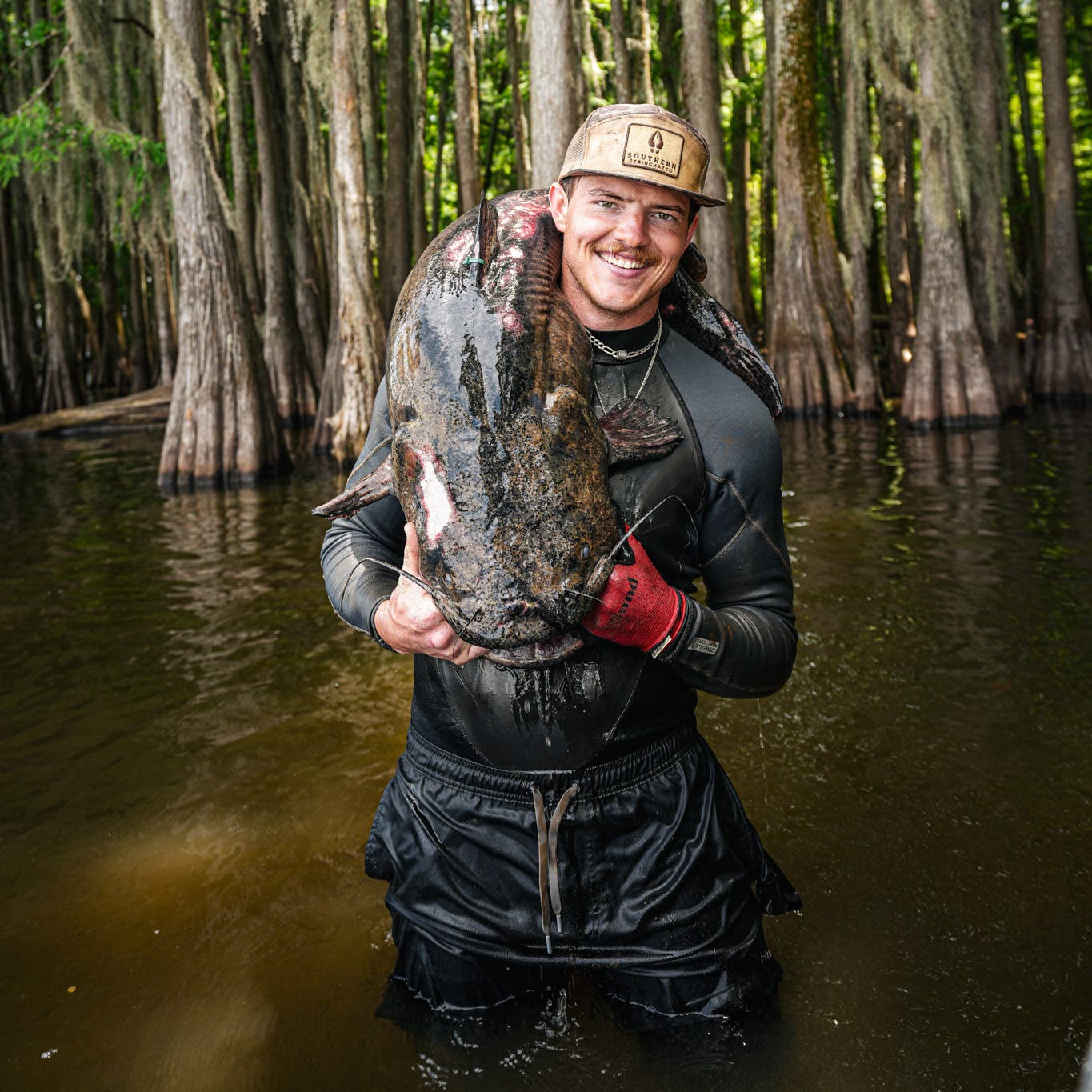
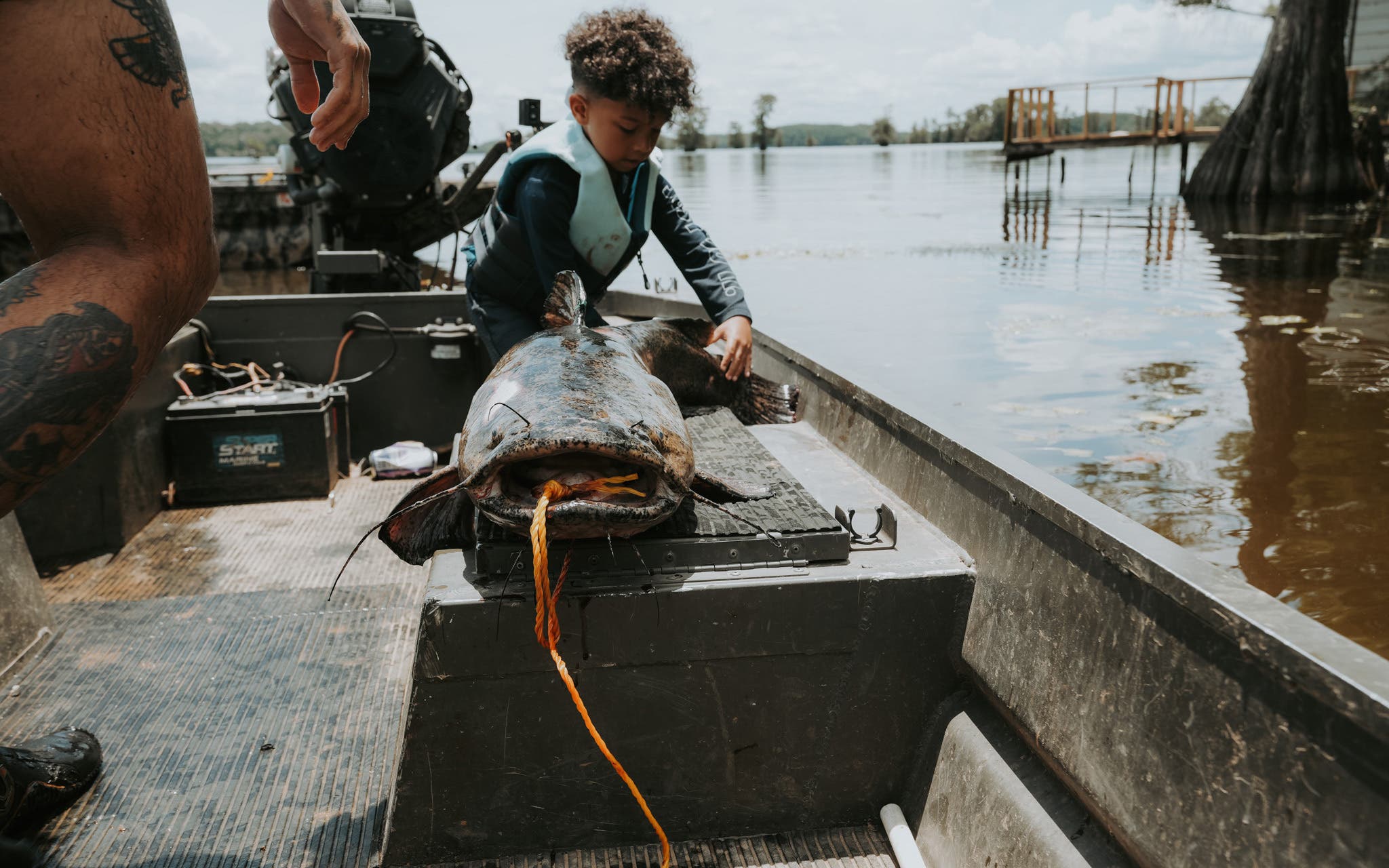
Eventually I’m able to get a good enough grip with my right hand to yank the blue out of its hole. This is in direct contradiction to Wozniak and Bearden’s constant instructions to resist pulling it out before getting a sturdy two-handed grip. Before I have the chance to lose it, though, my two guides plunge under to help secure the fish. All three of us surface with the 35-pound monster.
By the time Wozniak helps me haul it to the boat, the fish’s jaw is still locked on my hand, and my arm swings uncontrollably while it thrashes on the deck. When it lets go, my first feeling is relief more than triumph. Makaramba pans the video camera toward me, and I try to think of something cool to say, but only manage a meek “Come on, let’s go!” Later, I pose for the all-important fish picture, leaning back and pulling it up to my chin.
Sure, it took the help of two blue-collar dudes with more ingenuity in their fingertips than I’ll ever have, and I’m still not sure whether I caught the fish or it caught me. But I got the damn fish in the boat, and I’m now prepared to scour bayous all over the state to chase that high.
A few days later, Makaramba’s professionally produced video, featuring drone footage and close-ups of Wozniak and Bearden coaching me in the water, pops up on my Instagram feed. I repost the reel, then return to my air-conditioned office, proudly brandishing the scabs covering my knuckles.
