

Published October 20, 2026 03:32PM
A woman and her small dog, Gizmo, were kayaking along Oregon’s Clackamas River, roughly 30 miles southeast of Portland, when their boat flipped on October 16. With water temperatures in the low 50s and a current that threatened to sweep them downstream, the pair were left stranded in the river.
Of the two, only Gizmo was wearing a life jacket.
Authorities have not released the woman’s name or age, but both she and Gizmo escaped without injury. Matt Aalto, a division chief with the Estacada Fire District (EFD) who oversaw the rescue, told Outside that the incident reminds paddlers—and their pets—to always wear life jackets, regardless of how comfortable they feel on the water.
“It’s almost not negotiable,” Aalto said. “Especially in the Clackamas River, which can catch paddlers off guard, particularly during stretches of warm fall weather.”
EFD described the incident in a statement shared to Facebook. Authorities wrote that the woman launched near Milo McIver State Park, a popular recreation area with trails, campgrounds, and river access. According to Aalto, the woman struggled to control the kayak shortly after entering the water.
The kayak flipped while she was still within sight of the boat ramp, Aalto said, leaving her standing in the river with Gizmo and a boat full of water.
Aalto said the woman couldn’t self-rescue, but she was able to call her mother, who then alerted emergency responders. When firefighters arrived, the woman’s father met them at the scene and pointed out a trail that led directly to her location.
“The trail did open right up to where she was at,” Aalto told Outside. “That’s pretty fortunate.”
Inside the Rescue
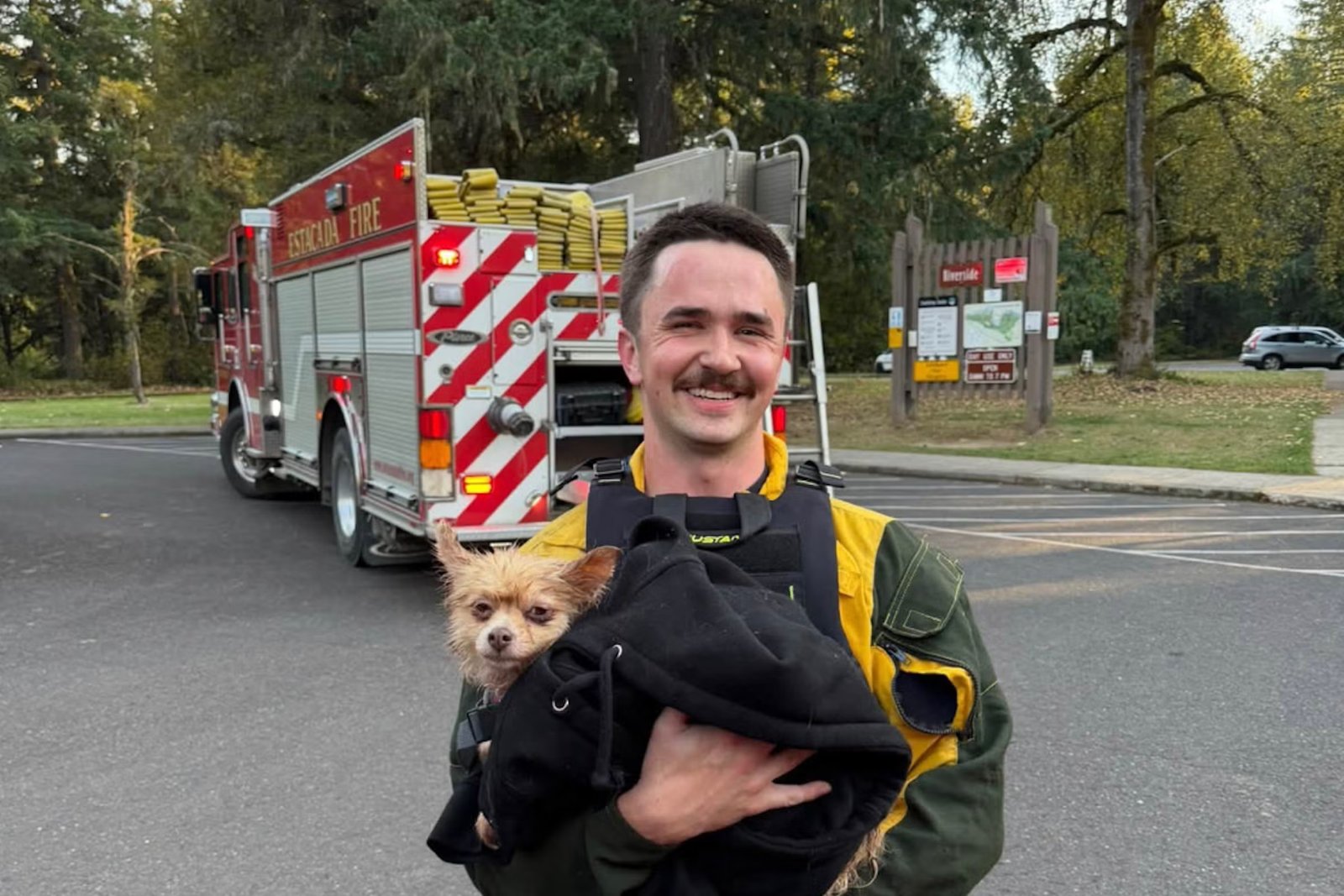
Crews positioned rescuers downstream with safety ropes in case the current swept her away, according to Aalto. Firefighters then waded into waist-deep water and first retrieved Gizmo, then his owner and the flooded kayak. The entire rescue took about ten minutes.
Gizmo was wearing a properly fitted life jacket with a handle, which Aalto said may have saved the small, scruffy dog’s life.
“Without a life jacket, Gizmo probably wouldn’t be with us today,” Aalto told Outside. “He may have stayed afloat, but he would have definitely, most definitely gone downstream. And whether or not he would have been found is a whole other thing.”
By the time Gizmo reached shore, he was OK, albeit a little cold.
“He was wide awake, staring at me, and shaking, but was still very sweet,” Aalto said. “So, I put my hand out to see if he would be interested in sniffing, and he just kind of let me pet him. But you could tell that he was a chilly little dog.”
Firefighters helped his owner safely to shore, and she did not require medical treatment.
Why Cold Water Can Be Dangerous Within Minutes
Fed by rain and snowmelt from the Cascade Mountains, the Clackamas can remain cold even when the air feels mild, and strong currents can overwhelm swimmers of all abilities.
On October 16, air temperatures in nearby Portland reached 78 degrees Fahrenheit, while a U.S. Geological Survey monitoring station recorded the river at 53.6 degrees that morning.
Some paddlers follow the Rule of 120, a guideline that uses the combined air and water temperatures to assess the need for cold-water protection. The day’s readings totaled roughly 132 degrees, above the rule’s 120-degree threshold, though the river was still cold enough to pose a risk of cold-water shock.
Sudden immersion in cold water can trigger an involuntary gasp and rapid breathing, according to the National Weather Service. If someone’s head is underwater during that initial shock, they risk inhaling water and drowning. As exposure continues, the cold can impair muscle control in the hands, arms, and legs, making it increasingly difficult to grip an overturned kayak or swim to shore. These effects can develop within minutes, well before hypothermia sets in.
Oregon law requires adult kayakers to carry a properly fitting, readily accessible Coast Guard-approved life jacket, though wearing one is legally required only in rougher water with moderate to difficult rapids (Class III and above). The Oregon State Marine Board recommends wearing one regardless of the conditions.
What Kayakers Should Know About Keeping Dogs Safe
The American Kennel Club (AKC) recommends on its website that dogs wear life jackets on the water, even if they are strong swimmers. A dog thrown into moving water can become exhausted or disoriented, and a properly fitted flotation device can help keep it afloat.
Not all canine life jackets are created equal. The BoatUS Foundation, a national nonprofit boating-safety organization that tests canine life jackets, says on its website that owners should look for jackets with sturdy rescue handles, wide, padded straps under the belly, and a secure fit that lets the dog move comfortably. Unlike human life jackets, canine flotation devices don’t have an official Coast Guard approval standard.
Paddlers should also skip using a dog leash on the water. The AKC advises against tethering dogs to kayaks or other watercraft, since they could become trapped if the boat capsizes.
Aalto told Outside that pet owners should ensure their dog can respond to voice commands before taking them on the water and choosing a life jacket suited to the animal’s size and the conditions.
But as Aalto noted, keeping a dog safe on moving current ultimately depends on the paddler staying upright, alert, and afloat, too.
“In this case, this person did a wonderful job,” Aalto said. “She just forgot her own.”
