

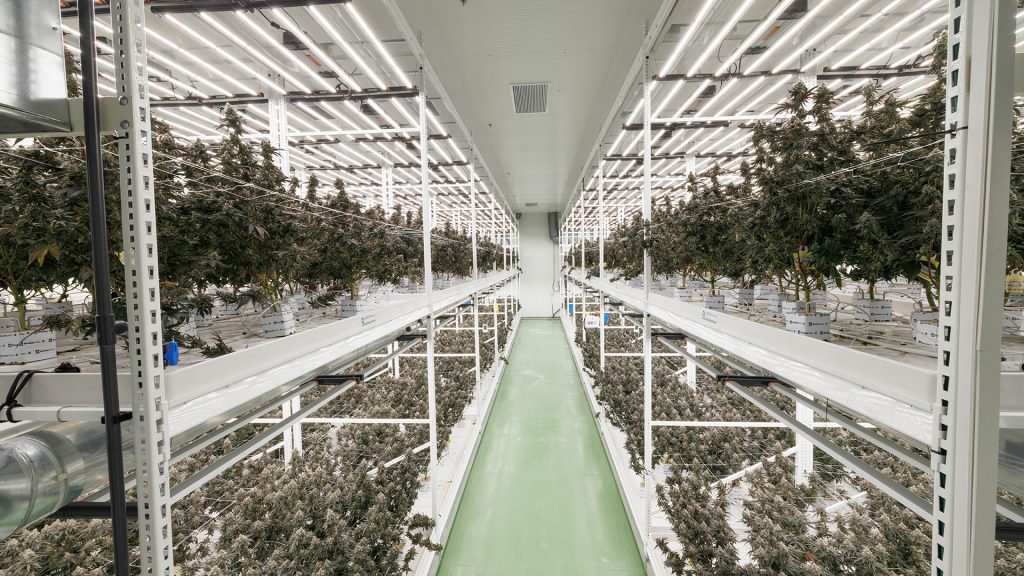
In this special report, Fluence delve into the important role of lighting in cultivating cannabis for future cannabis growers.
The pro-cannabis laws sweeping across many EU states are already creating a new wave of growers and investors, many who will be competing in the cannabis industry for the first time. Cannabis is a plant with very particular needs, and even the slightest change to a crop’s environment can produce undesired results. Cultivating cannabis is not as easy as growing it indoors alongside your standard perennials, and requires precision to yield high-quality, consistent buds.
So then, what does a new wave cannabis grower or investor need in their toolbelt to produce viable, high-quality cannabis plants and buds?
Lighting considerations for facility types
Your first order of business in setting up your cannabis operation should be evaluating the right lighting technology partner that fits your facility’s needs. Cultivating cannabis indoors, of course, requires a light source other than sunlight, while growers considering a commercial greenhouse strategy must factor in supplemental lighting, which also enables year-round cultivation.
Given current energy conditions in Europe, many investors and cultivators will likely opt for greenhouse facilities, which have the added advantage of harvesting natural sunlight. During the summer months, supplemental LED lighting usage will be minimal as cultivators can capture more sunlight during longer days. During winter, however, supplemental light will be a greenhouse’s primary light source. With year-round production now achievable, cultivators can focus on identifying the right lighting strategy—the combination of light intensity and spectra—that maximises yield and quality.
Selecting a lighting partner for cultivating cannabis
Ideally, growers will select an LED lighting partner that also has deep horticulture expertise to offer. The insight and guidance a lighting partner can give growers regarding the nuances of lighting in cannabis cultivation is crucial. While you may expect to experiment with lighting and other environmental settings in the cultivating cannabis process, expert advice can ensure plants reach their full potential faster. Fluence has a specialised services team and a growing body of research on the impact of light spectrum (the wavelengths of light from far-red to UV) on cannabis production, yield and bud quality, and light intensity (how much light is delivered to a plant canopy, measured in µmol/m2/s and known as photosynthetic photon flux density, or PPFD).
The best lighting providers, however, will also have a deep understanding of how lighting strategy affects every other aspect of a controlled environment. Strategic partners and solutions providers, for instance, should understand optimal environmental parameters specific to an individual operation, and knowing how to keep existing environmental conditions aligned is the key to raising successful cannabis crops. That trickles down into understanding the specific impact of CO2, nutrient uptake, air temperature and more on cannabis crops. Finding knowledgeable partners can take the guesswork out of calibrating these factors. As commercial cannabis growers evaluate potential cultivation partners, identifying and selecting those with demonstrated experience and expertise in cultivating cannabis will be crucial to success in Europe’s budding cannabis industry.
Light spectrum
Time and time again, Fluence research has shown that most cannabis cultivars prefer broad-spectrum (white) light. Some cultivars can tolerate narrow-band red+blue light without significant loss of yield or potency, but when applied at commercially relevant intensities, this will almost always result in severe photobleaching. It also introduces increased risk for significant photobleaching across the plant canopy, which affects aesthetic and, as a result, marketability to the consumer.
Fluence has conducted research on Type I, Type II and Type III cannabis strains at high light intensities under a broad-spectrum of light and a narrow spectrum containing mostly red light. In certain Type I cultivars , the more balanced broad-spectrum strategy generated 17% higher yields than the next best spectral solution.
Broad versus narrow spectral research has also demonstrated an impact on cannabinoid content, which is important information for growers seeking to maximise cannabinoid content in their plants. In a co-study with Netherlands-based Wageningen University & Research, Fluence researchers found that in some Type II cultivars, cannabinoid content (including THC, CBD and CBG) is inversely proportional to red light wavelengths. Under broad-spectrum light, researchers calculated an average of more than 180 milligrams of cannabinoid compounds per gram, compared to just 150 milligrams per gram under spectra with high levels of red light.
Light intensity
It is widely held that cannabis growers should adopt light intensities between 800 µmol/m2/s and 1,200 µmol/m2/s for cultivating cannabis. While this is a satisfactory range, it does not unleash the full potential of cannabis plants—remember, cannabis is always hungry for more light. For growers seeking true precision and maximum yield from their cultivation practices, there’s more potential to be unlocked at increased light intensities.
In Fluence’s proprietary research, cannabis plants have been exposed to as much as 1,500 µmol/m2/s without experiencing photobleaching. One Fluence study analysing yield variance in two cannabis plant groups—the first under a PPFD of 1,100 µmol/m2/s and the other at 1,500 µmol/m2/s—found a 27% increase in yields for plants grown under the higher light intensity. Beneath the right intensity and with the right spectrum exposure, it is even possible to enhance cannabinoid content, reach higher-than-expected THC levels and improve terpene profiles.
It’s worth noting that cultivation methods using light intensities of 1,200 to 1,500 µmol/m2/s are incredibly advanced. It’s akin to driving in Formula 1: Every aspect of the environment needs to be perfectly tuned and helmed by an experienced grower. [DH3]
Beyond light
Light spectrum and intensity are important aspects of an overall lighting solution, but they also define and influence other elements of a cultivation strategy, including climate control, CO2 concentrations and fertigation. Each has a direct relationship with the amount of light delivered to a crop. High light levels require higher CO2 and temperature setpoints, which lead to higher evaporation rates, greater water requirements and enhanced dehumidification capacity.
Other factors, like geography, play a significant role for greenhouses in particular. Natural light levels and climate in Spain, for instance, are much different than in the Netherlands. Combined with the nuances that come with various types of greenhouse facilities, the amount of light needed to supplement sunlight and reach year-round production is highly dependent on lighting conditions during the winter.
Lighting is never an isolated component of the cultivation process, making it that much more important that investors and cultivators identify partners who are highly skilled and experienced in horticulture consulting, who can implement successful cultivation strategies and optimise resources to maximise yield and crop quality.
At Fluence, we don’t simply sell light fixtures. That alone doesn’t guarantee a successful operation. We’re involved in every step of the cultivation process and have the knowledge and experience to help cultivators thrive in markets that are only going to become more competitive. We are led by science, investing in the practical fundamentals and applied research with world-renowned partners like Wageningen University & Research, VertiFy and Botany, while joining our own customers in the pursuit of science that impacts us all.
Contributor Details

