

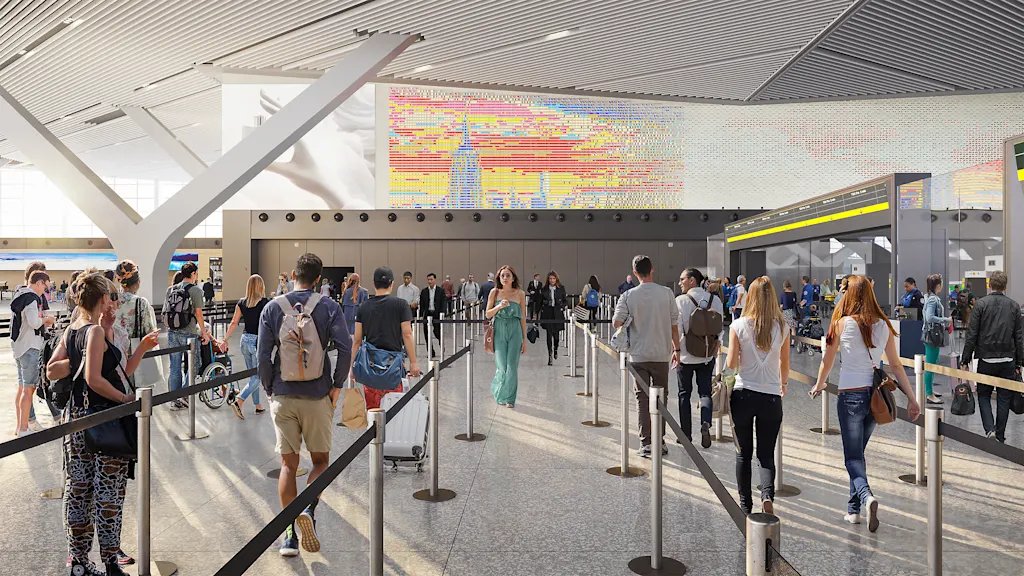
The historically long security lines currently snaking through U.S. airports are the painful result of extreme circumstances. Callouts, no-shows, and resignations by Transportation Security Administration workers fed up with a lack of pay during a partial government shutdown, combined with a bump in spring break travelers, have created unusually congested airport security checkpoints.
For the architects and airport authorities that work together to design these heavily regulated spaces, it’s the kind of convergence you can’t exactly plan for. But, according to some of the designers of these spaces, airports are increasingly incorporating design features that can help them manage extreme security lines in the future.
Flexible space allows for overflows
The lines, though currently caused by TSA worker shortages, are actually governed by the airports themselves and therefore are the airports’ problem. “There are regulations, but what the TSA is really interested in is the point from where you have your last document checked, called the TDC, to the actual [scanning] equipment,” says Ty Osbaugh, principal and global aviation leader at Gensler, a design and architecture firm. “That’s their land. How the queue works is purely up to an airport.”
How big that queue gets, though, is out of the airports’ and their designers’ hands.
Controlling the lines leading up to the security checkpoint takes a lot more than setting up a maze of stanchions. Osbaugh says airports carefully plan their pre-security, or landside, spaces to manage flows of passengers that can vary wildly during different times of the day and different days of the year. Building flexibility into this area, which can often share space with ticketing areas, allows for the lines to adapt to the crowds and circumstances.
Gensler is currently working on a $9.5 billion redesign of Terminal 1 at John F. Kennedy International Airport in New York City, and Osbaugh says the landside space was designed with softer edges to be able to accommodate overflow. “We’ve got a garden that’s [adjacent], so if the queue starts to back up—God forbid that it does—now people have that extra space to be able to queue instead of backing into the ticketing areas and everything,” he says.
Other airports, including some currently experiencing incredibly long security lines, don’t have this kind of flexibility. “That’s the problem that we see in Hartsfield right now,” Osbaugh says, referring to the Hartsfield–Jackson International Airport in Atlanta, where travelers have been advised to expect four-hour wait times. “The checkpoints are boxed in by hard elements on both sides. So it’s just trying to figure out how do you have that pressure relief valve in the queue?”
